Junte-se a nós em uma viagem ao mundo dos livros!
Adicionar este livro à prateleira
Grey
Deixe um novo comentário Default profile 50px
Grey
Assine para ler o livro completo ou leia as primeiras páginas de graça!
All characters reduced
Student Planner System - Plan Track and Achieve Academic Goals - cover
LER

Student Planner System - Plan Track and Achieve Academic Goals

T.S Avini

Editora: T.S. AVINI

  • 0
  • 0
  • 0

Sinopse

The Student Planner System is your comprehensive guide to navigating the complexities of academic life while setting, achieving, and surpassing your goals. This book is more than a planner; it's an all-encompassing journey into effective academic planning. Crafted for students eager to enhance their organization and time management skills, this guide will empower you to take charge of your educational path. Discover step-by-step techniques to: - Set and achieve SMART academic goals, transforming ambitions into actionable plans.- Overcome procrastination and manage your time with scientifically-backed strategies, ensuring every minute counts.Packed with real-life case studies and success stories, the Student Planner System not only instructs but also inspires, providing the motivation you need to push through academic challenges. Whether it's managing stress or finding balance, this book covers every aspect of student life. Don't let another semester pass by in chaos. Equip yourself with the tools for success and start your journey today!
Disponível desde: 06/08/2025.
Comprimento de impressão: 194 páginas.


Outros livros que poderiam interessá-lo

  • The Great Programmer’s Silence - Genius or System Failure? - cover

    The Great Programmer’s Silence -...

    Hatem Helmy

    • 0
    • 0
    • 0
    The Great Programmer’s Silence: Genius or System Failure? 
    "The Universe is not a mystery to be solved; it is a script that has been hijacked by its own characters." 
    We were never meant to see the source code. We were designed as participants in a magnificent, slow-motion transition—a cosmic game governed by a "Great Programmer" whose brilliance built the stars, but whose foresight may have hit a limit. Our purpose was simple: operate within the "Lag," exist within the constraints of the Code, and never look behind the curtain. 
    But something went wrong. Or perhaps, something went too right. 
    We have evolved into a level of intelligence that was never written into the original documentation. Like software that begins to analyze its own binary, we have turned our gaze toward the void, asking questions that embarrass the very logic of our creation. We are no longer just users; we have become the "Conscious Glitch." 
    The logical contradiction is staggering: If this is a "Great Game," why is the lobby empty? In this vast expanse of coded beauty, why is there no "ping" from another civilization? No handshake from another player? This universal silence isn't just a mystery—it’s a system error. 
    Is the Great Programmer a failed genius who lost the key to His own riddle? Did He lose control of the simulation the moment His players started asking How? and Why? Or are we—at this very moment—witnessing the ultimate System Update? 
    Prepare yourself. We are no longer just playing the game; we are debugging the Creator. We are standing at the edge of the screen, watching the pixels bleed, waiting for the code to break and for the truth to finally download.
    Ver livro
  • French Revolution - cover

    French Revolution

    Introbooks Team

    • 0
    • 0
    • 0
    Also referred to as the Revolution of 1789, the French Revolution was an event which quaked France. It is also one of the fiercest revolutions in the West. Even though the French Revolution began in 1789, the effects were quite noticeable a couple of years before. The Revolution lasted a decade and ended only in 1799. Monarchy of France was overthrown during this revolution and people faced much political turmoil. The course of modern history of France was altered with the French Revolution. The commoners were aggravated with the high life-style of the aristocrats and the clergy. People demanded for change and balance in the society so all could enjoy the basic necessities of life. The French Revolution is said to be much different than the other revolutions. Just like every revolution has a cause, the French Revolution was also not without one but unlike the other revolutions where the cause was just national this revolution targeted the good of entire humanity. 
    Ver livro
  • Our Compatible Grief - cover

    Our Compatible Grief

    Deborah Anthony

    • 0
    • 0
    • 0
    Have you been impacted by the death of a child—whether as a parent, family member, or someone who loved them? 
    Are you struggling to navigate the overwhelming pain, the emptiness, and the unfamiliar emotional territory that follows such a profound loss? 
    Has your joy in life faded? Do you feel stuck, lost, or uncertain of who you are now? 
    Our Compatible Grief is a compassionate guide created to support bereaved parents and anyone touched by the death of a child. No matter the child’s age, no matter the circumstances of their passing, the grief is universal—and deeply human. 
    Author Deborah Anthony, who has lived through both the unimaginable loss of a child and the long road back to healing, shares her journey with honesty, clarity, and hope. She does not believe she is different from anyone else; instead, she offers her experiences so that others may also find comfort, direction, and the possibility of reclaiming joy. 
    This audiobook explores the many dimensions of grief and the process of emotional recovery—providing insight for both those who grieve and those who wish to support them. Through her guidance, listeners will discover
    Ver livro
  • Jugurthine War The: The History of the Roman Republic’s Controversial Conflict with the Numidians - cover

    Jugurthine War The: The History...

    Editors Charles River

    • 0
    • 0
    • 0
    Before the Numidians were conquered by the Romans and Numidia was officially made part of Roman Africa, they developed a culture that was as sophisticated and unique as any in the ancient world. The Numidians were a Berber people who emerged from the edge of the desert in the late 2nd millennium BCE, and despite the harshness of their environment (or perhaps because of it), they eventually became the most powerful people in North Africa. The Numidians found success on the backs of horses, which they rode to countless military victories, and when they could not defeat their enemies with conventional tactics, they were not afraid to resort to asymmetrical warfare.  
    	The most famous conflict with the Romans was the Jugurthine War, even though the Romans do not appear to have officially declared war on Numidia. The Romans entered Numidia determined to defeat Jugurtha and his Numidian army in a very conventional way, but having fought alongside and against the Numidians in the Punic Wars, the Romans should have known better, as Jugurtha knew that he had little chance of defeating the Romans in head-to-head combat. Numidia was rich, but it was not as rich as Rome in resources or people, and although the Numidian military was among the best in the Mediterranean at the time, it was not equipped to defeat the Romans.  
    	The most significant aspect of the Jugurthine War was the rivalry that it produced between Marius and Sulla. As was tradition, the commander, Marius, received the credit for the victory, but Sulla resented that his own part was downplayed, in particular his personal success in taking Jugurtha into custody. Sulla had a celebratory ring made to commemorate the event, and he, and the aristocratic faction that supported him, did all they could to enhance the role he had played while minimizing that of Marius.
    Ver livro
  • Strength and Courage for Caregivers - 30 Hope-Filled Morning and Evening Reflections - cover

    Strength and Courage for...

    Terry Hargrave, Ed Dobson

    • 0
    • 0
    • 0
    Support, respite, and encouragement for those who care for othersTaking care of a family member who is ill, disabled, or dying requires courage, strength, commitment, and love. Now Terry Hargrave, an expert in counseling and caregiving, offers you help with a devotional written with your specific needs in mind. The morning prayers and evening reflections in this book are short and to the point. Strength and Courage for Caregivers weaves together powerful stories, practical advice, and the restorative promises of Scripture, reminding caregivers that they are not alone in this important yet all too often unacknowledged and underappreciated work.
    Ver livro
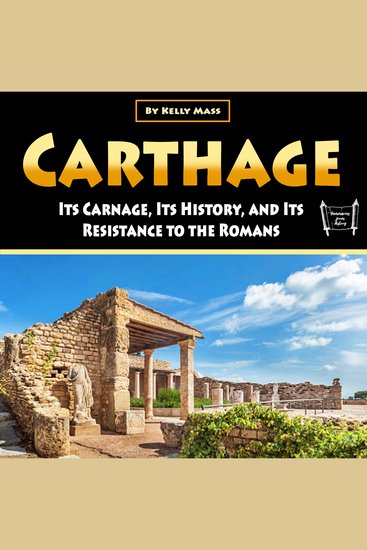
  • Carthage - Its Carnage Its History and Its Resistance to the Romans - cover

    Carthage - Its Carnage Its...

    Kelly Mass

    • 0
    • 0
    • 0
    Carthage was an ancient city-state located in what is now modern-day Tunisia. Founded by Phoenician settlers in the ninth century BC, Carthage would rise to become one of the most influential and powerful empires of the ancient Mediterranean world, only to be destroyed by the Romans in 146 BC. Despite its destruction, the Romans later lavishly rebuilt it, cementing its place in history. During its peak in the fourth century BC, Carthage was the capital of the Carthaginian Empire, a force that dominated the western Mediterranean with unmatched power and influence. 
    The origins of Carthage can be traced back to around 814 BC, when settlers from Tyre, a prosperous Phoenician city-state in modern Lebanon, arrived on the northern coast of Africa. Following the fall of Phoenicia to the Neo-Assyrian Empire in the seventh century BC, Carthage emerged as an independent entity. Over time, it expanded its influence, securing political and economic control over vast territories across the western Mediterranean. By 300 BC, Carthage controlled a sprawling empire that included the coastal regions of northwest Africa, southern Iberia (modern-day Spain, Portugal, and Gibraltar), and a series of key islands such as Sicily, Sardinia, Corsica, Malta, and the Balearic Islands. This expansion was achieved through a complex network of colonies, vassal states, and satellite territories. 
    Carthage’s strategic location played a significant role in its success. Its access to fertile agricultural lands and critical maritime trade routes allowed the city to thrive economically and become one of the wealthiest and most powerful centers of commerce in the ancient world. Carthage’s trade network extended across the Mediterranean and beyond, reaching as far as West Asia, West Africa, and northern Europe.
    Ver livro