Junte-se a nós em uma viagem ao mundo dos livros!
Adicionar este livro à prateleira
Grey
Deixe um novo comentário Default profile 50px
Grey
Assine para ler o livro completo ou leia as primeiras páginas de graça!
All characters reduced
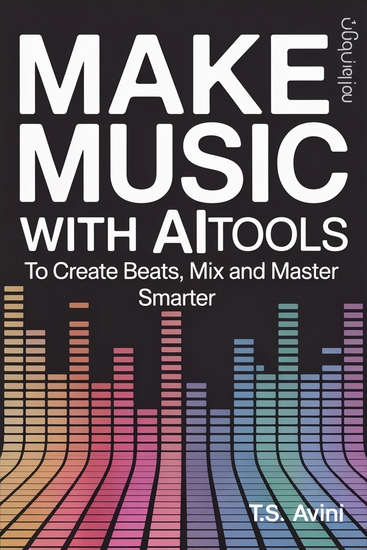
Make Music with AI Tools - Create Beats Mix and Master Smarter - cover
LER

Make Music with AI Tools - Create Beats Mix and Master Smarter

T.S Avini

Editora: T.S. AVINI

  • 0
  • 0
  • 0

Sinopse

Dive into the transformative world of AI-enhanced music production. This meticulously crafted book is your gateway to understanding and utilizing artificial intelligence in the creation, mixing, and mastering of music, no matter your level of expertise. Whether you're a novice or a seasoned producer, you'll discover the tools and techniques that AI offers to streamline and elevate your music production process.  - Learn how to set up your digital audio workstation to enhance your creative flow.  - Explore cutting-edge AI beat-making tools that redefine music creation for the modern artist.  With practical insights and hands-on techniques, this book empowers musicians to harness AI’s capabilities and push the boundaries of their creativity. Ready to transform your music journey? Embrace the future and innovate with AI today!
Disponível desde: 28/07/2025.
Comprimento de impressão: 140 páginas.
Outros livros que poderiam interessá-lo

  • The Read Aloud Factor - How to Create the Habit That Boosts Your Baby's Brain - cover

    The Read Aloud Factor - How to...

    Rekha S. Rajan

    • 0
    • 0
    • 0
    New neuroscience research is showing us the long-term impact that reading aloud has on children, stretching all the way into adulthood. We have always known that reading aloud is an important way to bond with your baby and develop language skills. But the latest research, led by author Rekha S. Rajan, shows that individuals who were read to more frequently as children showed a healthier brain in old age. Parents reading to their own child was a valuable and important part of supporting lifelong brain development. The Read Aloud Factor gives parents and caretakers what they need to make read-alouds a regular and enjoyable part of the family routine. This innovative book shares the latest research on brain development, describes how reading aloud supports language and social-emotional development, and provides ideas for integrating STEAM practices of reading aloud with arts and technology. The scientific insight that inspired this project is distilled into accessible, actionable information for parents and educators on how to read aloud in an effective, engaging, and meaningful way. The key to the book is its accessible approach, which combines findings from the most modern research to provide new pathways for parents and caregivers to support their baby's development.
    Ver livro
  • Aztec Astronomy and Astrology: The History of the Aztec’s Measurements of the Planets and Stars - cover

    Aztec Astronomy and Astrology:...

    Editors Charles River

    • 0
    • 0
    • 0
    Nearly 500 years after the Spanish conquered their mighty empire, the Aztecs are often remembered today for their major capital, Tenochtitlan, as well as being fierce conquerors of the Valley of Mexico who often engaged in human sacrifice rituals. Unlike the Maya, the Aztecs are not widely viewed or remembered with nuance, in part because their own leader burned extant Aztec writings and rewrote a mythologized history explaining his empire’s dominance less than a century before the Spanish arrived. Naturally, Cortes and other Spaniards depicted the Aztecs as savages greatly in need of conversion to Catholicism. While the Maya are remembered for their astronomy, numeral system, and calendar, the Aztecs have primarily been remembered in a far narrower way, despite continuing to be a source of pride to Mexicans through the centuries. 
    	For the Aztec, astronomy was not a purely scientific pursuit but intimately linked to religious, mythological, and ideological elements that were of the highest importance. The celestial realm held a sacred nature, as did the many gods and goddesses that dwelt there, so for all Mesoamerican cultures, astronomy was a fundamental part of their daily lives. Thus, astronomy was present in their calendars, religion, and even agriculture, and in close relation to astronomy, the concept of time was also an essential part of their worldview. The Aztec recorded many of the astronomical events they observed in codices and hieroglyphic inscriptions, but the main evidence of their deep astronomical knowledge comes from their calendar system. This information was then used to plan the orientation of buildings and ceremonial centers, which were aligned to sunrises or sunsets corresponding to special dates, such as solstices or equinoxes. Observational calendars were also used to schedule agricultural activities, as well as rituals, festivals, and celebrations, on an annual cycle.
    Ver livro
  • History of Computers - cover

    History of Computers

    Introbooks Team

    • 0
    • 0
    • 0
    Since the time human beings took birth on the earth, tremendous changes have been observed in all phases of life. One such aspect was the phase of the technology itself. Technology has advanced itself beautifully and has made the work of humans easier. Like for instance, earlier people used to keep track of all the readings in the journal in handwritten format, but now there are many different types of computer applications available for doing the same. Similarly, primitive people made use of the bones and sticks to perform simple mathematical calculations, and now it’s just a calculator away, which you can find on your smartphones as well.  
    Computers form an integral part of our lifestyle. These are used for work purposes, entertainment purposes, gaming purposes, data storing purposes, file creating sorting and managing, and so on. 
    Earlier, the computers used to be big and occupied a lot of space and used to be very costly, could store only a minute amount of data, consumed a high amount of energy, and dissipated a large amount of heat. But, over time, as the technology evolved and the advancements took place, the size of the computer lessened, they began to be available at low prices in the market, energy consumption was reduced, heat dissipation was decreased, etc.  
    The computer will not be able to work until and unless it has been programmed.   
    Computer is defined as a programmable electronic device that intakes raw data as input and processes the information with the help of programs and gives the final result as output. Charles Babbage is called the 'Father of Computer". The first working mechanical computer was designed by Charles Babbage that was known as the Analytical Engine. Read-only memory was used as punch cards in this computer. 
    Ver livro
  • The Genius Life - Heal Your Mind Strengthen Your Body and Become Extraordinary - cover

    The Genius Life - Heal Your Mind...

    Max Lugavere

    • 0
    • 0
    • 0
    The Genius Life has descriptive copy which is not yet available from the Publisher.
    Ver livro
  • Data Analysis for Beginners - Part 2 Unlocking the Secrets of Data Analysis A Practical Guide for Beginners - cover

    Data Analysis for Beginners -...

    Daniel Garfield

    • 0
    • 0
    • 0
    In a data-driven world, the ability to analyze and derive insights from vast amounts of information is becoming increasingly crucial. If you're new to the field of data analysis and eager to dive into this fascinating realm, "Data Analysis for Beginners" is the perfect companion on your learning journey. 
    This comprehensive guide equips you with the essential knowledge and practical skills needed to navigate the complex world of data analysis. Starting from the basics, you'll learn how to effectively clean, manipulate, and explore datasets, ensuring data accuracy and reliability. Through hands-on examples and real-world scenarios, you'll gain a solid foundation in data wrangling techniques and uncover hidden patterns and trends. 
    As you progress, you'll discover the art of data visualization, transforming raw data into captivating visual representations. From creating informative charts and graphs to designing interactive dashboards, you'll learn how to communicate complex insights in a visually compelling and understandable way. With the help of popular tools and libraries like Python, R, and Tableau, you'll master the art of data storytelling and make your analyses more impactful. 
    But data analysis is more than just visual representation. This book also guides you through the realm of statistical analysis, helping you understand the underlying principles and techniques. You'll learn about probability, hypothesis testing, and correlation analysis, empowering you to draw meaningful conclusions and make informed decisions based on data. 
    "Data Analysis for Beginners" is your go-to resource for mastering the art of data analysis. Join the ranks of data-savvy individuals and unleash the power of data to drive meaningful change and gain a competitive edge in today's data-driven world. 
     
    Ver livro
  • Quantum Physics Made Simple - From the Origins of the Universe to Quantum Computing — Discover Superposition Tunneling Time Light and Relativity in the Simplest Possible Way - cover

    Quantum Physics Made Simple -...

    Maynard Marrow

    • 0
    • 0
    • 0
    Quantum physics sounds brilliant—until someone actually tries to explain it. 
    Suddenly you’re drowning in equations, paradoxes, or New Age promises. You’re told particles can be in two places at once… that time isn’t real… that light behaves like a wave and a particle… but no one seems to explain how or why in a way that actually makes sense. 
    So you nod, smile, and move on—still confused. 
    This audiobook fixes that. 
    You’ll understand what superposition really is. What tunneling actually means. How Einstein proved light could knock out electrons. Why your thoughts might influence physical matter. And how quantum theory is powering the next generation of computers and technologies. 
    Here’s what you’ll take away:Why Max Planck’s idea shattered physics—and created an entirely new oneWhat the birth of the universe has to do with particle uncertaintyHow particles tunnel through walls (yes, seriously)Why black body radiation melted 19th-century science—and changed everythingWhat light really is, and why it behaves so weirdlyHow Einstein explained the photoelectric effect—and kicked off the tech ageWhy quantum physics and the Law of Attraction might have more in common than you thinkHow time works in quantum theory (hint: not how you expect)Why one particle can be in two places at once—and what that means for your computerWhat quantum computing is, and how it’s already rewriting the rules 
    If you’ve ever wished someone would finally explain quantum physics like a real person would, here it is.Start listening and see just how simple this “impossible” science can be.
    Ver livro