¡Acompáñanos a viajar por el mundo de los libros!
Añadir este libro a la estantería
Grey
Escribe un nuevo comentario Default profile 50px
Grey
Suscríbete para leer el libro completo o lee las primeras páginas gratis.
All characters reduced
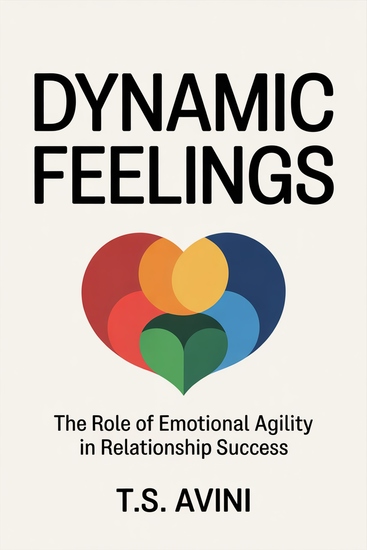
Dynamic Feelings - The Role of Emotional Agility in Relationship Success - cover

Dynamic Feelings - The Role of Emotional Agility in Relationship Success

T.S Avini

Editorial: T.S. AVINI

  • 0
  • 0
  • 0

Sinopsis

In "Dynamic Feelings: The Role of Emotional Agility in Relationship Success," explore the transformative power of emotional agility—a vital skill to navigate the complex dance of human relationships. This book delves into the core elements that make relationships thrive, offering insights and strategies to foster emotional intelligence and intimacy.- Learn the science behind emotions and their significant impact on how we connect with others.- Uncover practical tools to enhance self-awareness and emotional adaptability, key components for enduring partnerships.By building empathy, recognizing emotional patterns, and embracing diversity in feelings, readers will discover a richer, more connected experience in their interactions. This book offers not only theoretical insights but actionable steps to empower readers in their personal and relational growth journey. Harness the strength of emotional agility and transform your relationships today!
Disponible desde: 07/08/2025.
Longitud de impresión: 176 páginas.


Otros libros que te pueden interesar

  • Native Americans - Uncovering the History of the Cherokee Sioux and Comanche Tribes - cover

    Native Americans - Uncovering...

    Kelly Mass

    • 0
    • 0
    • 0
    This is a combo of several books, which are: 
    1 - The Cherokee are among the native tribes of the United States' Southeastern Woodlands. They resided in communities along river valleys in what's now southwestern North Carolina, southeastern Tennessee, the limits of western South Carolina, northern Georgia, and northeastern Alabama just before the 18th century. Cherokee belongs to the Iroquoian language family. One oral legend tells of the people moving south in age-old times from the Great Lakes area, where other Iroquoian-speaking tribes were based, according to James Mooney, an early American ethnographer. 
    2 - The Comanche are a Native American people from the contemporary United States' Great Plains. Most of contemporary northwestern Texas, and also surrounding parts in eastern New Mexico, southeastern Colorado, southwestern Kansas, western Oklahoma, and northern Chihuahua, were previously part of their historical domain. 
    The Comanche people are acknowledged by the federal government as the Comanche Country, which is headquartered in Lawton, Oklahoma. 
    The Comanche language belongs to the Uto-Aztecan family of Numic languages. It started as a Shoshoni dialect, but has since developed into its own language. 
    3 - The Sioux, also called the Oceti Sakowin are a North American people of Native American tribe and First Countries tribes. The contemporary Sioux are split into 2 significant groups based upon language: Dakota and Lakota; they're called together as the Ohéthi akówi ("7 Council Fires"). The term "Sioux" is an exonym stemmed from a French transliteration of the Ojibwe term "Nadouessioux," and can apply to any ethnic group or language dialect within the Great Sioux Country.
    Ver libro
  • Don't Trust Your Gut - Using Data to Get What You Really Want in Life - cover

    Don't Trust Your Gut - Using...

    Seth Stephens-Davidowitz

    • 0
    • 0
    • 0
    Seth Stephens-Davidowitz is as good a data storyteller as I have ever met.” — Steven Levitt, co-author, Freakonomics 
    Big decisions are hard. We consult friends and family, make sense of confusing “expert” advice online, maybe we read a self-help book to guide us. In the end, we usually just do what feels right, pursuing high stakes self-improvement—such as who we marry, how to date, where to live, what makes us happy—based solely on what our gut instinct tells us. But what if our gut is wrong? Biased, unpredictable, and misinformed, our gut, it turns out, is not all that reliable. And data can prove this. 
    In Don’t Trust Your Gut, economist, former Google data scientist, and New York Times bestselling author Seth Stephens-Davidowitz reveals just how wrong we really are when it comes to improving our own lives. In the past decade, scholars have mined enormous datasets to find remarkable new approaches to life’s biggest self-help puzzles. Data from hundreds of thousands of dating profiles have revealed surprising successful strategies to get a date; data from hundreds of millions of tax records have uncovered the best places to raise children; data from millions of career trajectories have found previously unknown reasons why some rise to the top. 
    Telling fascinating, unexpected stories with these numbers and the latest big data research, Stephens-Davidowitz exposes that, while we often think we know how to better ourselves, the numbers disagree. Hard facts and figures consistently contradict our instincts and demonstrate self-help that actually works—whether it involves the best time in life to start a business or how happy it actually makes us to skip a friend’s birthday party for a night of Netflix on the couch. From the boring careers that produce the most wealth, to the old-school, data-backed relationship advice so well-worn it’s become a literal joke, he unearths the startling conclusions that the right data can teach us about who we are and what will make our lives better. 
    Lively, engrossing, and provocative, the end result opens up a new world of self-improvement made possible with massive troves of data. Packed with fresh, entertaining insights, Don’t Trust Your Gut redefines how to tackle our most consequential choices, one that hacks the market inefficiencies of life and leads us to make smarter decisions about how to improve our lives. Because in the end, the numbers don’t lie. 
    Supplemental enhancement PDF accompanies the audiobook.
    Ver libro
  • Meeting of Minds - Volume V - cover

    Meeting of Minds - Volume V

    Steve Allen

    • 0
    • 0
    • 0
    By " assembling" some of the most fascinating figures in world history, Meeting of Minds provided a groundbreaking opportunity for audiences to be exposed to ideas by way of a medium not normally known for its intellectual vigor. Portrayed by actors, panelists engage in stimulating round-table discussions that were conducted like any other talk show but featured prominent influencers from bygone generations— not just philosophers and politicians, but poets, playwrights, and presidents. From activists and artists to international leaders— both famous and infamous— these conversations are unfailingly witty, thought-provoking, and genuinely entertaining.
    An innovative series, Meeting of Minds remains one of the most delightful ways of gaining historical perspective ever devised, and these original soundtrack recordings capture the intellectual and spirited debates of the episodes hosted by Steve Allen. The panelists featured in this volume are German theologian Martin Luther, French philosopher and writer Voltaire, Greek philosopher Plato, and social reformer and nurse Florence Nightingale.
    Ver libro
  • Internal Family Systems Guide to Recovery from Eating Disorders An - Healing Part by Part - cover

    Internal Family Systems Guide to...

    Amy Yandel Grabowski

    • 0
    • 0
    • 0
    Drawing on the evidence-based Internal Family System (IFS) therapy model, An Internal Family Systems Guide to Recovery from Eating Disorders: Healing Part by Part addresses the necessity of healing the eating disorder sufferer's three groups of inner "Parts": the Mentors, the Advocates, and the Kids. In order to reconnect to their sense of Self and to achieve an inner balance necessary for recovery, the listener learns to address the unique needs of each of their "Parts." Written in an accessible style, this book combines compassionate examples from the author's client cases and her own recovery with a step-by-step framework for identifying and healing the listeners' Parts using the IFS model. Each chapter ends with questions for the listener to answer to further enhance their personal recovery. An Internal Family Systems Guide to Recovery from Eating Disorders: Healing Part by Part will be essential to mental health professionals treating clients with eating disorders and to the clients themselves.
    Ver libro
  • And Then? And Then? What Else? - cover

    And Then? And Then? What Else?

    Daniel Handler

    • 0
    • 0
    • 0
    YOU NEVER LOVE A BOOK THE WAY YOU LOVE A BOOK WHEN YOU ARE TEN. 
     
    Writing as Lemony Snicket, Daniel Handler has led several generations of young readers into that special and curious space of being hopelessly lost, and joyfully finding yourself, in the essential strangeness of literature. The wondrous and perilous journey of the Baudelaire orphans sprung from the author’s own path, from his childhood discovery of Baudelaire’s poetry through the countless peculiarities of his pursuit of a literary life—abject failure and startling success, breakthrough and breakdown, concordance and controversy—lit along the way by the books and culture he loved best. 
     
    At once a personal memoir and a literary exploration, a how-to book and a critical inquiry, a sequence of stories and a series of events, And Then? And Then? What Else? is a book not just for anyone curious about the creator of Lemony Snicket, but for anyone who loved books when they were a child, and still loves them now.
    Ver libro
  • Rolling Thunder Against the Rising Sun - The Combat History of US Army Tank Battalions in the Pacific in World War II - cover

    Rolling Thunder Against the...

    Gene Eric Salecker

    • 0
    • 0
    • 0
    This WWII history sheds light on the extensive use of armored fighting vehicles in the Pacific Theater from the Philippines to Okinawa.   Although the history of armor in World War II has captured the attention of countless authors, the extensive use of tanks in the Pacific has gone largely unexamined. Now historian Gene Eric Salecker corrects this oversight. With comprehensive detail, Salecker describes the exploits of American tanks on the jungle islands where troops engaged in savage combat and encountered unforgiving weather and terrain.    Stationed in the Philippines when the Japanese attacked the islands in 1941, the U.S. Army's independent tank battalions fought from the very start of the war. From New Guinea and the Solomons to Makin, Saipan, and Guam, American armor proved instrumental in winning World War II in the Pacific.
    Ver libro