Unisciti a noi in un viaggio nel mondo dei libri!
Aggiungi questo libro allo scaffale
Grey
Scrivi un nuovo commento Default profile 50px
Grey
Iscriviti per leggere l'intero libro o leggi le prime pagine gratuitamente!
All characters reduced
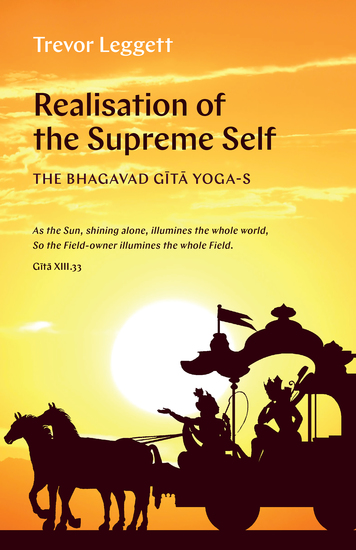
The Realisation of the Supreme Self - cover

The Realisation of the Supreme Self

Trevor Leggett

Casa editrice: TLAYT

  • 0
  • 0
  • 0

Sinossi

A practical training method, and not merely a text of revelation and worship – such is the true status of the ancient Sanskrit text Bhagavad Gītā. The special contribution of the Gītā is yoga, practical methods for expanding individual consciousness to realise the Supreme Self. This book presents the Gītā yoga in the light of explanations by Śan˙kara, the great seventh-century Indian philosopher and yogin, and Hari Prasad Shastri, who taught in Britain from 1929 till his death in 1956. The Gītā is directed in the first instance at the vigorously active, with responsibilities in the world. The actual practices of yoga are given for meeting the shock of the world-energies in the form of illusions, fear, greed, and anger. The whole basis of Gītā yoga is confirmation through experiment, not mere exhortation. This highly significant book presents the Gītā as a training manual for spiritual practice. Trevor Leggett studied Vedānta and the traditional Yoga of the Self for over sixty years and for eighteen years he was a pupil of Hari Prasad Shastri. Trevor Leggett published translations and transcriptions from both Sanskrit and Japanese including 'The Complete Commentary by Śaṅkara on the Yoga Sūtras' and 'Zen and the Ways'. In 1987 the All-Japan Buddhist Association gave him a Literary Award for his translations and in 1990 he was invited to speak on his Śaṅkara translations to the three day International Seminar on Śaṅkara held at New Delhi. Trevor Leggett studied Judo and Zen in Japan. He achieved sixth dan in Judo from the Kodokan and he was one of Great Britain's leading teachers of Judo. For twenty years he was head of the BBC's Japanese Service until his retirement in 1970. He died on 2nd August 2000. Trevor Leggett's other books on Yoga and Zen include 'Encounters in Yoga and Zen', 'Lotus Lake, Dragon Pool', 'The Chapter of the Self ', 'Jewels from the Indra Net', 'A First Zen Reader,' 'A Second Zen Reader (The Tiger's Cave)', 'The Spirit of Budo', 'The Dragon Mask', 'Samurai Zen (The Warrior Koans)', and 'Three Ages of Zen'. He is also the author of 'Japanese Chess, the game of Shogi'. Realisation of the Supreme Self THE BHAGAVAD GĪTĀ YOGA-S Realisation of the Supreme Self THE BHAGAVAD GĪTĀ YOGA-S As the Sun, shining alone, illumines the whole world, So the Field-owner illumines the whole Field. Gītā XIII.33 Trevor Leggett Trevor Leggett
Disponibile da: 06/06/2023.
Lunghezza di stampa: 145 pagine.

Altri libri che potrebbero interessarti

  • The Life Of Poor Children - Child Labour - cover

    The Life Of Poor Children -...

    Saurabh Kumar

    • 0
    • 0
    • 0
    This book tells us about the life of poor children, their thinking and the difficulties faced by them. It also sheds light on a global issue, child labour.
    Mostra libro
  • Home Away Elsewhere - cover

    Home Away Elsewhere

    Vaughan Rapatahana

    • 0
    • 0
    • 0
    A poetry collection in three parts. Home is events, situations, descriptions, and attitudes about Hong Kong, which is now Vaughan's home. Away contains poems about events, situations, descriptions, and attitudes about Aotearoa (New Zealand), in particular from a Maori (marginalised) perspective and also about all the other places where Vaughan has lived – The Republic of Nauru, Brunei Darussalam, The People's Republic of China, Australia, The United Arab Emirates (UAE), The Philippines. Elsewhere is emotions (the entire gamut), relationships (marriages, family, friends), deaths (parents, children), reflections – some wry, etcetera – not specifically tied to physical locations. Vaughan does not write to any set forms/formats but attempts to utilise type-face/shape/what a poem looks like on a page to reflect what he attempts to say. He writes to stay sane. "These poems express what I am, and what I also think people I see are, within. They are not mere academic or literary exercises. They are lived experiences, I guess." 
     Poems with attitude. … passionate, uncompromising and sardonic. …there is darkness here … also wit in abundance and a playfulness in language and thought … at times laugh-out-loud funny…. a compelling voice and Vaughan uses it skillfully to tell us his stories, make his often pungent points, and take us places few of us have seen. — James Norcliffe, Robert Burns Fellow (2000), Aotearoa-New Zealand. 
     These poems are pieces of an intricately interlinked multi-cultural and multi-lingual world, in which the poet must learn to live. In fact the poet relishes this confusing richness. His verses celebrate the graphic possibility of words, their visual appearance and sounds. So one must come to them with big eyes, big ears and a limitless imagination. — Muhammad Haji Salleh, National Laureate, Malaysia.
    Mostra libro
  • Olmec Civilization The: An Enthralling Overview of the History of the Olmecs Starting from Agriculture in Mesoamerica to the Fall of La Venta - cover

    Olmec Civilization The: An...

    Enthralling History

    • 0
    • 0
    • 0
    Which came first – the Olmecs or the Mayan? The Olmecs or the Incans? Walk with us among Colossal Heads and some of the first pyramids in Mesoamerica – yes! Pyramids across the world from Giza and Egypt! Come join us on the journey to discover just where this amazing culture began and ended – and why we are still studying the Olmecs today.  
    Historians and scholars still battle over the origins of – and reasons for– some of Mesoamerica’s formative civilizations downturn. How could such unique, innovative, and thriving societies fall without certain evidence of the causes? And what might the Mayans or Incans have to do with the Olmecs' rise and fall? 
    This audiobook takes listeners on a journey that few have taken, deep into archaeological sites, artifacts, and the many theories surrounding the Olmecs and their history, so shrouded in mystery. As you listen, you’ll learn: 
    ●      Why their placement in Mesoamerica’s history is so important 
    ●      Why a rock overhang was so crucial to their survival 
    ●      How the Olmecs domesticated - - yes, corn! 
    ●      Why and how they moved from hunter-gatherer to farming 
    ●      The importance of a rock to their society (Well, not just any rock!) 
    ●      Adzes – What they were and how they helped trade 
    You’ll learn some fun facts – but will also be challenged with archaeologically-puzzling discoveries and learn about some fascinating finds. The “Forgotten Civilization” lays claim to some fantastic people who forged the way for modern-day Mexico to become the rich and historically diverse culture it is today! 
    Grab your copy of this audiobook, and dive into the many astonishing elements of this vast and controversial Mesoamerican civilization! 
    Mostra libro
  • Mud Flood Hypothesis The: The History of the Conspiracy Theory about the Global Empire of Tartaria - cover

    Mud Flood Hypothesis The: The...

    Editors Charles River

    • 0
    • 0
    • 0
    From time to time, a new theory about world history still makes an appearance, particularly interesting when based on a geological reality. A popular notion at present is the existence of a great empire covering the bulk of Asia and Russia until only one hundred years ago that was destroyed and covered up to enable the rise of present nations. This was accomplished by worldwide deluges of mud, modern energy weapons, and the erasure of an advanced architectural and technological civilization that was far beyond its time. Over the past four years, the theory has developed branch extensions that go off in seemingly all directions. 
    	The “mud flood” hypothesis is centered around the ancient empire of Tartaria, or Tartary, as it existed two hundred years ago, a continent-wide showcase of advanced architecture, transportation, free energy, and wireless technology. Tartary is generally described as occupying a large portion of Asia and Russia, bounded by the Caspian Sea and the Ural Mountains, the Pacific Ocean and Bulgaria, and the southern borders of China, India, and Persia. At one point, it took up the vast bulk of the Russian continent.  
    	Tartaria is a story in present circulation as a country that once seemed known to the world but is now forgotten. Tartaria, Tartary, or Grand Tartaria troubles online researchers as they look over old maps dating back as far as the fifteenth century. The intrigue began with a declassified document from the CIA in 1957, mentioning the deletion of the country’s history at the hands of communist attackers. The Khanate of Khazan (Bulgaria) was named Tatarstan, a republic of the Russian Federation that purportedly flew the same flag as ancient Tartaria. In a map of 1824, Chinese-Tartaria and China appear to coexist. By 1850, Mongolia begins to appear where independent Tartaria was before, while China expands to become an empire and Tartaria disappears from view.
    Mostra libro
  • Nara Period - Imperial Splendor and the Rise of Buddhist Influence - cover

    Nara Period - Imperial Splendor...

    Rolf Hedger

    • 0
    • 0
    • 0
    The Nara Period (710–794) marked a transformative era in Japanese history, characterized by the establishment of a centralized government, the increasing influence of Buddhism, and cultural exchanges with China and Korea. It was during this time that Japan’s first permanent capital was established in Nara, shaping the foundations of political and cultural development for centuries to come. 
    Before the Nara Period, Japan’s capitals frequently shifted locations with the death of each emperor, a practice rooted in Shinto beliefs regarding spiritual purity. However, in 710, Emperor Genmei broke this tradition by moving the capital to Heijō-kyō (modern-day Nara), modeling it after the grand Tang dynasty capital of Chang’an. This decision signified Japan’s growing commitment to a stable and sophisticated political structure. Nara’s grid-like city layout, Buddhist temples, and administrative buildings reflected Chinese architectural and governmental influences, showcasing the era’s desire for centralized control and cultural refinement. 
    At the heart of the Nara government was the ritsuryō system, an adaptation of China’s bureaucratic model, which aimed to solidify imperial rule through codified laws, land distribution policies, and taxation systems. The emperor held supreme authority, but powerful aristocratic families, particularly the Fujiwara clan, played a crucial role in court politics. The implementation of the Taihō Code in 701 reinforced these administrative reforms, further consolidating the emperor’s influence while allowing aristocrats to maintain their dominance over court affairs.
    Mostra libro
  • Cocaine Cowboys - The Deadly Rise of Ireland's Drug Lords - cover

    Cocaine Cowboys - The Deadly...

    Nicola Tallant

    • 0
    • 0
    • 0
    Cocaine Cowboys tells the story of Ireland's love affair with cocaine since it first washed ashore on Cork's rugged coast to the billion-euro trade it has become. From Ireland's first cocaine lord and his attempts to establish a direct route from Miami to Dublin, to the modern-day violence that led to the brutal dismemberment of teenager Keane Mulready Woods, the book will follow the stories and the increasing chaos that has engulfed those desperate for a slice of this modern day gold rush. Along the way it details how cocaine has woven bonds between high society and the underworld, tracing the deal that killed the model Katy French and detailing how the Kinahan Cartel and Ireland's one time richest and most influential family joined forces to wash dirty money. Cocaine Cowboys is the definitive tale of the rise of Colombia's most famous export to become the drug of a nation. 
     
    Contains mature themes.
    Mostra libro