Junte-se a nós em uma viagem ao mundo dos livros!
Adicionar este livro à prateleira
Grey
Deixe um novo comentário Default profile 50px
Grey
Assine para ler o livro completo ou leia as primeiras páginas de graça!
All characters reduced
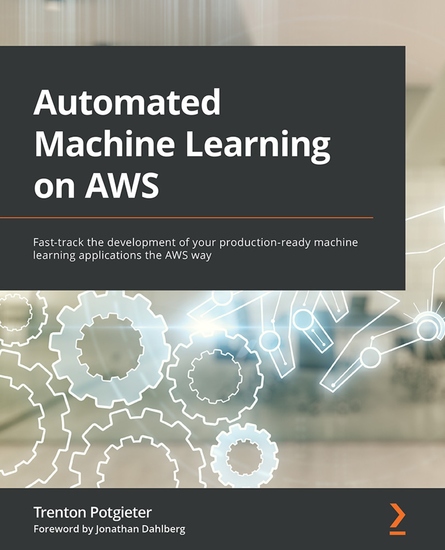
Automated Machine Learning on AWS - Fast-track the development of your production-ready machine learning applications the AWS way - cover
LER

Automated Machine Learning on AWS - Fast-track the development of your production-ready machine learning applications the AWS way

Trenton Potgieter

Editora: Packt Publishing

  • 0
  • 0
  • 0

Sinopse

AWS provides a wide range of solutions to help automate a machine learning workflow with just a few lines of code. With this practical book, you'll learn how to automate a machine learning pipeline using the various AWS services.
Automated Machine Learning on AWS begins with a quick overview of what the machine learning pipeline/process looks like and highlights the typical challenges that you may face when building a pipeline. Throughout the book, you'll become well versed with various AWS solutions such as Amazon SageMaker Autopilot, AutoGluon, and AWS Step Functions to automate an end-to-end ML process with the help of hands-on examples. The book will show you how to build, monitor, and execute a CI/CD pipeline for the ML process and how the various CI/CD services within AWS can be applied to a use case with the Cloud Development Kit (CDK). You'll understand what a data-centric ML process is by working with the Amazon Managed Services for Apache Airflow and then build a managed Airflow environment. You'll also cover the key success criteria for an MLSDLC implementation and the process of creating a self-mutating CI/CD pipeline using AWS CDK from the perspective of the platform engineering team.
By the end of this AWS book, you'll be able to effectively automate a complete machine learning pipeline and deploy it to production.
Disponível desde: 15/04/2022.
Comprimento de impressão: 420 páginas.

Outros livros que poderiam interessá-lo

  • Made To Live - cover

    Made To Live

    Dr. Paul Saba

    • 0
    • 0
    • 0
    Made to Live depicts a physician’s journey to save lives. Dr. Paul Saba begins his story with the battle to save the life of his baby girl, Jessica, who was born with a severe congenital cardiac malformation. He describes the challenges of facing difficult diagnoses through both his personal experiences and those of his patients. This book debunks the myths of euthanasia and assisted suicide. Dr. Saba’s battle has taken him to the Canadian courts, where he has been silenced from challenging Canada’s euthanasia laws. He has been forbidden from utilizing the Canadian Constitution or presenting his arguments in court to oppose euthanasia and assisted suicide. Dr. Saba believes no one can know what the future holds. Hope and loving support can overcome many obstacles in life’s journey. In the end, we are all “made to live,” as his daughter Jessica inscribed on one of her paintings at seven years old.
    Ver livro
  • Birdsplaining - A Natural History - cover

    Birdsplaining - A Natural History

    Jasmine Donahaye

    • 0
    • 0
    • 0
    Winner of the 2021 New Welsh Writing Awards: Rheidol Prize for Prose with a Welsh Theme or Setting
    'Vivid, quick and iridescent, Birdsplaining is an absolute kingfisher of a book' – Mike Parker
    A wren in the house foretells a death, while a tech-loving parrot aids a woman's recovery. Crows' misbehaviour suggests how the 'natural' order, ranked by men, may be challenged. A blur of bunting above an unassuming bog raises questions about how nature reserves were chosen. Should the oriole be named 'green' or golden? The flaws of field guides across decades prove that this is a feminist issue. A buzzard, scavenging a severed ewe's leg, teaches taboos about curiosity.
    Whose poo is the mammal scat uncovered in the attic, and should the swallows make their home inside yours? The nightjar's churring brings on unease at racism and privilege dividing nature lovers, past and present. The skin of a Palestine sunbird provokes concern at the colonial origins of ornithology. And when a sparrowhawk makes a move on a murmuration, the starlings show how threat – in the shape of flood, climate change or illness – may be faced down.
    Jasmine Donahaye is in pursuit of feeling 'sharply alive', understanding things on her own terms and undoing old lessons about how to behave. Here, she finally confronts fear: of violence and of the body's betrayals, daring at last, to 'get things wrong'.
    Roaming across Wales, Scotland and California, she is unapologetically focused on the uniqueness of women's experience of nature and the constraints placed upon it. Sometimes bristling, always ethical, Birdsplaining upends familiar ways of seeing the natural world.
    'Unusual, vivid… remarkably easy-to-read & enjoyable. Doesn't shy away from taking on difficult subjects… A means for personal reflection.' – BTO News [British Trust for Ornithology]
    'An erudite, bold, questing and valid collection of beautifully written essays. Whilst one eye stays focused on the injustices and cruelties of the world, the other gulps in its jewels and preciousness. Moving, stirring, and vital.' – Niall Griffiths
    'Superb… by turns moving, funny, illuminating… and… thought-provoking' – Katherine Stansfield
    'Upends familiar ways of seeing the natural world ― and in doing so, creates its own ecological niche' – Karen Lloyd, Caught by the River
    'A curiosity and passion so unapologetically alive that her words form wings' – Lotte Williams, Nation.Cymru
    'Neither human-centred nor its opposite. Although she explores human grief, violence and recovery, Donahaye also has a beautifully conveyed passion for the unromantic aspects of the environment… She bridges the very gap [in nature writing] that she identifies.' – Saskia McCracken, The Welsh Agenda
    'Whilst birds might not provide the answer to the meaning of life for Donahaye, they do have a part to play in finding meaning IN life, whether that be through personal symbolism and anecdotal encounters, or in larger questions about power and responsibility.' – Gwales.com
    'A fresh way of looking at nature writing, a deeply personal account that embraces its own subjectivity' – Zoe Kramer, Wales Arts Review
    'This is a beautiful collection where the nonhuman appears as a close neighbour… [and which] searches for hope and resilience in times of risk.' – Yvonne Reddick, New Welsh Reader
    Ver livro
  • Feral Borough - cover

    Feral Borough

    Meryl Pugh

    • 0
    • 0
    • 0
    Set in the urban pastoral of an East London postcode, Feral Borough asks what it means to call a place home, and how best to share that home with its non-human inhabitants. Meryl Pugh reimagines the wild as 'feral', recording the fauna and flora of Leytonstone in prose as incisive as it is lyrical. Here, on the edge of the city, red kite and parakeets thrive alongside bluebell and yarrow, a muntjac deer is glimpsed in the undergrowth, and an escaped boa constrictor appears on the High Road. In this subtle, captivating book – part herbarium, part bestiary and part memoir – Pugh explores the effects of loss, and lockdown, on human well-being, conjuring the local urban environment as a site for healing and connection.
    'A subtle, heartfelt and affecting book about home, the city and the self -- Pugh reminds us that nowhere, however urban, is without nature; that wherever we go, the intricate web of life continues to shape and change us.' Rebecca Tamás
    Ver livro
  • How to Start a YouTube Channel - cover

    How to Start a YouTube Channel

    Shawn Jones

    • 0
    • 0
    • 0
    Learn about how to Start a YouTube Channel
    Ver livro
  • Purified - How Recycled Sewage Is Transforming Our Water - cover

    Purified - How Recycled Sewage...

    Peter Annin

    • 0
    • 0
    • 0
    In Purified, veteran journalist Peter Annin shows that wastewater has become a surprising weapon in America's war against water scarcity. Annin probes deep into the water reuse movement in five water-strapped states—California, Texas, Virginia, Nevada, and Florida. He drinks beer made from purified sewage, visits communities where purified sewage came to the rescue, and examines how one of the nation's largest wastewater plants hopes to recycle one hundred percent of its wastewater by 2035. At each stop, listeners come face to face with the people who are struggling for, and against, recycled water. While the current filtration technology transforms sewage into something akin to distilled water—free of chemicals and safe to drink—water recycling's challenge isn't technology. It's terminology. Concerns about communities being used as "guinea pigs," sensationalist media coverage, and taglines like "toilet to tap" have repeatedly crippled water recycling efforts. Potable water recycling has become the hottest frontier in the race for expanded water supply options. But can public opinion turn in time to avoid the worst consequences? Purified's fast-paced narrative cuts through the fearmongering and misinformation to make the case that recycled water is direly needed in the climate-change era. Water cannot be taken for granted anymore—and that includes sewage.
    Ver livro
  • The Shortest History of AI - The Six Essential Ideas That Animate It - cover

    The Shortest History of AI - The...

    Toby Walsh

    • 0
    • 0
    • 0
    Since Alan Turing first posed the question "Can machines think?" artificial intelligence has evolved from a speculative idea to a transformative force. The Shortest History of AI traces this evolution, from Ada Lovelace's visionary work to IBM's groundbreaking defeat of the chess world champion and the revolutionary emergence of ChatGPT. It also explores AI's cultural journey, touching on classics such as Frankenstein, A Hitchhiker's Guide to the Galaxy, and 2001: A Space Odyssey. 
     
    Revealing how many "overnight" successes were decades in the making, this accessible and illuminating book helps us to understand how AI functions by explaining the six key ideas that animate it: it searches for answers using predetermined symbols and means-end analysis; it bases its answers on what sort of response it thinks it will get; it follows a set of rules in order to simulate human expertise; it copies the human brain by learning from experience; it uses reinforcement learning, rewarding its own successes and punishing itself for its failures; and it uses Bayes' theorem to calculate the probability of a cause based on its effect. 
     
    Fast-paced and rich with facts, The Shortest History of AI equips listeners to understand where we've been—and where we're headed.
    Ver livro