¡Acompáñanos a viajar por el mundo de los libros!
Añadir este libro a la estantería
Grey
Escribe un nuevo comentario Default profile 50px
Grey
Suscríbete para leer el libro completo o lee las primeras páginas gratis.
All characters reduced
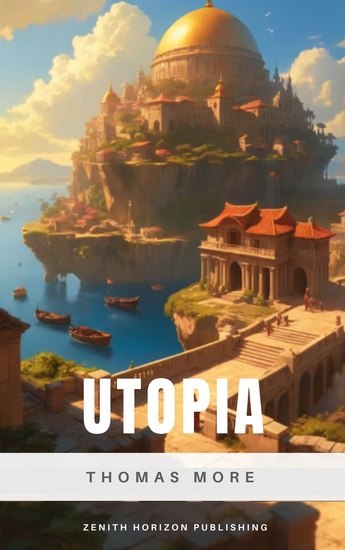
Utopia - A Visionary Blueprint for Ideal Society - cover

Utopia - A Visionary Blueprint for Ideal Society

Thomas More, Zenith Horizon Publishing

Editorial: Zenith Horizon Publishing

  • 0
  • 0
  • 0

Sinopsis

Step into the brilliant mind of Sir Thomas More as he imagines a perfect world in Utopia — a timeless exploration of justice, equality, governance, and human dignity. Written in 1516, this foundational philosophical and political work still inspires debate and admiration today.

More's masterpiece presents a fictional island society governed by reason, community welfare, and shared values — offering a sharp critique of the corruption, inequality, and moral failings of 16th-century Europe. Through dialogue, wit, and vision, Utopia urges readers to ask: What would a better world truly look like?

This edition is essential for lovers of political philosophy, Renaissance thought, and classic literature. It remains a must-read for anyone seeking insight into the roots of modern social theory and the timeless search for justice and harmony.

👉 Click "Buy Now" to explore a world where imagination meets reform.
Disponible desde: 20/06/2025.
Longitud de impresión: 155 páginas.

Otros libros que te pueden interesar

  • Eleanor of Aquitaine and Richard the Lionheart: The History of the Mother and Son Who Shaped Medieval Europe - cover

    Eleanor of Aquitaine and Richard...

    Charles River Editors

    • 0
    • 0
    • 0
    Laying next to the tomb effigy of King Henry II of England in France's Fontevraud Abbey is a curious coffin chiseled in the shape of a young woman in repose. The once vibrant paint on the effigy is flaking, and several areas of the centuries-old tombs are chipped, but her general features are still somewhat recognizable. The beautiful, crowned queen, depicted with a soft smile on her face, was dressed in a simple, but elegant gown in white and blue, and an open book in her arms. The effigy is for none other than Duchess Eleanor of Aquitaine. 
    	Over the years, this mysterious 12th century figure has been portrayed in countless ways, from a valiant warrior queen and resourceful politician to a control-obsessed and manipulative siren whose only objective in life was power. What is clear is that during her long life, Eleanor she played an outsized role in both French and English history, and she also had an impact on the course of the Crusades, not just with her first husband, France’s King Louis VII, but also through her offspring with her second husband, Henry II.  
    	The enduring figure of the Middle Ages is the chivalrous knight who served as a hero across much of Europe, and nobody played a more defining role in casting the popular image of medieval knights than Eleanor’s son Richard the Lionheart, one of the most famous English kings and crusaders. In many respects, it was ironic that Richard became one of the central characters of the Middle Ages, and his very popular legacy today belies centuries of controversy. Richard I Plantagenet, better known by his nickname “Coeur de Lion” (Lionheart), eventually became King of England, Grand Duke of Aquitaine, Duke of Poitou, and Duke of Anjou, but as the third son in a large family, he did not expect to or even want to rule England. Nevertheless, it was he who eventually came to the throne upon his father's death, assisted in great measure by his statesmanlike mother Eleanor.
    Ver libro
  • The 4th Industrial Revolution from an Ethical Perspective - cover

    The 4th Industrial Revolution...

    Timo Plutschinski, Andrew...

    • 0
    • 0
    • 0
    As the Fourth Industrial Revolution ushers into a new era of artificial intelligence (AI) and virtual reality, how should we respond to the societal and ethical dilemmas associated with this new age of transformative scientific power? This research highlights the need for an ethical and globally shared view on how technology affects the economic, social, cultural and spiritual aspects of daily life. With thanks to the international team of experts this book is outlining consequences of the Fourth Industrial Revolution in a broad range for business and work life, for leadership, for media and communication, for churches and for personal and family life. Authors are: Prof. Dr. Jack Barentsen (USA) Andrew Bunnell (USA) Jonathan Ebsworth (United Kingdom) Prof. Dr.-Ing. Klaus Henning (Germany) Prof. Dr. Bruce A. Little (USA) Jeremy Peckham (United Kingdom) Rev. Timo Plutschinski (Germany) Sallux Publishing Printed Edition: ISBN 978-94-92697-20-2
    Ver libro
  • Pacific Theater in 1944 The: The History of the Decisive Campaigns that Contributed to the Allies’ Victory over Japan - cover

    Pacific Theater in 1944 The: The...

    Editors Charles River

    • 0
    • 0
    • 0
    The powerful forces of the United States Navy (USN), Marine Corps, and Army advanced inexorably against Imperial Japan in 1944. Following massive interdiction of Japanese merchant shipping by American submarines and multiple naval victories, the Americans stood poised to liberate the Philippines, then move on to locations closer to the Japanese home islands. 
    In early 1944, arguments raged over the best approach to the “strategic triangle” created by Formosa, Luzon, and China. Finally, on March 12th, the Joint Chiefs of Staff – consisting of Admirals William D. Leahy and Ernest J. King, and Generals George C. Marshall and Henry H. “Hap” Arnold - issued a directive picking the next target: “[T]he most feasible approach to the Formosa-Luzon-China area is by way of Marianas-Carolines-Palau-Mindanao area, and that the control of the Marianas-Carolines-Palau area is essential to the projection of our forces into the former area, and their subsequent effective employment therefrom.” 
    The Americans' plans focused on three islands near the southern end of a 15-island, north to south aligned island chain: Saipan, Tinian, and Guam. These islands, relatively large, offered space for the construction of large air bases within strategic bomber range of Japan itself, as well as closer targets. 
    The Japanese also recognized the strategic importance of the Mariana Islands, and Saipan in particular, given its location just 1,272 miles from Tokyo itself. This would place the Japanese capital well within the 3,250 mile range of the Boeing B-29 Superfortress. With these facts in their possession and the Marianas as one of the Americans' most logical next choices, the Japanese worked to move both reinforcements and materials for new fortifications to the southern Marianas in early 1944. 
    With that, the stage was set for the kind of deadly amphibious operations that would take place not only on the Marianas but also Iwo Jima and Okinawa after it. 
    Ver libro
  • The Mysterious Druids of Ancient Britain - Uncovering the Secrets of Their Rituals Knowledge and Lost Influence - cover

    The Mysterious Druids of Ancient...

    Iain Carter

    • 0
    • 0
    • 0
    For centuries, the Druids have fascinated historians and mystics alike. Were they wise scholars, powerful sorcerers, or secretive rebels against Rome? Their influence shaped early Britain, yet much of their knowledge has been lost to time. 
    This audiobook uncovers the rituals, beliefs, and legacy of the Druids, separating myth from reality. Explore their connection to nature, role in ancient Celtic society, and encounters with the Roman Empire. Who were the real Druids, and what secrets did they guard? 
    The Mysterious Druids of Ancient Britain is an immersive journey into history, perfect for those intrigued by ancient religions, lost wisdom, and Celtic culture.
    Ver libro
  • Italian History - An Overview of Cities Venetians and Historic Sites - cover

    Italian History - An Overview of...

    Kelly Mass

    • 0
    • 0
    • 0
    This is a 2-book combo, which contains these books: 
    1: Naples (or, in Italian, Napoli) is the local capital of Campania and Italy's third-largest city, after Rome and Milan, with a population of 967,069 people living within the city's administrative limits since 2017. With a population of 3,115,320 people, its province-level town is Italy's third-most inhabited urbane city, and its city periods for around twenty miles outside the city walls. 
    Naples, established by Greeks in the first millennium BC, is just one of the world's oldest constantly occupied cities. 
    On the isle of Megaride, a district, referred to as Parthenope, was established in the ninth century BC. It was re-founded as Neápolis in the sixth century BC. 
    Naples has a long history, all the way dating back to Roman times, the outbreak of the Vesuvius, and much more. Let’s learn more about this fascinating city’s history. 
    2: When we think of Venice, we think of masks, canals, murals and frescoes, and little “gondoliers” with picturesque boats. Venice, indeed, has an impressive artistic history. But did you know that Venice was also, for a while, a considerably-sized empire? 
      
    Although no enduring historic records associate with the creation of Venice, the Republic of Venice's history is typically said to start at 12 a.m. on Friday, March 25th, AD 421, when authorities from Padua established the city to develop a trading center in that area of northern Italy. 
    The creation of the Venetian republic is said to have accompanied the starting of the church of St. James at the exact same time. Still, the church (which is believed to be that of Saint Giacomo di Rialto) dates no earlier than the l lth century, and no after the mid-twelfth century.
    Ver libro
  • 100 Facts About Book Marketing - English to Spanish - cover

    100 Facts About Book Marketing -...

    Science-Based Language Learning Lab

    • 0
    • 0
    • 0
    Introduction to the 100 Somethings Language Learning Series 
     
    Welcome to a revolutionary approach to language learning! This series helps you master Spanish by intertwining it with compelling topics like Book Marketing. Each book centers on a theme (art, science, history) and presents 100 carefully chosen facts in both English and Spanish. 
     
    How It Works: 
     
    - Each fact is first introduced in Spanish, encouraging you to interpret it. 
     
    - The following page provides the fact in English and then repeats it in Spanish, aiding comprehension and memorization. 
     
    - The second half flips this order—English first, then Spanish, and English again—helping you practice translation in both directions for better mastery. 
     
    Benefits: 
     
    - Concise Learning: Focuses on one-sentence facts to ensure every word learned is impactful and directly related to your interests, making them easier to remember. 
     
    - Reinforcement: Alternating languages for each fact naturally strengthens vocabulary and grammar. 
     
    - Engagement: Learning vocabulary through topics you're passionate about keeps the process dynamic and relevant. 
     
    - Dual Knowledge: You enrich your understanding of a specific subject while learning a new language. 
     
    This series is tailored for learners who thrive on clear, targeted information, making it both educational and enjoyable. Whether you’re a beginner or expanding your linguistic skills, this series promises an effective and engaging educational journey. Embrace these 100 facts and let your passions drive your progress in mastering a new language!
    Ver libro