Junte-se a nós em uma viagem ao mundo dos livros!
Adicionar este livro à prateleira
Grey
Deixe um novo comentário Default profile 50px
Grey
Assine para ler o livro completo ou leia as primeiras páginas de graça!
All characters reduced
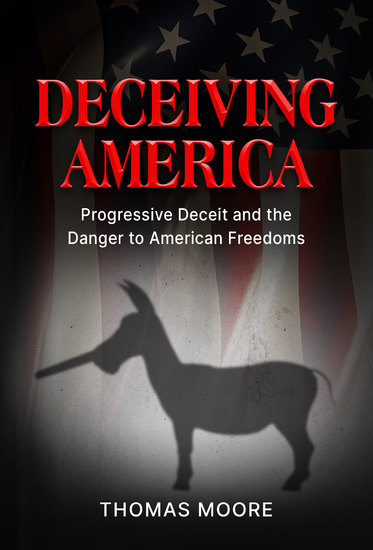
Deceiving America - Progressive Deceit and the Danger to American Freedoms - cover
LER

Deceiving America - Progressive Deceit and the Danger to American Freedoms

Thomas Moore

Editora: Defiance Press and Publishing

  • 0
  • 0
  • 0

Sinopse

In "Deceiving America," Thomas Moore delivers a powerful examination of how progressive policies are fundamentally transforming the United States—and not for the better. Drawing from historical context and contemporary examples, Moore methodically reveals how today's progressive movement mirrors dangerous totalitarian systems of the past.
 
From critical race theory being integrated into public education to radical criminal justice reforms that have increased violent crime, Moore presents a compelling case that progressive Democrats are undermining American freedoms. He explores how media propaganda, federal overreach, and the weakening of constitutional protections are creating a society increasingly controlled by government authority rather than individual liberty.
 
Moore's analysis tackles controversial topics like gun legislation, the COVID-19 response, escalating urban crime, and the indoctrination of American schoolchildren with ideological concepts instead of essential skills. Drawing parallels between current progressive tactics and the failed socialist regimes of history, he warns that America stands at a critical crossroads.
 
Written with conviction and deeply researched, "Deceiving America" offers conservatives and concerned Americans a clear-eyed view of the challenges facing the nation's founding principles. Moore's urgent warning will resonate with readers looking to understand and counteract the progressive agenda reshaping American institutions.
 
If you enjoyed "American Marxism" by Mark Levin, "The Authoritarian Moment" by Ben Shapiro, and "Culture Jihad" by Todd Starnes, you'll love "Deceiving America."
Disponível desde: 24/09/2024.
Comprimento de impressão: 232 páginas.

Outros livros que poderiam interessá-lo

  • First Among Equals - US Foreign Policy in a Multipolar World - cover

    First Among Equals - US Foreign...

    Emma Ashford

    • 0
    • 0
    • 0
    A fresh, concise roadmap for United States grand strategy in a multipolar world For the past thirty years, post–Cold War triumphalism and a desire to reshape the world have defined United States foreign policy. But the failures of the global war on terror, the return of conflict to Europe, and growing tensions with China all suggest that this approach to the world is flawed. For the United States—the country that has ruled the international system largely alone since 1991—this moment is particularly perilous. Can policymakers adapt American foreign policy to better fit the twenty-first century, and in doing so avoid the pitfalls and excesses of the past three decades? In this book, Emma Ashford proposes a return to a more pragmatic, realist set of strategic principles, ones better suited for the emerging multipolar world, that would pursue narrower United States interests, cultivate the capabilities of friendly states, and emphasize room for maneuver over rigid alliances. In this she provides a valuable counterpoint to today's liberal internationalist consensus, as well as a road map for policymakers who seek to change the course of United States foreign policy.
    Ver livro
  • Our Search for Belonging - How Our Need to Connect Is Tearing Us Apart - cover

    Our Search for Belonging - How...

    Howard J. Ross, JonRobert...

    • 0
    • 0
    • 0
    Why are we so divided today? Paradoxically, Howard Ross, author of Everyday Bias, says it's our compulsion to belong to a group--something hardwired into us-- that ends up making us deeply connected with some, yet deeply divided from others. Ross shows how we can overcome this growing tribalism. 
     
    We are living in a world of almost unparalleled separation. People are no longer disagreeing, but are instead disavowing each other's rights to an opinion. What is driving this polarization, and how can we overcome it? Howard Ross says that ironically it's our profound need to belong. He delves deeply into the powerful psychological, neurological, and biological forces that drive us to want to identify so strongly with a group we're sometimes even willing to sacrifice our individual identity. 
    Drawing on his decades of leadership in the diversity and inclusion field, Ross probes the depth and impact of this growing tribalism, the role social media plays in exacerbating it, the ways it impacts every aspect of the daily lives, and how to combat it.  Readers will gain tools for exploring contentious dialogue in healthier ways and guidelines for breaking down barriers and building bridges across difference, and organizations and institutions will be able to develop approaches that can open dialogue and encourage mutual understanding.
    Ver livro
  • The Rivalry Peril - How Great-Power Competition Threatens Peace and Weakens Democracy - cover

    The Rivalry Peril - How...

    Van Jackson, Michael Brenes

    • 0
    • 0
    • 0
    How the US policy of competition with China is detrimental to democracy, peace, and prosperity—and how a saner approach is possible 


    For close to a decade, the US government has been preoccupied with the threat of China, fearing that the country will "eat our lunch," in the words of Joe Biden. The United States has crafted its foreign and domestic policy to help constrain China's military power and economic growth. Van Jackson and Michael Brenes argue that great-power competition with China is misguided and vastly underestimates the costs and risks that geopolitical rivalry poses to economic prosperity, the quality of democracy, and, ultimately, global stability. 


    This in-depth assessment of the trade-offs and pitfalls of protracted competition with China reveals how such a policy exacerbates inequality, leads to xenophobia, and increases the likelihood of violence around the world. In addition, it distracts from the priority of addressing such issues as climate change while at the same time undercutting democratic pluralism and sacrificing liberty in the name of prevailing against an enemy "other." Jackson and Brenes provide an informed and urgent critique of current US foreign policy and a road map toward a saner, more democratically accountable strategy of easing tension and achieving effective diplomacy.
    Ver livro
  • Generative Artificial Intelligence - What Everyone Needs to Know ® - cover

    Generative Artificial...

    Jerry Kaplan

    • 0
    • 0
    • 0
    Advances in Generative Artificial Intelligence (GAI) have created a new class of computer systems that exhibit astonishing proficiency on a wide variety of tasks with superhuman performance, producing novel text, images, music, and software by analyzing enormous collections of digitized information. Soon, these systems will provide expert medical care; offer legal advice; draft documents; write computer programs; tutor our children; and generate music and art. These advances will accelerate progress in science, art, and human knowledge, but they will also bring new dangers. 


    Have we finally discovered the holy grail of AI—machines that match or exceed human intelligence? Which industries and professions will thrive, and which will wither? What risks and dangers will it pose? How can we ensure that these systems respect our ethical principles? Will the benefits be broadly distributed or accrue to a lucky few? How will GAI alter our political systems and international conflicts? Are we merely a stepping stone to a new form of non-biological life, or are we just getting better at building useful gadgets? 


    Generative Artificial Intelligence: What Everyone Needs to Know® equips listeners with the knowledge to answer these pressing questions.
    Ver livro
  • Bridging Divides: Why We Can't Agree on What's Right - "Dive into 'Bridging Divides' with captivating audio lessons that enhance your understanding and spark meaningful conversations!" - cover

    Bridging Divides: Why We Can't...

    Orson Trevelyan

    • 0
    • 0
    • 0
    Bridging Divides: Why We Can't Agree on What's Right 
    ⭐⭐ Simplified Audio Guide with Explanations ⭐⭐ 
    Are you eager to advance in your career and enhance your knowledge by effectively navigating today’s complex challenges? 
    Searching for a thorough guide that equips you with all the essential components to transform challenges into opportunities? 
    Your quest ends here! 
    This guide acts as your ultimate resource for deepening your understanding, honing your abilities, and participating in practical exercises. With this material, you're set for success. 
    Updated for the latest challenges. 
    Key features of this enriched guide: 
    - In-depth insights about transforming challenges into opportunities 
    - Comprehensive explanations that reveal your strengths 
    - Effective strategies for preparation and problem-solving 
    Our guide stands out with its extensive coverage, which is vital for your success. Concepts are explored in detail, not just skimmed over. 
    Please note that this guide is an independent resource and is not affiliated with any official entity. 
    Crafted with a straightforward structure and accessible language, our guide ensures smooth transitions between topics. Say farewell to complicated jargon and embrace clear, precise, and technically accurate content. 
    So, why wait? Click the BUY NOW button, secure your guide, and embark on your journey to success! 
    Transform your insights and turn challenges into golden opportunities with this essential guide!
    Ver livro
  • Plagues and Their Aftermath - How Societies Recover from Pandemics - cover

    Plagues and Their Aftermath -...

    Brian Michael Jenkins

    • 0
    • 0
    • 0
    From a plague in Athens during the Peloponnesian War in 430 BCE, to another in 540 that wiped out half the population of the Roman empire, down through the Black Death in the Middle Ages and on through the 1918 flu epidemic (which killed between 50 and 100 million people) and this century's deadly SARS outbreak, plagues have been a much more relentless fact of life than many realize. 


    The legacy of epidemics, Brian Michael Jenkins observes, is not only one of lives lost but of devastated economies and social disorder, all of which have severe political repercussions. 


    Thus, each chapter of Plagues and Their Aftermath draws on those historical precursors to focus on one particular aspect of their aftermath: What happens to political systems? What happens in the area of crime and terrorism? Do wars happen? What are the effects on cultures? What was the impact of widespread fear and public hysteria, of increased suspicion and scapegoating, of the spread of rumors and conspiracy theories? 


    Jenkins's sobering analysis is riveting and thought-provoking listening for general listeners and specialists alike, and throws welcome light into what many fear is a dark future.
    Ver livro