Rejoignez-nous pour un voyage dans le monde des livres!
Ajouter ce livre à l'électronique
Grey
Ecrivez un nouveau commentaire Default profile 50px
Grey
Abonnez-vous pour lire le livre complet ou lisez les premières pages gratuitement!
All characters reduced
Le Morte Darthur - cover

Le Morte Darthur

Thomas Malory

Maison d'édition: Caelwick Press

  • 0
  • 0
  • 0

Synopsis

We rely on your support to help us keep producing beautiful, free, and unrestricted editions of literature for the digital age. Will you support our efforts with a donation ? Thomas Malory did not invent the stories of Arthur, King of Britain, but it is fair to say that he reinvented them. Although the legends were already hundreds of years old by the fifteenth century, the contemporary stories of Arthur in Malory's day were primarily French. The French had added many of the elements familiar to modern readers, among them Lancelot, and the search for the Holy Grail. Malory combined, edited, and added some of his own material to the stories available to him, and in the process created a uniquely British work. (It was his printer Caxton who gave it a French name.) Le Morte d'Arthur is the source material for almost all modern retellings of King Arthur and his knights, from Hollywood movies and musicals to Nobel-prize winning writers. Malory's identity is still in some dispute, as there are several men of various spellings of the name to choose from. Sir Thomas Malory from Newbold Revel in Warwickshire is the most popular choice, but his life of crime—he was a rapist and serial thief at the minimum—seems to be at odds with the acts of chivalry and moral code present in this book. It is known from the author's own notes that he wrote the book while in prison; perhaps he was trying to make amends for his crimes. Regardless, the result was to give new life to King Arthur and his Knights of the Round Table.
Disponible depuis: 19/05/2026.
Longueur d'impression: 1122 pages.
D'autres livres qui pourraient vous intéresser

  • Zadig - cover

    Zadig

    Voltaire

    • 0
    • 0
    • 0
    An oriental philosophical tale, ´Zadig´ traces the adventures of the titular character, a man renowned for his 'just and moderate mind' and 'sincere and noble heart'. But his gifts give rise to jealousies in others that expose him to the vagaries of fate...Appointed prime minister, then disgraced and driven out of Babylon, Zadig, like all the heroes of fairy tales, is drawn into an initiatory journey that will take him from the banks of the Euphrates to Egypt; reduced to slavery, then freed by his master, he will cross Arabia and Syria. Faced with a thousand obstacles that put his reason and his optimism to the test, Zadig discovers that it is not easy to be happy.With this book, Voltaire, faithful to his theological concerns, poses the problem of evil and Providence, as he traces the life of this character who will come to say: 'that there is no evil from which good is not born.'´Zadig´ is perfect for fans of Voltaire's ´Candide´. Voltaire (1694-1778) is a renowned writer and philosopher. A universal spirit who marked the century of the "Enlightenment" and a fierce defender of individual freedom and tolerance, Voltaire was very successful with the liberal bourgeoisie. He left behind a great legacy. Due to censorship, most of his writings were banned. They were published anonymously, printed abroad and smuggled into France.
    Voir livre
  • Guide to Health A - Audiobook - cover

    Guide to Health A - Audiobook

    Mahatma Gandhi, Classic...

    • 0
    • 0
    • 0
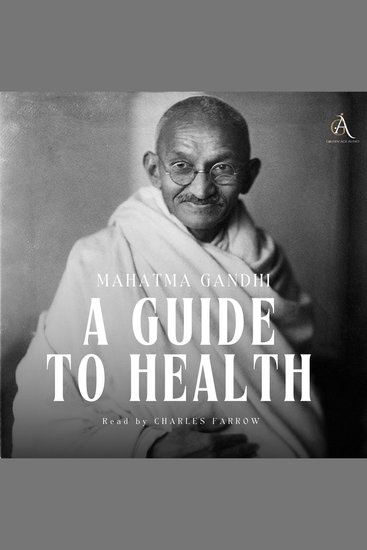
    In A Guide to Health, Mahatma Gandhi sets forth his philosophy of simple living, self-discipline, and the intimate connection between body and spirit. Written with clarity and conviction, the book emphasizes natural methods of maintaining health, advocating for moderation, vegetarianism, and a life of balance and restraint. Gandhi believed that true well-being comes not from indulgence, but from self-control and harmony with nature.The text is not a technical medical manual but rather a reflection on how one can live in alignment with both physical health and moral duty. Gandhi's advice ranges from diet and hygiene to the importance of personal responsibility in maintaining one's own vitality. His approach reveals the unity of physical, mental, and ethical health as essential to a fulfilling life.For modern readers and listeners, A Guide to Health remains a timeless call to simplicity. It invites us to consider how conscious choices in daily living—what we eat, how we care for ourselves, and how we view health—can shape a more meaningful existence.
    Voir livre
  • Moon of Israel - A Tale of the Exodus - cover

    Moon of Israel - A Tale of the...

    H. Rider Haggard

    • 0
    • 0
    • 0
    The Exodus from the Egyptian side: an Egyptian scribe, a prince who will not be Pharaoh, and Merapi — a Hebrew girl the court calls the Moon of Israel — while the plagues arrive one after another and the priesthood explains each one away. Haggard had Egyptologists check every line; the film of it was Hungary's most expensive production of 1924. The book takes both religions seriously, which was not usual.
    Voir livre
  • Adieu - cover

    Adieu

    Honoré de Balzac

    • 0
    • 0
    • 0
    An officer sees, at a country house in 1819, the woman he lost at the crossing of the Berezina seven years before — and she does not know him, or anything, and has not spoken since. What he does about it is one of the coldest ideas in French fiction. Balzac worked at night on fifty cups of coffee a day; this short story takes the Retreat from Moscow and puts it in a Normandy park.
    Voir livre
  • The Red Badge of Courage - cover

    The Red Badge of Courage

    Stephen Crane

    • 0
    • 0
    • 0
    The Red Badge of Courage is one of the most psychologically penetrating war novels ever written. Published in 1895, Stephen Crane’s groundbreaking work strips away romantic notions of heroism to reveal war as it is experienced from the inside—through fear, confusion, shame, and hard-earned self-awareness. 
    The story follows Henry Fleming, a young Union Army private who enters the Civil War filled with dreams of glory, only to find himself overwhelmed by the chaos and terror of battle. When Henry flees his first engagement, he becomes consumed by guilt and a desperate longing for a wound—a visible “red badge of courage” that might redeem him in the eyes of others and himself. As his regiment returns to combat, Henry must confront his own weakness and decide what courage truly means when survival and conscience collide. 
    Renowned for its vivid battle imagery and modern psychological realism, The Red Badge of Courage examines the inner life of a soldier rather than the spectacle of war. Crane’s prose captures the disorientation of combat and the fragile line between cowardice and bravery, making this novel a timeless exploration of human fear, growth, and moral reckoning. 
    Narrated by Michael Lyons, this audiobook presents Crane’s classic with clarity, restraint, and emotional depth, honoring the novel’s enduring power and introspective force.
    Voir livre
  • The Wind in the Rose-Bush - And Other Supernatural Stories - cover

    The Wind in the Rose-Bush - And...

    Mary Wilkins

    • 0
    • 0
    • 0
    Ford Village has no railroad station, being on the other side of the river from Porter’s Falls, and accessible only by the ford which gives it its name, and a ferry line.The ferry-boat was waiting when Rebecca Flint got off the train with her bag and lunch basket. When she and her small trunk were safely embarked she sat stiff and straight and calm in the ferry-boat as it shot swiftly and smoothly across stream. There was a horse attached to a light country wagon on board, and he pawed the deck uneasily. His owner stood near, with a wary eye upon him, although he was chewing, with as dully reflective an expression as a cow. Beside Rebecca sat a woman of about her own age, who kept looking at her with furtive curiosity; her husband, short and stout and saturnine, stood near her. Rebecca paid no attention to either of them. She was tall and spare and pale, the type of a spinster, yet with rudimentary lines and expressions of matronhood. She all unconsciously held her shawl, rolled up in a canvas bag, on her left hip, as if it had been a child. She wore a settled frown of dissent at life, but it was the frown of a mother who regarded life as a forward child, rather than as an overwhelming fate. Listen and enjoy.
    Voir livre