Junte-se a nós em uma viagem ao mundo dos livros!
Adicionar este livro à prateleira
Grey
Deixe um novo comentário Default profile 50px
Grey
Assine para ler o livro completo ou leia as primeiras páginas de graça!
All characters reduced
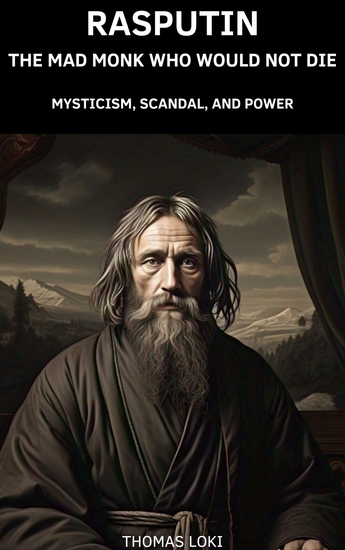
Rasputin - The Mad Monk Who Wouldn’t Die - cover
LER

Rasputin - The Mad Monk Who Wouldn’t Die

Thomas Loki

Editora: Heritage Books

  • 0
  • 0
  • 0

Sinopse

Mysterious, feared, and nearly impossible to kill, Rasputin remains one of history’s most enigmatic figures. A self-proclaimed holy man with an uncanny influence over Russia’s imperial family, he was loved by some and despised by many. His piercing eyes and hypnotic presence captivated the Romanovs, while his critics saw him as a dangerous fraud whose power threatened the empire.


But who was Rasputin really? A mystic with supernatural gifts or a cunning manipulator who used faith for his own gain? This book unravels the truth behind the legend, tracing his rise from a Siberian peasant to the most infamous figure in Tsarist Russia. Withstanding multiple assassination attempts before his final, gruesome demise, his life was as bizarre as his death.


Step into the shadowy world of Rasputin and discover the man behind the myth, the power he wielded, and the secrets that followed him to the grave.
Disponível desde: 05/03/2025.
Comprimento de impressão: 72 páginas.

Outros livros que poderiam interessá-lo

  • The Cash Ceiling - Why Only the Rich Run for Office—and What We Can Do about It - cover

    The Cash Ceiling - Why Only the...

    Nicholas Carnes

    • 0
    • 0
    • 0
    Why working-class Americans almost never become politicians, what that means for democracy, and what reformers can do about itWhy are Americans governed by the rich? Millionaires make up only three percent of the public but control all three branches of the federal government. How did this happen? What stops lower-income and working-class Americans from becoming politicians? The first book to answer these urgent questions, The Cash Ceiling provides a compelling and comprehensive account of why so few working-class people hold office—and what reformers can do about it.Using extensive data on candidates, politicians, party leaders, and voters, Nicholas Carnes debunks popular misconceptions (like the idea that workers are unelectable or unqualified to govern), identifies the factors that keep lower-class Americans off the ballot and out of political institutions, and evaluates a variety of reform proposals.In the United States, Carnes shows, elections have a built-in “cash ceiling,” a series of structural barriers that make it almost impossible for the working-class to run for public office. Elections take a serious toll on candidates, many working-class Americans simply can’t shoulder the practical burdens, and civic and political leaders often pass them over in favor of white-collar candidates. But these obstacles aren’t inevitable. Pilot programs to recruit, train, and support working-class candidates have the potential to increase the economic diversity of our governing institutions and ultimately amplify the voices of ordinary citizens.Who runs for office goes to the heart of whether we will have a democracy that is representative or not. The Cash Ceiling shows that the best hope for combating the oversized political influence of the rich might simply be to help more working-class Americans become politicians.
    Ver livro
  • Origin of the Nephilim in Mesopotamia - How the Anunnaki Giants the Watchers and Apkallu Became a Global Phenomenon - cover

    Origin of the Nephilim in...

    Faruq Zamani

    • 0
    • 0
    • 0
    The Anunnaki in the Epic of Gilgamesh compared to the Nephilim Flood Narrative? 
    Scholars have long debated whether the Anunnaki in the Epic of Gilgamesh is the same beings as the Nephilim of Genesis 6. there is a direct connection between these two groups of entities which sheds light on this critical question. One of the biggest problems with interpreting certain parts of ancient texts, such as the Book of Genesis, and other writings, can be traced back to an almost fanatical obsession. Many have treated all such writings as purely historical documents rather than trying to understand them within their proper cultural context. We run into all kinds of challenges because we deal with stories initially intended to be read or listened to for entertainment or some religious significance rather than for their scientific or historical accuracy. This does not mean that these narratives have no value in terms of what they can teach us about ancient societies but means that scholars need to approach them from different perspectives if they wish to make any progress when it comes time for interpretation. 
    Was Noah’s flood an actual event? 
    “The Epic of Gilgamesh,” written in ancient Akkadian and Babylonian, is an epic poem discovered on 12 clay tablets. It tells the story of Gilgamesh, a demigod king who seeks to find immortality after being grieved by the death of his companion Enkidu. The hero travels across the world and meets Utnapishtim, the survivor of a great flood sent by the gods to destroy humankind. After hearing about Utnapishtim’s story and lessons, Gilgamesh returns home to his city empty-handed.
    Ver livro
  • Neem Karoli Baba's Beautiful Gang Of Four - cover

    Neem Karoli Baba's Beautiful...

    Sripad Jagannatha Dasa

    • 0
    • 0
    • 0
    Neem Karoli Baba, known to his followers as Maharaj-ji, was a mystic saint and devotee of Hanuman. Maharaj-ji’s teachings were simple and universal. He often said, “Sub Ek” — All is One. He taught us to “love everyone, serve everyone, remember God, and tell the truth.” Strongly connected to Hanuman, God in the form of a monkey, Maharaj-ji taught in a highly personalized, non-traditional way that reflected the deep devotion of the bhakti path of the heart. Known as the “Miracle Baba” throughout north India, he manifested many siddhis (powers), such as being in two places at once or putting devotees in samadhi (elevated state of God consciousness) at the touch of a finger. Here is the essence of his remarkable life and teachings. He is known outside India for being the spiritual master of a number of Americans who traveled to India in the '60s and '70s, including Ram Dass and Bhagavan Das, as well as musician Krishna Das. For many years Baba was closely associated with silent sadhu Baba Hari Dass. 
     
    Dr. Richard Alpert, a former Harvard professor was an icon of the hippie, LSD-fueled revolution of the '60s. After that, on a trip to India - like Clark Kent changing into Superman - he became the much-beloved spiritual teacher Baba Ram Das. His '70s iconic book, Be Here Now, turned on a generation to the deep, nonsectarian spirituality within us all. Krishna Das is an American vocalist known for performing Vedic devotional music known as kirtan. Bhagavan Das is an American yogi who lived for six years in India, Nepal, and Sri Lanka. He is a bhakti yogi, kirtan singer, spiritual teacher, and writer. Baba Hari Dass was initiated in the Vairagi Vaishnava order in 1942. Dass has practiced continual silence since 1952. This is the true story of each of the spiritual "Gang of four" and their master and deep inspiration Neem Karol Baba.
    Ver livro
  • The Straw Man Fallacy - Misrepresenting an Argument to Refute It More Easily - cover

    The Straw Man Fallacy -...

    William Rands

    • 0
    • 0
    • 0
    The Straw Man Fallacy is one of the most pervasive forms of logical misrepresentation, often employed to simplify complex arguments for easier refutation. At its core, this fallacy involves constructing a distorted or exaggerated version of an opponent's position, subsequently attacking this weakened argument instead of addressing the original point. The technique, though logically flawed, can be compelling, as it plays on cognitive biases and simplifies discourse in ways that resonate with audiences. 
    This fallacy derives its name from the image of a straw man, an effigy made of straw that lacks the strength or integrity of a real person. Just as a straw man is easily knocked down, so too is the misrepresented argument—a weaker version created not to understand but to refute. While the method is intellectually dishonest, its use is widespread, spanning casual conversations, heated debates, and high-stakes political rhetoric. 
    Understanding the Straw Man Fallacy begins with recognizing its foundational elements. First, the original argument is altered, often stripped of nuance or exaggerated to absurdity. For example, an individual advocating for environmental regulations might have their argument reframed as "wanting to eliminate all economic progress," a position they never claimed. This misrepresentation not only undermines meaningful dialogue but also diverts attention away from the core issue.
    Ver livro
  • Time to Escape - cover

    Time to Escape

    Raphael Terra

    • 0
    • 0
    • 0
    This audiobook has been recorded using Text to speech (TTS). 
     
    This is a mad, mad world. A world full of crazy humans. Our species is growing at an alarming rate; the globe is warming out of control; our food sources are being depleted; a massive energy crisis is looming and the pressure on each and every one of us to earn more, compete with our peers and look cool is so great that suicide rates are growing faster than ever. 
     
    Marry, have two children, hold down a good job, fight for your country, pay your mortgage and drive a petrol guzzling car. What about creativity, freedom, emotions? We are sold to, manipulated by marketing and propaganda, told what and who to believe. We are born and thrown into a bewildering world of control with no options and no purpose other than to feed the machine. 
     
    For many it all becomes too much and the pressure forces suicide. But is this the only way to live? No it is not. There are ways to escape the madness of human society. To escape the Queen Bee of capitalism and control. To no longer be a drone. 
     
    It is time to jump off.
    Ver livro
  • Luftwaffe Bomber to Nightfighter - Volume II: The Memoirs of a Knight's Cross Pilot - cover

    Luftwaffe Bomber to Nightfighter...

    Arnold Doring, Richard Overy

    • 0
    • 0
    • 0
    Arnold Döring was just twenty-three years old when he flew his first mission against the Soviet Union on June 21, 1941. On that day he started writing his diary. His account not only describe the technical aspects and the difficulties posed by weather and terrain, but are also filled with suspense, with detailed descriptions of bombing raids and narrow escapes from enemy fighter planes. With detached professionalism, Döring offers us thrilling, action-packed snapshots of life as a Luftwaffe pilot.This volume of the diaries, translated into English for the first time, covers the period from August 1943 to May 1945, when the author was flying sorties as a nightfighter, including Operation Gisela, the largest and final operation of the Luftwaffe against the Allies. Despite experiencing crash-landings, near misses, terrifying night missions and precarious flights with too little fuel and under-trained crew, Döring survived through his skill and instincts, as well as a fair amount of luck.
    Ver livro