Join us on a literary world trip!
Add this book to bookshelf
Grey
Write a new comment Default profile 50px
Grey
Subscribe to read the full book or read the first pages for free!
All characters reduced
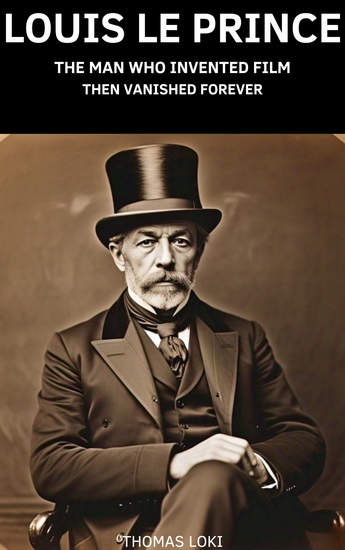
Louis Le Prince - The Man Who Invented Film—Then Vanished Forever - cover

Louis Le Prince - The Man Who Invented Film—Then Vanished Forever

Thomas Loki

Publisher: Heritage Books

  • 0
  • 0
  • 0

Summary

Before Thomas Edison and the Lumière brothers became famous for their contributions to cinema, there was Louis Le Prince—a visionary inventor who captured the world's first motion picture. Yet, just as he was preparing to unveil his groundbreaking creation, he mysteriously vanished without a trace.


His disappearance in 1890 remains one of history's most baffling unsolved cases. Was he the victim of foul play, a tragic accident, or something even more sinister? With no body, no clues, and no answers, Le Prince's fate has fueled speculation for over a century.


This book unravels the story of the forgotten pioneer of film, his revolutionary work, and the mystery that swallowed him whole. Discover the man who should have been remembered as the father of cinema—but instead became its greatest enigma.
Available since: 04/02/2025.
Print length: 69 pages.

Other books that might interest you

  • Charles Babbage and Ada Lovelace: The History of the Partnership Behind the World’s First Computer - cover

    Charles Babbage and Ada...

    Charles River Editors

    • 0
    • 0
    • 0
    While many are familiar with those facts, and a recent movie revived interest in Alan Turing’s achievements with computing during World War II, it was Charles Babbage who was the first to conceive the notion of a programmable and automatic universal computer, which, on top of its ability to calculate any mathematical equation at an unmatched speed, could also be used for a seemingly infinite number of other applications. In other words, he envisioned the precursor to the modern computer.   
    At first blush, Babbage hardly seemed the type, because in many ways, Babbage was the antithesis of the debonair, silver-tongued, and effortlessly charismatic CEOs of present-day tech giants. Babbage was a quirky individual to say the least. He was highly observant, but was in the same breath a habitual daydreamer, often caught in a trance of deep thought.  Indeed, his unquenchable thirst for knowledge and his brilliant mind were unparalleled, but this was paired with his restless, addictive, and extreme nature, as well as his obsession with precision and factual accuracy.  
    	Working with Babbage was certainly an unusual path for any woman, but Ada Lovelace managed to do so before an incredibly premature death. Augusta Ada King, Countess of Lovelace, died in 1852 at the age of 36, but during her short and tumultuous life, she was one of the first to recognize that computers could do far more than complex calculations. This was all the more surprising given that, during her life, no computers existed, and her ideas were based on an implicit understanding of the theoretical work of Charles Babbage, who himself is today recognized as the “Father of the Computer.” What makes her work truly startling is that she did this more than 100 years before the first computer had even been created. But Ada Lovelace was a woman, and in Victorian England, her work was generally either ignored or disparaged.
    Show book
  • The Writing Revolution 20 - A Guide to Advancing Thinking Through Writing in All Subjects and Grades - cover

    The Writing Revolution 20 - A...

    Natalie Wexler, Judith C....

    • 0
    • 0
    • 0
    This new edition of The Writing Revolution adds guidance for teachers seeking a way to bring their students' writing ability up to rigorous state standards. As thousands of educators have already discovered, The Writing Revolution provides the road map they need, clearly explaining how to incorporate the Hochman Method into their instruction. The new edition provides a reorganized sequence of activities and even more student-facing examples, making it easier than ever to bring the method to your classroom. 


    The Writing Revolution isn't a separate curriculum or program teachers need to juggle. Rather, it is a method providing strategies and activities that teachers can adapt to their preexisting curriculum and weave into their content instruction. By focusing on specific techniques and providing them with targeted feedback, The Writing Revolution can turn weak writers into strong and confident communicators. In addition, the method can: 


    ● Identify misconceptions and gaps in knowledge 


    ● Boost reading comprehension and learning 


    ● Improve organizational skills 


    ● Enrich oral language 


    The Writing Revolution takes the mystery out of teaching students to write well.
    Show book
  • Waiting for Mister Rogers - Teaching with Attachment Attunement and Intention - cover

    Waiting for Mister Rogers -...

    Wysteria Edwards

    • 0
    • 0
    • 0
    Every day children enter classrooms crying out for love and relief. Waiting for Mister Rogers reveals a Kindergarten teacher's journey to find answers for the broken children entering her classroom—and the wounds in her own heart—through the personal notes, speeches, and writings of Fred Rogers.  Many moments of adversity, violence, and suffering can be traced back to broken attachments in childhood. These early attachment wounds follow children into adulthood, often damaging their interpersonal relationships.  Where the world offers shallow and complex solutions, the gentle work of Mister Rogers models simple and deep ways to heal insecure attachment. Waiting for Mister Rogers, answers questions of personal development and connection for anyone seeking support, such as:  What do children need to be securely attached?  How can teachers heal their wounds to be fully present, intentional, and effective with their students?  Could student be triggering a teacher's childhood trauma?  Can teachers go deeper while doing less?  It's time to remember childhood, return to the Neighborhood and teach with attachment, attunement, and intention. Mister Rogers was right all along!
    Show book
  • Divine Wisdom in the Temples of Egypt - Decoding Ancient Esoteric Mysteries - cover

    Divine Wisdom in the Temples of...

    EZRA IVANOV

    • 0
    • 0
    • 0
    Since the temple embodies all of divine life on a macrocosmic scale, it reflects the sublime qualities of divine regions in the physical world. The soaring columns of the temple’s hypostyle Hall, which leads celebrants into the environment of the Neteru, embody the sacred marshes of time. 
    Auxiliary chambers and the Hall of Records in the temple reflect the majestic halls of the Duat. The divine genealogy of royal persons and thus humanity was recorded here. Additionally, the sacred mound on which the ancients rested at the dawn of time is in the temple’s sanctuary. In this sanctuary lies the naos where the Neter rests.
    Show book
  • Origin of the Nephilim in Mesopotamia - How the Anunnaki Giants the Watchers and Apkallu Became a Global Phenomenon - cover

    Origin of the Nephilim in...

    Faruq Zamani

    • 0
    • 0
    • 0
    The Anunnaki in the Epic of Gilgamesh compared to the Nephilim Flood Narrative? 
    Scholars have long debated whether the Anunnaki in the Epic of Gilgamesh is the same beings as the Nephilim of Genesis 6. there is a direct connection between these two groups of entities which sheds light on this critical question. One of the biggest problems with interpreting certain parts of ancient texts, such as the Book of Genesis, and other writings, can be traced back to an almost fanatical obsession. Many have treated all such writings as purely historical documents rather than trying to understand them within their proper cultural context. We run into all kinds of challenges because we deal with stories initially intended to be read or listened to for entertainment or some religious significance rather than for their scientific or historical accuracy. This does not mean that these narratives have no value in terms of what they can teach us about ancient societies but means that scholars need to approach them from different perspectives if they wish to make any progress when it comes time for interpretation. 
    Was Noah’s flood an actual event? 
    “The Epic of Gilgamesh,” written in ancient Akkadian and Babylonian, is an epic poem discovered on 12 clay tablets. It tells the story of Gilgamesh, a demigod king who seeks to find immortality after being grieved by the death of his companion Enkidu. The hero travels across the world and meets Utnapishtim, the survivor of a great flood sent by the gods to destroy humankind. After hearing about Utnapishtim’s story and lessons, Gilgamesh returns home to his city empty-handed.
    Show book
  • Frederick Douglass Revolt & Rebellion - cover

    Frederick Douglass Revolt &...

    Frederick Douglass

    • 0
    • 0
    • 0
    Frederick Douglass was an American social reformer, abolitionist, orator, writer, and statesman. After escaping from slavery in Maryland, he became a national leader of the abolitionist movement in Massachusetts and New York, becoming famous for his oratory and incisive antislavery writings. Accordingly, he was described by abolitionists in his time as a living counterexample to slaveholders' arguments that slaves lacked the intellectual capacity to function as independent American citizens. Northerners at the time found it hard to believe that such a great orator had once been a slave. It was in response to this disbelief that Douglass wrote his first autobiography. 
     
    Following the Civil War, Douglass was an active campaigner for the rights of freed slaves . Douglass also actively supported women's suffrage, and he held several public offices. Without his permission, Douglass became the first African American nominated for vice president of the United States, as the running mate of Victoria Woodhull on the Equal Rights Party ticket. 
     
    Douglass believed in dialogue and in making alliances across racial and ideological divides, as well as in the liberal values of the U.S. Constitution. When radical abolitionists, under the motto "No Union with Slaveholders", criticized Douglass's willingness to engage in dialogue with slave owners, he replied: "I would unite with anybody to do right and with nobody to do wrong.
    Show book