Begleiten Sie uns auf eine literarische Weltreise!
Buch zum Bücherregal hinzufügen
Grey
Einen neuen Kommentar schreiben Default profile 50px
Grey
Jetzt das ganze Buch im Abo oder die ersten Seiten gratis lesen!
All characters reduced
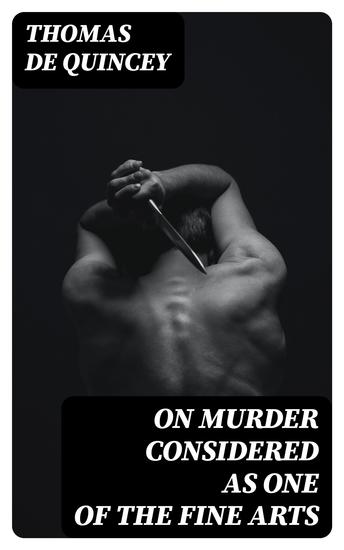
On Murder Considered as one of the Fine Arts - Enriched edition - cover

On Murder Considered as one of the Fine Arts - Enriched edition

Thomas De Quincey

Verlag: DigiCat

  • 0
  • 0
  • 0

Beschreibung

In "On Murder Considered as one of the Fine Arts," Thomas de Quincey ventures into a provocative exploration of aesthetics and morality against the backdrop of early 19th-century Britain. This remarkable essay employs a distinctive blend of dark humor and philosophical inquiry, challenging the reader to contemplate murder not just as an act of violence but as an artistic phenomenon worthy of scrutiny and appreciation. De Quincey's lyrical prose and intricate rhetorical style enhance the literary merit of the text, positioning it within the canon of Gothic literature and early criminal psychology, as he dissects the motivations of both murderer and audience in a meticulously structured narrative that balances grotesque fascination with moral complexity. De Quincey, a notable figure of the Romantic movement, drew upon his own tumultuous experiences and opium use, navigating the realms of addiction and intellectual exploration. His introspective writings often reflect upon darker aspects of human nature, which profoundly informed his unique perspective on violence and beauty. This work encapsulates not only his intellectual milieu but also the broader cultural currents of a society grappling with the implications of violence captured in popular media and societal narratives. "On Murder Considered as one of the Fine Arts" is essential reading for anyone seeking to understand the intersection of art and ethics, as well as the philosophical underpinnings of violence in literature. De Quincey's nuanced argumentation invites readers to appreciate the aesthetic dimensions of even the darkest human actions, making this text a compelling and unsettling exploration of art's moral territory.

In this enriched edition, we have carefully created added value for your reading experience:
- A succinct Introduction situates the work's timeless appeal and themes.
- The Synopsis outlines the central plot, highlighting key developments without spoiling critical twists.
- A detailed Historical Context immerses you in the era's events and influences that shaped the writing.
- An Author Biography reveals milestones in the author's life, illuminating the personal insights behind the text.
- A thorough Analysis dissects symbols, motifs, and character arcs to unearth underlying meanings.
- Reflection questions prompt you to engage personally with the work's messages, connecting them to modern life.
- Hand‐picked Memorable Quotes shine a spotlight on moments of literary brilliance.
- Interactive footnotes clarify unusual references, historical allusions, and archaic phrases for an effortless, more informed read.
Verfügbar seit: 29.05.2022.
Drucklänge: 29 Seiten.

Weitere Bücher, die Sie mögen werden

  • Healthy Living - Balancing Mind Body and Soul in Everyday life (2 Titles) - cover

    Healthy Living - Balancing Mind...

    Anna Bridges

    • 0
    • 0
    • 0
    This title contains these books: 
    Mind-Body Connection: The mind-body connection is a profound and dynamic relationship that has captured the attention of scientists, healthcare professionals, and individuals seeking a deeper understanding of their health. This connection underscores how our thoughts, emotions, and mental states influence our physical well-being. From the nervous energy before an important event to the physical toll of chronic stress, it is clear that the mind and body communicate in ways that shape our overall health. This book aims to explore that intricate connection, shedding light on the role emotions play in shaping not just our mental state but also our physical health. 
    Self-Care for Well-Being: In today's fast-paced world, it’s easy to become overwhelmed by the demands of daily life. The constant pressures of work, family, relationships, and personal expectations can quickly take a toll on our well-being. In the midst of this, self-care often falls to the bottom of our priority lists, overshadowed by the urgent needs of others or the never-ending tasks on our to-do lists. Yet, self-care is not a luxury; it is a necessity for maintaining physical, emotional, and spiritual health. Self-care is the conscious practice of taking care of oneself—physically, mentally, and emotionally—by engaging in activities that promote well-being. It is about recognizing the need for balance and nurturing our whole self. When we engage in self-care, we are actively choosing to invest in our health and happiness, which in turn enhances our ability to care for others and handle life’s challenges. It’s a practice that requires time, effort, and commitment, but its benefits are immeasurable.
    Zum Buch
  • Growing Up! - Systemic and Neurological Independence - cover

    Growing Up! - Systemic and...

    LCSW Brandon Heugly

    • 0
    • 0
    • 0
    Growing Up! is a practical audiobook for neurodiverse young adults, older teens, and the parents and clinicians who support them. With warmth and clarity, it offers step-by-step ways to strengthen self-regulation, decision-making, and independence skills that last while building inner confidence. 
    Through relatable stories, simple neuroscience, and short journaling practices, listeners learn how to pause before reacting, recover more quickly from overwhelm, and build confidence in their own choices. The focus is on practical autonomy: skills that can be tested in real life and adapted for ADHD, autism, and other neurodiverse experiences. 
    Chapters explore systemic and neurological independence, the brain’s natural design for growth, and proven methods for rewiring habits. Each section includes mini-challenges that help listeners experience immediate results—less spiraling, more clarity, and greater ease with everyday tasks. 
    Whether you are a young adult navigating life on your own, a parent supporting your child’s growth, or a clinician looking for accessible resources, Growing Up! provides a clear, encouraging guide. It is both a self-help audiobook and a young adult guide to independence—showing that growing up is not about doing more, but about finding your true inner compass and trusting it.
    Zum Buch
  • Hope and Healing - Black Colleges and the Future of American Democracy - cover

    Hope and Healing - Black...

    Jr. John Silvanus Wilson

    • 0
    • 0
    • 0
    In Hope and Healing, former Morehouse College president John Silvanus Wilson, Jr. looks to Historically Black Colleges and Universities (HBCUs) to examine what it takes not only to survive as a relevant institution of higher education, but to thrive. Wilson draws on pivotal moments in the timelines of HBCUs and the work of past visionaries to yield important perspectives on the future of higher education and the role of HBCUs within it. 


    Wilson documents the strengths of HBCUs, which endure even as factors such as school desegregation, enrollment shifts, and fundraising shortages have deeply affected their operation. These schools have long optimized institutional character, and he encourages their leaders to similarly optimize institutional capital. Wilson emphasizes the indispensable role of educational finance in keeping schools viable and vital to education, discussing funding approaches. Wilson's asset-based framework reveals pathways for all higher education institutions to invest in their long-term futures. 


    Suffused with optimism, the book credits HBCUs as exemplars that consistently demonstrate how all colleges and universities can marshal their institutional resources to shape better citizens, foster civic literacy, and work toward a better tomorrow.
    Zum Buch
  • Dividing Lines - How Transportation Infrastructure Reinforces Racial Inequality - cover

    Dividing Lines - How...

    Deborah N. Archer

    • 0
    • 0
    • 0
    Our nation's transportation system is crumbling. But as acclaimed scholar and ACLU president Deborah Archer warns in Dividing Lines, before we can think about rebuilding and repairing, we must consider the role race has played in transportation infrastructure, from the early twentieth century and into the present day. 


    As Archer demonstrates, the success of the Civil Rights movement and the fall of Jim Crow in the 1960s did not mean the end of segregation. With state-sanctioned racism no longer legal, officials across the country turned to transportation infrastructure to keep Americans divided. A wealthy white neighborhood could no longer be "protected" by racial covenants and segregated shops, but a multilane road, with no pedestrian crossings, could be built along its border to make it difficult for people from a lower-income community to visit. Highways could not be routed through Black neighborhoods based on the race of their residents, but those neighborhoods' lower property values—a legacy of racial exclusion—could justify their destruction. 


    Drawing on a wealth of sources, including interviews with people who now live in the shadow of highways and other major infrastructure projects, Archer presents a sweeping, national account—from Atlanta and Houston to Indianapolis and New York City—of our persistent divisions.
    Zum Buch
  • 5 Types of People Who Can Ruin Your Life - Identifying and Dealing with Narcissists Sociopaths and Other High-Conflict Personalities - cover

    5 Types of People Who Can Ruin...

    LCSW Esq. Bill Eddy

    • 0
    • 0
    • 0
    Some difficult people aren’t just hard to deal with—they’re dangerous. 
      
    Do you know someone whose moods swing wildly? Do they act unreasonably suspicious or antagonistic? Do they blame others for their own problems? 
      
    When a high-conflict person has one of five common personality disorders—borderline, narcissistic, paranoid, antisocial, or histrionic—they can lash out in risky extremes of emotion and aggression. And once an HCP decides to target you, they’re hard to shake. 
      
    But there are ways to protect yourself. Using empathy-driven conflict management techniques, Bill Eddy, a lawyer and therapist with extensive mediation experience, will teach you to: 
      
    • Spot warning signs of the five high-conflict personalities in others and in yourself.  
    • Manage relationships with HCPs at work and in your private life.  
    • Safely avoid or end dangerous and stressful interactions with HCPs. 
      
    Filled with expert advice and real-life anecdotes, 5 Types of People Who Can Ruin Your Life is an essential guide to helping you escape negative relationships, build healthy connections, and safeguard your reputation and personal life in the process. And if you have a high-conflict personality, this book will help you help yourself. 
      
    “[This] brilliant book on high-conflict personalities saves us from trusting the wrong people and making the worst relationship mistakes at work, at home, and in our lives. You need this information today!”—Randi Kreger, bestselling author of Stop Walking on Eggshells and The Essential Family Guide to Borderline Personality Disorder
    Zum Buch
  • Future Tense - Why Anxiety Is Good for You (Even Though It Feels Bad) - cover

    Future Tense - Why Anxiety Is...

    Tracy Dennis-Tiwary

    • 0
    • 0
    • 0
    A psychologist confronts our pervasive misunderstanding of anxiety and presents a powerful new framework for reimagining and reclaiming the confounding emotion as the advantage it evolved to be. 
    We taught people that anxiety is dangerous and damaging, and that the solution to its pain is to eradicate it like we do any disease—prevent it, avoid it, and stamp it out at all costs. Yet cutting-edge therapies, hundreds of self-help books, and a panoply of medications have failed to keep debilitating anxiety at bay. A third of us will struggle with anxiety disorders in our lifetime and rates in children and adults continue to skyrocket. 
    That’s because the anxiety-as-disease story is false—and it’s harming us. 
    In this radical reinterpretation, Dr. Tracy Dennis-Tiwary argues that anxiety is an evolved advantage that protects us and strengthens our creative and productive powers. Although it’s related to stress and fear, it’s uniquely valuable—allowing us to imagine the uncertain future and compelling us to make that future better. That’s why anxiety is inextricably linked to hope. 
    By distilling the latest research in psychology and neuroscience, including her own, combining it with real-world stories and personal narrative, Dennis-Tiwary shows how we can acknowledge the discomfort of anxiety and see it as a tool, rather than something to be feared and reviled. Detailing the terrible cost of our misunderstanding of anxiety, while celebrating the lives of people who harness it to their advantage, she argues that we can—and must—learn to be anxious in the right way. 
    Future Tense blazes the way for a paradigm shift in how we relate to and understand anxiety in our day-to-day lives—a fresh set of beliefs and insights that allow us to explore and leverage even very distressing anxiety rather than to be overwhelmed by it. Through this new prism of thinking, even anxiety disorders can be alleviated. Achieving a new mindset will not fix anxiety itself—because the emotion of anxiety is not broken; the way we cope with it is. By challenging our long-held assumptions about anxiety, this book provides a concrete framework for how to reclaim it for what it has always been—a gift rather than a curse, and a source of inner strength, joy, and ingenuity. 
    Zum Buch