Join us on a literary world trip!
Add this book to bookshelf
Grey
Write a new comment Default profile 50px
Grey
Subscribe to read the full book or read the first pages for free!
All characters reduced
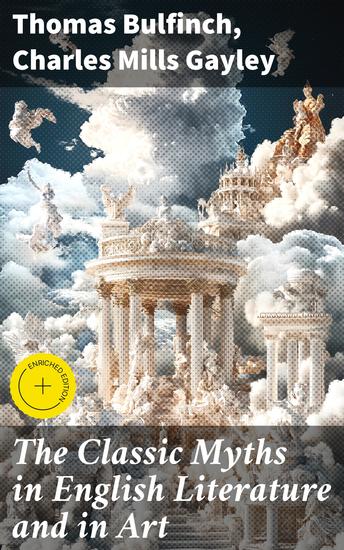
The Classic Myths in English Literature and in Art - Based Originally on Bulfinch's "Age of Fable" - cover

The Classic Myths in English Literature and in Art - Based Originally on Bulfinch's "Age of Fable"

Thomas Bulfinch, Charles Mills Gayley

Publisher: Good Press

  • 0
  • 0
  • 0

Summary

The anthology 'The Classic Myths in English Literature and in Art' presents a vivid tapestry of myths that have significantly shaped Western literature and art. Assembled with remarkable diversity in narrative style, this collection delves into the timeless themes of heroism, morality, and the divine. With carefully curated myths from ancient sources, each piece serves as a testament to the enduring influence these stories have on modern narratives and cultural expressions. While maintaining a deep respect for the original tales, the collection brings forward-dimensional retellings that stand out in their approach to blending the mythological canon with artful interpretation. Esteemed contributors Thomas Bulfinch and Charles Mills Gayley, both prolific figures in the preservation and propagation of classical literature, enrich this collection with their expertise. Bulfinch, renowned for his storytelling prowess, and Gayley, with his scholarly insight into the mythological impact on the arts, illuminate the anthology's overarching themes. Their combined efforts bring to light the parallels between classical mythology and various literary and artistic movements, offering a comprehensive exploration of cultural exchanges over centuries. By amalgamating such a range of narratives and interpretations, this anthology frames a profound dialogue on the convergence of myth and art. For readers seeking a journey through the mythological landscapes that have colored literature and art for generations, 'The Classic Myths in English Literature and in Art' is an essential compendium. It provides a unique opportunity to traverse a multitude of perspectives, enriched by scholarly interpretations and diverse storytelling methods. This anthology invites readers to deepen their understanding of the universality of myth in shaping cultural and artistic dialogues, offering both educational insights and an inspiring literary experience. Embark on a journey that transcends time, discovering what makes these ancient myths resonate so deeply in contemporary contexts.
Available since: 10/20/2023.
Print length: 677 pages.

Other books that might interest you

  • New World Order 2024 March - cover

    New World Order 2024 March

    Eduard Wagner

    • 0
    • 0
    • 0
    No AI, No AI translated by Eduard WagnerEvents happen every day that can be seen from a different perspective. Here I try to document such views. Whether they can agree or not is up to their point of view. It may be that you can't exactly agree with that, but there are perhaps problems that would be easier to solve than just using armed force. Our planet would benefit from a different perspective on so many events. That's why I decided to see some events in society, politics and the climate from a different perspective.
    Show book
  • The Irrelevance of Space and Other Stories - cover

    The Irrelevance of Space and...

    Swapna Gupta, Ashish Gupta

    • 0
    • 0
    • 0
    The Irrelevance of Space, The Katowice Eviction, Remembrance, Fal-e-Hafez, Guantanamo, and The Cyberdeath Files - stories of surprises, memories, and loss that range in settings from Scandinavia to Canada, Eastern Europe, Iran, Cuba and the USA. A thread of coincidences runs through the stories, some true, other fanciful.
    Show book
  • Gabriel-Ernest - From their pens to your ears genius in every story - cover

    Gabriel-Ernest - From their pens...

    Saki Saki

    • 0
    • 0
    • 0
    Hector Hugh Munro, more familiarly known by his pen-name ‘Saki’ was born in what was then Akyab in British Burma on 18th December 1870. His father was an Inspector General for the Indian Imperial Police, and his mother the daughter of a Rear Admiral. 
    When he was 2 his mother died and he and his siblings were sent back to England to be raised by their grandmother and paternal maiden aunts in a strict, puritanical household near Barnstaple, Devon. Educated by governesses Saki used many of these women as character models for his later writing. 
    At 17 his father retried and returned to England and then embarked on a series of European travels with Saki and his siblings. 
    After a short stint working in Burma with the Indian Imperial Police Saki decided to move to London to make a living as a writer. Initially he wrote as a journalist for a number of newspapers and magazines before attempting an historical study, ‘The Rise of the Russian Empire’, whose real value lay in directing him to writing short stories instead, the first of which, ‘Dogged’, he published in 1899. 
    From here it was a short stab of the pen to writing political satire before in 1902 he became the foreign correspondent for The Morning Post, first in the Balkans, then Russia, Paris and back to London in 1908, where 'the agreeable life of a man of letters with a brilliant reputation awaited him.'  
    Collections of his short stories full of witty, mischievous and often macabre stories that satirized Edwardian society and two novels now appeared in the years up to the Great War.  At its’ outbreak he was 43 but managed to join as an ordinary trooper. More than once he returned to the battlefield when officially too sick or injured.  
    On 14th November 1916 Hector Hugh Munro was sheltering in crater during the Battle of the Ancre, when he was shot and killed by a German sniper. According to several sources, his last words were "Put that bloody cigarette out!"
    Show book
  • The Good Captain - A Personal Memoir of America at War - cover

    The Good Captain - A Personal...

    R.D. Hooker

    • 0
    • 0
    • 0
    The veteran soldier, Pentagon advisor and White House staffer recounts his long and distinguished military career in this acclaimed memoir. 
     
    A combat soldier and leader in five wars, R. D. Hooker also served as a White House staff member in four different administrations. He retired in 2010 as the most decorated colonel in the US Army. Beginning with his enlistment at 18 in 1975, this memoir chronicles his experiences in the post-Vietnam Army as a young paratrooper, West Point cadet, and combatant in the many military conflicts which followed.  
     
    Hooker served in Grenada, Somalia. Rwanda, Bosnia, and Kosovo. He played a key role in the response to 9/11 and returned to combat in Iraq and Afghanistan. He commanded a paratroop company, battalion and brigade and served in the continental US, Latin America, Europe, the Middle East, Africa and Southwest Asia. When not deployed, he taught at West Point and served in several high-level Pentagon assignments and in the White House in the administrations of George H. W. Bush, Bill Clinton, George W. Bush and Donald Trump. 
     
    In The Good Captain, Hooker recounts his storied career with insights and lessons learned through five different conflicts. He also describes each of these campaigns from a strategic and policy perspective informed by his White House and Pentagon experiences as well as years of academic training.
    Show book
  • Ten Thousand Hours in Paradise: Volume 3 - Reckoning - cover

    Ten Thousand Hours in Paradise:...

    Andrew M. Crusoe

    • 0
    • 0
    • 0
    The Reckoning started with the lava flow, threatening to trap Andrew in Puna. Then the hurricane hit. 
    From seeing the hidden fractals within the trees, to meditating in silence for 10 days, to falling in love and seeing that love crumble, the Big Island gives Andrew unparalleled opportunities to grow. Buoyed by a new project, Andrew starts off the new year with a fresh energy and is guided to the biweekly talks of a Hawaiian elder. 
    The elder reminds him of truths that he’d forgotten, and he leads the group through the healing techniques of laulima and ho‘oponopono, giving Andrew a new energy to release the last shred of attachment to a person who simply doesn’t want to be with him. 
    Now that he has created more space and clarity, his social circle expands, and Andrew meets someone who becomes one of the strongest catalysts for joy and growth in his life. But she is leaving the island in just six months. 
    Andrew faces a forking path. All the while, lava is heading toward Pahoa, threatening to isolate all of Puna. The elder taught him that love prevails all trauma, but will that be enough? 
    Ten Thousand Hours in Paradise is a 3-volume true story about the consciousness shift that happens when you embrace Hawaii. Volume 3: Reckoning takes flight with earthshaking changes, powerful healing, a new lava flow, and a hurricane, resulting in a reckoning that changes Andrew forever.
    Show book
  • The Fall of Communism - Understanding the Collapse of the Soviet Union and Its Impact - cover

    The Fall of Communism -...

    Arlo Holders

    • 0
    • 0
    • 0
    The origins of communism can be traced back to the mid-19th century, largely shaped by the theories of Karl Marx and Friedrich Engels. Marx's writings, particularly The Communist Manifesto (1848), presented a vision for a classless society where the working class, or proletariat, would overthrow the capitalist bourgeoisie and establish a dictatorship of the proletariat. Marx believed this revolution would lead to the eventual abolition of private property, creating a system where resources and wealth were shared equally among all people. Engels, Marx’s collaborator, helped to spread these ideas, laying the theoretical foundation for communism as a political ideology. 
    In the early 20th century, the ideas of Marxism found fertile ground in Russia, where economic disparity and social unrest were widespread. The Russian Empire, under Tsar Nicholas II, faced increasing pressure from industrialization, a growing working class, and a largely disenfranchised peasantry. The Russian Revolution of 1917, led by the Bolshevik Party under Vladimir Lenin, marked the beginning of communism’s practical implementation. The Bolsheviks sought to establish a socialist state where the working class would control the means of production and dismantle the old Tsarist monarchy. 
    Following the revolution, the Soviet Union was formed in 1922, uniting the Russian Federation and several other Soviet republics under a single communist government. The new government, however, faced significant challenges, including civil war, foreign intervention, and the task of restructuring a country that had been predominantly agrarian into a socialist industrialized state. Lenin’s death in 1924 led to the rise of Joseph Stalin, who consolidated power through brutal purges and policies such as forced collectivization and rapid industrialization.
    Show book