Junte-se a nós em uma viagem ao mundo dos livros!
Adicionar este livro à prateleira
Grey
Deixe um novo comentário Default profile 50px
Grey
Assine para ler o livro completo ou leia as primeiras páginas de graça!
All characters reduced
"About My Father's Business": Work Amidst the Sick the Sad and the Sorrowing - Navigating Work with Compassion and Empathy - cover
LER

"About My Father's Business": Work Amidst the Sick the Sad and the Sorrowing - Navigating Work with Compassion and Empathy

Thomas Archer

Editora: Good Press

  • 0
  • 0
  • 0

Sinopse

In "About My Father's Business: Work Amidst the Sick, the Sad, and the Sorrowing," Thomas Archer presents a poignant exploration of the human condition through the lens of caregiving and compassion. The book combines narrative realism with lyrical prose, weaving personal anecdotes and philosophical reflections that shed light on the struggles and resilience of individuals facing illness and sorrow. Archer'Äôs literary style is characterized by its empathetic tone and vivid imagery, positioning the work within the broader context of social literature'Äîwhere the stark realities of life intersect with the enduring spirit of hope and community service. Thomas Archer, influenced by his background in social work and psychology, approached this book as both a professional and a personal journey. His experience in supporting vulnerable populations lends authenticity to his reflections, as he draws from real-life encounters to illustrate the profound impact of compassion and duty. Archer'Äôs insights resonate with readers seeking to understand the moral obligations we bear toward one another, particularly when confronted with suffering and despair. This compelling work is highly recommended for readers interested in the intersections of literature, social justice, and empathy. Archer'Äôs eloquent prose invites contemplation and renewal of purpose, making it essential reading for anyone inspired to engage in the compassionate service of others.
Disponível desde: 26/10/2023.
Comprimento de impressão: 244 páginas.


Outros livros que poderiam interessá-lo

  • A Rare Recording of Film Icon Burt Lancaster - cover

    A Rare Recording of Film Icon...

    Burt Lancaster

    • 0
    • 0
    • 0
    Burton Stephen Lancaster (November 2, 1913 - October 20, 1994), born in New York City, was an American actor, producer and director. Initially known for playing tough guys with a tender heart, he went on to achieve success with more complex and challenging roles over a 45-year career in films and television. He was a four-time Academy Award Best Actor nominee, winning the Oscar and Golden Globe for the 1960 film, Elmer Gantry, and BAFTA award winner for Birdman of Alcatraz (1963) and Atlantic City (1982). The following recordings are from tv interviews from 1963 and 1973.
    Ver livro
  • How to Be Queer - An Ancient Guide to Sexuality (Ancient Wisdom for Modern Readers) - cover

    How to Be Queer - An Ancient...

    Sarah Nooter

    • 0
    • 0
    • 0
    The idea of sexual fluidity may seem new, but it is at least as old as the ancient Greeks, who wrote about queer experiences with remarkable frankness, wit, and insight. How to Be Queer is an infatuating collection of these writings about desire, love, and lust between men, between women, and between humans and gods, in lucid and lively new translations. 


    How to Be Queer starts with Homer's Iliad and moves through lyric poetry, tragedy, comedy, philosophy, and biography, drawing on a wide range of authors, including Sappho, Plato, Anacreon, Pindar, Theognis, Aristophanes, and Xenophon. It features both beautiful poetry and thought-provoking prose, emotional outpourings and humorous anecdotes. From Homer's story of the relationship between Achilles and Patroclus, one of the most intense between men in world literature, to Sappho's lyrics on the pleasures and pains of loving women, these writings show the many meanings of what the Greeks called eros. 


    Complete with brief introductions to the selections, How to Be Queer reveals what the Greeks knew long ago—that the erotic and queer are a source of life and a cause for celebration.
    Ver livro
  • The History and Legacy of Germany’s Most Controversial Events Between World War I and World War II - cover

    The History and Legacy of...

    Charles River Editors

    • 0
    • 0
    • 0
    The early 1930s were a tumultuous period for German politics, even in comparison to the ongoing transition to the modern era that caused various forms of chaos throughout the rest of the world. In the United States, reliance on the outdated gold standard and an absurdly parsimonious monetary policy helped bring about the Great Depression. Meanwhile, the Empire of Japan began its ultimately fatal adventurism with the invasion of Manchuria, alienating the rest of the world with the atrocities it committed. Around the same time, Gandhi began his drive for the peaceful independence of India through nonviolent protests against the British. 
    	It was in Germany, however, that the strongest seeds of future tragedy were sown. The struggling Weimar Republic had become a breeding ground for extremist politics, including two opposed and powerful authoritarian entities: the right-wing National Socialists and the left-wing KPD Communist Party. As the 1930s dawned, these two totalitarian groups held one another in a temporary stalemate, enabling the fragile ghost of democracy to continue a largely illusory survival for a few more years.  
    	That stalemate was broken in dramatic fashion on a bitterly cold night in late February 1933, and it was the Nazis who emerged decisively as the victors. A single act of arson against the famous Reichstag building proved to be the catalyst that propelled Adolf Hitler to victory in the elections of March 1933, which set the German nation irrevocably on the path towards World War II. That war would plunge much of the planet into an existential battle that ultimately cost an estimated 60 million lives. 
    Ver livro
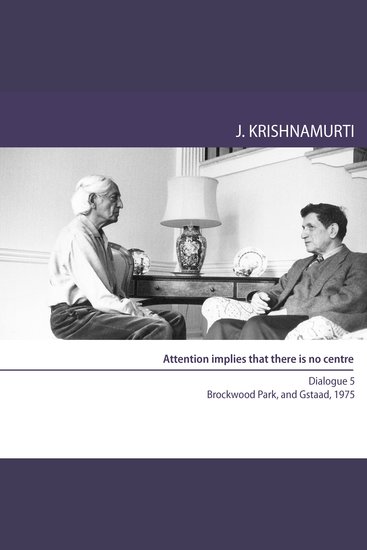
  • Attention Implies That There is No Centre - Brockwood Park and Gstaad 1975 - Dialogue 5 - cover

    Attention Implies That There is...

    Jiddu Krishnamurti

    • 0
    • 0
    • 0
    Attention implies that there is no centre - 22 June 1975 
    • Consciousness, because it is in constant movement, has never found an energy 
    which is not contradictory, which is not produced by desire and thought. 
    • Can thought ever see its own movement and the futility of its own movement? • Attention implies that there is no centre. 
    • Is there a perception, a seeing outside the space which is part of consciousness? • Therearetwohumanbeings,onegetsconditionedandtheotherdoesn’t.Why? 
    How has it happened the other doesn’t get conditioned? 
    • How does this perception which is beyond attention, beyond awareness, 
    beyond concentration come about? 
    • Thought is rather superficial, it’s merely a very small part of the operation of the 
    brain. 
    • Can consciousness be completely empty of its content? • Order and disorder
    Ver livro
  • Misfortune on Cleveland’s Millionaires’ Row - cover

    Misfortune on Cleveland’s...

    Alan F. Dutka

    • 0
    • 0
    • 0
    Extreme wealth could buy a mansion in Millionaires' Row but not immunity from unsavory business dealings or shameful behavior. 


    May Hanna gave her millionaire ex-husband's hired Pinkerton detectives the slip to sneak out of the country. To escape financial embarrassment, James Potter, the manager of a prominent Euclid Avenue apartment building, gave his family cough medicine laced with poison, killing his entire family including himself. Married to a Millionaires' Row doctor, the infamous con woman Cassie Chadwick posed as Andrew Carnegie's illegitimate daughter and forged a fake $5 million check. Author Alan Dutka delves into sixteen tales of anguish and deceit that offer a startling perspective on Cleveland's super-rich.
    Ver livro
  • How we save the world - The Fight to Rewrite Our Future Begins Now - cover

    How we save the world - The...

    Jack Jay

    • 0
    • 0
    • 0
    How We Save The World by Jack Jay is a manifesto for those eager to reshape humanity’s future. Blending philosophy with actionable wisdom, Jay explores pressing global issues like inequality, environmental damage, and AI ethics. 
    Chapter 1: Introduces a new meta-narrative, emphasizing the need for a better global story. 
    Chapter 2: Explores the rapid evolution of technology. 
    Chapter 3: Discusses how information shapes reality through the butterfly effect. 
    Chapter 4: Outlines pragmatic philosophies for creating effective global movements. 
    Chapter 5: Introduces the concept of the “Prodemic” — viral methods anyone can use to upgrade humanity. 
    Chapter 6/7: Focus on hacking dopamine systems to avoid burnout and redefine laziness. 
    Chapter 8: Advocates for simplicity in self-improvement and avoiding over-optimization. 
    Chapter 9: Addresses the AI alignment problem, offering a solution for humanity to collectively manage the risks of AI. 
    Chapter 10: Redefines consumerism and philanthropy through designer goods purchased via tax-deductible donations. 
    Chapter 11: Introduces “storyhacking” to help individuals start global movements. 
    Chapter 12: Emphasizes long-term thinking in a future dominated by AI. 
    Chapter 13: Presents the concept of "spear ritual wisdom" as a catalyst for positive global change. 
    Chapter 14-16: Dive deeper into leading and sustaining such a movement. 
    Chapter 17: Discusses real-world operations for achieving tipping points in society. 
    Chapter 18: Focuses on the strategy behind global leadership and spear rituals. 
    Chapter 19: Recaps the book’s worldview, offering new solutions and missions for a brighter future. 
    The book combines deep reflections with practical approaches for individuals and movements to spark change, encouraging people to take action in reshaping the world.
    Ver livro