Begleiten Sie uns auf eine literarische Weltreise!
Buch zum Bücherregal hinzufügen
Grey
Einen neuen Kommentar schreiben Default profile 50px
Grey
Jetzt das ganze Buch im Abo oder die ersten Seiten gratis lesen!
All characters reduced
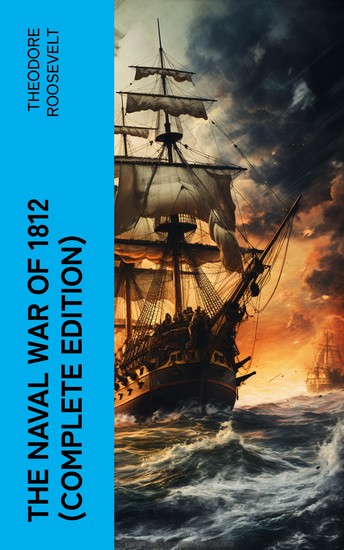
The Naval War of 1812 (Complete Edition) - cover

The Naval War of 1812 (Complete Edition)

Theodore Roosevelt

Verlag: e-artnow

  • 0
  • 0
  • 0

Beschreibung

The Naval War of 1812, written by the former president Theodore Roosevelt, deals with battles and naval technology used during the War of 1812 between the United States and the Great Britain. Roosevelt's history is considered as one of the best on this particular topic and it had a great impact on the formation of the modern day U.S. Navy. At the beginning, the author gives the insight of the political and social conditions in Great Britain and America prior to the war. Roosevelt, then, discusses the naval war on both the Atlantic Ocean and the Great Lakes. Finally, the last chapter covers the Battle of New Orleans, the final major battle of the War of 1812.
Verfügbar seit: 14.12.2023.
Drucklänge: 359 Seiten.

Weitere Bücher, die Sie mögen werden

  • Waco Rising - David Koresh the FBI and the Birth of America's Modern Militias - cover

    Waco Rising - David Koresh the...

    Kevin Cook

    • 0
    • 0
    • 0
    In 1993, David Koresh and a band of heavily armed evangelical Christians took on the might of the US government. A two-month siege of their compound in Waco, Texas, ended in a firefight that killed seventy-six, including twenty-five children. America is still picking up the pieces, and we still haven't heard the full story. 


    Kevin Cook finally provides the full story of what happened at Waco. He gives listeners a taste of Koresh's deadly charisma and takes us behind the scenes at the Branch Davidians' compound, where "the new Christ" turned his followers into servants and sired seventeen children by a dozen "wives." In vivid accounts packed with human drama, Cook harnesses never-reported material to reconstruct the FBI's fifty-one-day siege of the Waco compound in minute-to-minute detail. He sheds new light on the Clinton administration's approval of a lethal governmental assault in a new, definitive account of the firefight that ended so many lives and triggered the rise of today's militia movement. Waco drew the battle lines for American extremists—in Oklahoma City bomber Timothy McVeigh's words, "Waco started this war." With help from sources as diverse as Branch Davidian survivors and the FBI's lead negotiator during the siege, Cook draws a straight line from Waco's ashes to the January 6, 2021, riot at the US Capitol and insurrections yet to come.
    Zum Buch
  • Africonomics - A History of Western Ignorance - cover

    Africonomics - A History of...

    Bronwen Everill

    • 0
    • 0
    • 0
    A bold, concise history of Western economic interventions in Africa, by the former director of the Centre of African Studies at the University of Cambridge 
     
    For centuries, Westerners have tried to "fix" African economies. From the abolition of slavery onward, missionaries, philanthropists, development economists, and NGOs have arrived on the continent, full of good intentions and bad ideas. Their experiments have invariably gone awry. 
     
    Historian Bronwen Everill argues that these interventions fail, and frequently cause harm, because they start from a misguided premise: that African economies just need to be more like the West. Ignoring Africa's own traditions of economic thought, Americans and Europeans assumed a set of universal economic laws that they thought could be applied anywhere. They enforced specifically Western ideas about growth, wealth, debt, unemployment, inflation, women's work, and more, and used Western metrics to find African countries wanting. 
     
    The West does not know better than African nations how an economy should be run. By laying bare the myths and realities of our tangled economic history, Africonomics moves from Western ignorance to African knowledge.
    Zum Buch
  • Troubling the Water - The Urgent Work of Radical Belonging - cover

    Troubling the Water - The Urgent...

    Ben McBride

    • 0
    • 0
    • 0
    From one of the most courageous and visionary leaders of our time comes Troubling the Water, an immersive book about the violence and injustice that threaten to drown us all. Ben McBride recounts how he first waded into the water: from the Kill Zone in Oakland, where he moved with his young family, to the uprising in Ferguson, to the moral impoverishment of the white evangelical church. In the truth-telling tradition of Bryan Stevenson and Bishop William Barber, McBride leads us right into the fury and fragmentation of our moment, and then steadies us once we're there. 


    What would it take to truly belong to each other? Radical belonging, McBride argues, means looking at our implicit biases, at our faulty understandings of power, and at how we "other"—or "same"—people. Sometimes it even means troubling the waters—speaking hard truths in situations that appear calm but that cloak injustice. 


    With a blend of provocation and good humor, McBride leads us beyond inaction on the one hand and polemic on the other. What results is an indelible manifesto—a troublemaking reverend's call to the most urgent task of our time. As inequality, racism, and alienation weaken our common life, well-meaning people ask: What do I need to do to create a world where all can belong? But McBride asserts that instead, we need to ask: Who do I need to become?
    Zum Buch
  • Dark Psychology - Reading People Detecting Lies Mind Control and Persuasion Tips - cover

    Dark Psychology - Reading People...

    Wesley Felt

    • 0
    • 0
    • 0
    This book consists of three titles, which are the following: 
    Dark Psychology: Reading People, Detecting Lies, Mind Control, and Persuasion Tips 
    Dark Psychology: Mind Control, Manipulation, Fear, Emotions, and Persuasion 
    Dark Psychology: The Dark Side of Human Nature, Mind Games, and Psychopathology 
    Take advantage of this discounted bundle sale now!
    Zum Buch
  • Abraham Lincoln - His Life Death Morals Civil War and Assassination - cover

    Abraham Lincoln - His Life Death...

    Kelly Mass

    • 0
    • 0
    • 0
    From 1861 till his assassination in 1865, Abraham Lincoln was an American legal representative and statesman who functioned as the 16th president of the United States. Lincoln led the nation through the American Civil War, preserving the Union, eliminating slavery, enhancing the federal government, and helping the economy of the United States. 
    Lincoln grew up on the frontier, mainly in Indiana, and was born into poverty in a log cabin. He was self-taught and went on to end up being a legal representative, Whig Party leader, Illinois state lawmaker, and member of the U.S.A. Congress for Illinois. 
    In 1849, he resumed his law business, but was bothered by the Kansas-- Nebraska Act, which permitted farther terrain to be opened to slavery. In 1854, he went back to politics as a leader of the freshly formed Republican politician Party, and in 1858, he disputed Stephen Douglas in front of a nationwide audience. 
    Let’s learn more about this distinct, important, prominent figure in the United States’ history.
    Zum Buch
  • Battle of Kapetron The: The History and Legacy of the First Major Battle Between the Byzantine Empire and Seljuk Turks - cover

    Battle of Kapetron The: The...

    Editors Charles River

    • 0
    • 0
    • 0
    The Byzantine Empire existed for over a thousand years, with a history spanning from the division of the Roman Empire in 395 until the Ottoman conquest of Constantinople in 1453. It was formed from the previous Eastern Roman Empire, and during its long existence, the Byzantine inhabitants were very proud to call themselves Romans.  
    	However, many things changed during the long lifespan of the Byzantine Empire, starting with a Hellenization in the 6th century. The use of the Latin language diminished and Greek took its place, while the typical Roman culture gave way to a more Hellenistic one. The Hellenization of Byzantium was detrimental to the relationship with the Holy Roman Empire, and the Christian world from that point would be split in two. The subsequent strengthening of the Orthodox Church caused many civil wars and conflicts to arise during the centuries, which shattered and reshaped the territory time after time. By the end of the Byzantine Empire’s existence, the old age had weakened both the state and church, making it an easy target for invading forces.  
    	The most notable invaders were the Turkish-speaking Seljuks, led through a series of battles by Kutalmishouglu Suleiman, who supported different usurpers against the Byzantine emperor. The expansion of the Seljuks was so successful that when Suleiman died, he had put all of Bithynia under his control as well as several important harbor towns along the shores on the Asian side of Bosphorus. With that accomplishment, he had managed to separate the Byzantines living in Anatolia from their emperor in Constantinople. This immediately weakened the unity of the Byzantine Empire.  
    	Of all the conflicts that brought this state of affairs into being, few were as instrumental as the Battle of Kapetron, the culmination of one of the first major Seljuk raids into Byzantine territory.
    Zum Buch