¡Acompáñanos a viajar por el mundo de los libros!
Añadir este libro a la estantería
Grey
Escribe un nuevo comentario Default profile 50px
Grey
Suscríbete para leer el libro completo o lee las primeras páginas gratis.
All characters reduced
The Complete Works of Theodore Roosevelt - Exploring the Legacy of a Progressive Visionary - cover

The Complete Works of Theodore Roosevelt - Exploring the Legacy of a Progressive Visionary

Theodore Roosevelt, Henry Cabot Lodge

Editorial: Good Press

  • 0
  • 0
  • 0

Sinopsis

The Complete Works of Theodore Roosevelt is a compelling anthology that encapsulates the diverse literary contributions of one of America's most vibrant historical figures. The collection spans Roosevelt's broad array of writings, from his gripping narratives on history and politics to his passionate expositions on conservation and adventure. The range of literary styles, from incisive political discourses to evocative personal reflections and robust policy advocacies, showcases Roosevelt's dynamic versatility. As a blend of personal musings and public speeches, the anthology provides a comprehensive portrayal of Roosevelt'Äôs multifaceted intellect and his profound impact on socioeconomic and environmental paradigms. Theodore Roosevelt's writings are complemented by insightful editorial contributions from Henry Cabot Lodge, a staunch confidant and fellow political trailblazer. Together, their works echo the resonant dialogues of early 20th-century American politics and reformist ideologies. The anthology offers a window into the intersection of American history and literature, giving voice to the Progressive Era's challenges and triumphs. Lodge's contributions not only contextualize Roosevelt's legacy but also enrich the narrative tapestry, reinforcing the anthology's alignment with the era's cultural renaissance and political reformations. This anthology is an invaluable resource for those eager to immerse themselves in the literary breadth of a historical icon. The Complete Works of Theodore Roosevelt invites readers to witness a wide spectrum of themes and insights, weaving a dialogue between diverse voices that enlightens and educates. It is highly recommended for students of history, literary aficionados, and anyone seeking to understand the complexities of early American political thought through the eyes of one of its most eloquent advocates. By engaging with this collection, readers gain access to an intricate mosaic of ideologies that continue to resonate profoundly in contemporary discourse.
Disponible desde: 17/01/2024.
Longitud de impresión: 4120 páginas.

Otros libros que te pueden interesar

  • Morphine - This story is perhaps the greatest depiction and description in literature of the human psyche going through addiction - cover

    Morphine - This story is perhaps...

    Mikhail Bulgakov

    • 0
    • 0
    • 0
    Mikhail Bulgakov was born on 15th May 1891 in Kiev, in the Kiev Governorate of the Russian Empire, into a Russian family.  He was one of seven children. 
     
    In 1901, Bulgakov attended the First Kiev Gymnasium, and developed a keen interest in Russian and European literature, theatre and opera.  After the death of his father in 1907, his mother assumed responsibility for his education.  After graduating Bulgakov entered the Medical Faculty of Kiev University and then took up a post as physician at the Kiev Military Hospital. 
     
    At the outbreak of the First World War, he volunteered as a doctor and was sent directly to the front, where he was badly injured at least twice.  To suppress chronic pain, especially in the abdomen, he injected morphine.  It took years to wean himself off. 
     
    He now took up medical posts in various towns and in 1919, he was mobilised by the Ukrainian People's Army and assigned to the Northern Caucasus.  There, he became seriously ill with typhus and barely survived.  
     
    After this illness, Bulgakov abandoned his medicine to pursue writing.  He moved to Vladikavkaz and had two plays staged there with great success.  He wrote too for various newspapers and other outlets, but his critics were many.  And growing. 
     
    When a Moscow's theatre director severely criticised Bulgakov, Stalin personally protected him, saying that a writer of Bulgakov's quality was above ‘party words’ like ‘left’ and ‘right’.   Indeed, it is said that Stalin watched ‘The Days of the Turbins’ at least 15 times. 
     
    It was not to last and by March 1929, Bulgakov's career was ruined when Government censorship stopped publication of any of his work and plays. 
     
    In despair, Bulgakov wrote a personal letter to Stalin.  He requested permission to emigrate.  He received a phone call from the Soviet leader, who asked the writer whether he really desired to leave. He replied that a Russian writer cannot live outside of his homeland.  Stalin thus gave him permission to continue working. In May 1930, he re-joined the theater, as stage director's assistant.  
     
    During the last stressful decade of his life, and in poor health, Bulgakov continued to work on ‘The Master and Margarita’, wrote plays, critical works, stories, and continued translations and dramatisations of novels.  Many of them were not published, others were derided by critics.  
     
    On 10th March 1940, Mikhail Afanasyevich Bulgakov died from nephrosclerosis.  He was 48. 
     
    ‘The Master and Margarita’ was not published in any form until the mid-1960’s 
     
    In this story Bulgakov relates the terrifying and hellish descent into addiction that seems so avoidable and yet so chillingly not.
    Ver libro
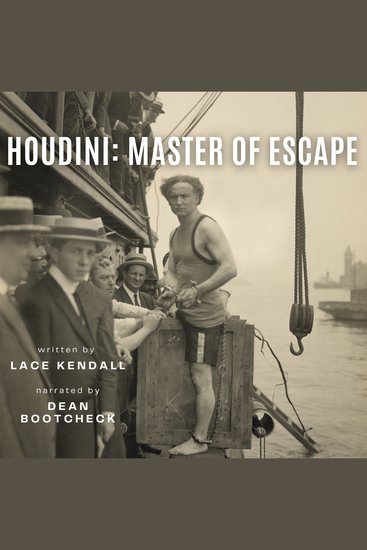
  • Houdini: Master of Escape - cover

    Houdini: Master of Escape

    Lace Kendall

    • 0
    • 0
    • 0
    Harry Houdini, born Eric Weiss on March 24, 1874, was a legendary magician and escape artist who gained international fame for his daring and death-defying stunts, such as escaping from handcuffs, chains, and locked containers, often submerged underwater. His incredible physical strength, skill at manipulating locks, and next-level charitable acts made him a household name. 
    In addition to his escape acts, Houdini was a passionate debunker of fraudulent spiritualists and mediums. He believed that their tricks were performed using natural means—not ghostly manifestations or the ability to speak with the spirits. Houdini's crusade against fake spiritualists was so intense that he even conducted experiments to communicate with his wife after death, which ultimately failed. He continued to perform and innovate until his death on October 31, 1926, in Detroit, Michigan, leaving behind a legacy as one of the greatest magicians and escape artists of all time. 
    Never has a biography been so successful at making you feel like you are really there, reliving every moment with Harry and his wife, Bess. Whether you are a student needing information for a term paper, or simply someone who enjoys a riveting tale of gritty determination, Houdini: Master of Escape will provide you with what you need.
    Ver libro
  • On Our Way Home from the Revolution - Reflections on Ukraine - cover

    On Our Way Home from the...

    Sonya Bilocerkowycz

    • 0
    • 0
    • 0
    In 2014 Sonya Bilocerkowycz is a tourist at a deadly revolution. At first she is enamored with the Ukrainians' idealism, which reminds her of her own patriotic family. But when the romantic revolution melts into a war with Russia, she becomes disillusioned, prompting a return home to the US and the diaspora community that raised her. As the daughter of a man who studies Ukrainian dissidents for a living, the granddaughter of war refugees, and the great-granddaughter of a gulag victim, Bilocerkowycz has inherited a legacy of political oppression. But what does it mean when she discovers a missing page from her family's survival story—one that raises questions about her own guilt? 


    In these linked essays, Bilocerkowycz invites listeners to meet a swirling cast of post-Soviet characters, including a Russian intelligence officer who finds Osama bin Laden a few weeks after 9/11; a Ukrainian poet whose nose gets broken by Russian separatists; and a long-lost relative who drives a bus into the heart of Chernobyl. On Our Way Home from the Revolution muddles our easy distinctions between innocence and culpability, agency and fate.
    Ver libro
  • Beyond the Mountains - An Immigrant's Inspiring Journey of Healing and Learning to Dance with the Universe - cover

    Beyond the Mountains - An...

    Deja Vu Prem

    • 0
    • 0
    • 0
    The powerful story of how an immigrant from the Philippines overcame childhood trauma and an emotionally abusive marriage to find her voice and thrive 


    As a child in a small barrio in the Philippines, Deja Vu Prem faced neglect and physical abuse. At age seventeen, desperate to escape her situation and claim a better life for herself beyond the mountains of her town, she became a mail-order bride and moved to San Francisco. But the challenges of her childhood didn't go away—they merely evolved into the form of her emotionally abusive husband. 


    Cut off from her family and any kind of emotional or financial support, Prem was a prisoner in her own home, unable even to use the phone or check the mail. But she wasn't helpless. Relying on her deep faith and the fire within that had always pushed her to achieve, Prem made the brave decision to escape her situation to provide a better life for herself and her two young children. 


    Recounting Prem's harrowing yet hopeful journey, Beyond the Mountains is a stirring and moving portrait of one immigrant's refusal to be defined as a victim and a testament on finding the strength to forgive in order to reclaim the power that lives within us all.
    Ver libro
  • The Shape Of Further Things - cover

    The Shape Of Further Things

    Brian W. Aldiss

    • 0
    • 0
    • 0
    The sci-fi author behind Steven Spielberg's A. I. shares his thoughts on the present, the future, and his own work and life. 


    "We are infinitely rich, yet we mess about with penny-in-the-slot machines," writes Brian W. Aldiss in this autobiographical work written over the course of one month. From his Oxfordshire home, he ruminates on dreams, education, the role of technology in our lives, the rise and function of science fiction, and a variety of other topics. The Shape of Further Things is a window into the life and mind of a Science Fiction Grand Master. 


    Winner of two Hugo Awards, one Nebula Award, and named a Grand Master by the Science Fiction Writers of America, Brian W. Aldiss challenged readers' minds for over fifty years with literate, thought-provoking, and inventive science fiction. 


    "This short book flows with large ideas, a time capsule now from the grandest of writers." —SF Site
    Ver libro
  • Gaius Marcus - The Controversial General Who Led the Roman Armies to Victory - cover

    Gaius Marcus - The Controversial...

    Kelly Mass

    • 0
    • 0
    • 0
    Gaius Marius was one of the most influential military commanders and statesmen of the late Roman Republic. Born into a well-off, provincial Italian family in Arpinum, Marius rose from relatively humble beginnings to become a key figure in Rome’s transformation from a republic to an empire. Known for his military prowess and political savvy, Marius served as consul an unprecedented seven times, a record that set him apart from other Roman leaders. 
    His career began in earnest during the Siege of Numantia in 134 BC, where he gained valuable military experience under the command of Scipio Aemilianus. Marius was not born into the traditional aristocracy of Rome but quickly ascended through the ranks of Roman politics. In 119 BC, he was elected as tribune of the plebs, where he passed significant legislation that aimed to curb the influence of the aristocracy in Roman elections. His political career continued to build momentum as he was elected praetor in 115 BC and later became the governor of Further Spain, where he fought against bandit forces. Marius’s personal life also intertwined with the leading families of Rome—he married Julia, the aunt of the future dictator Julius Caesar, cementing ties with one of Rome’s most powerful clans. 
    Marius’s most famous military achievements came in the course of the Jugurthine War in Numidia, which he brought to a successful conclusion in 107 BC. That same year, he was appointed to command Roman forces in the war against the Germanic tribes, the Cimbri and Teutones, who threatened Rome’s existence. He was elected consul for the second time in 104 BC, a post he would hold consecutively for five years. His victories at the battles of Aqua Sextiae in 102 BC and Vercellae in 101 BC cemented his reputation as one of Rome’s greatest military leaders, and he was hailed as the “third founder of Rome,” a title that reflected his role in securing the republic’s future.
    Ver libro