Join us on a literary world trip!
Add this book to bookshelf
Grey
Write a new comment Default profile 50px
Grey
Subscribe to read the full book or read the first pages for free!
All characters reduced
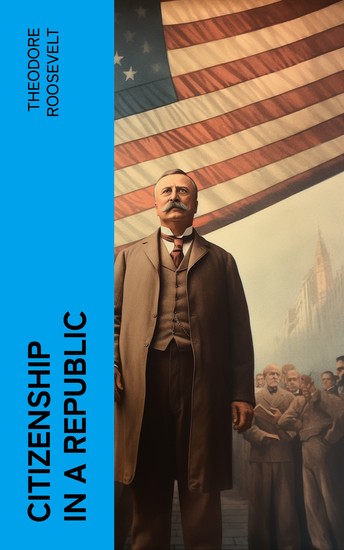
Citizenship in a Republic - cover

Citizenship in a Republic

Theodore Roosevelt

Publisher: e-artnow

  • 0
  • 0
  • 0

Summary

Citizenship in a Republic is the title of a speech given by Theodore Roosevelt, former President of the United States, at the Sorbonne in Paris, France, on April 23, 1910. One notable passage from the speech is referred to as "The Man in the Arena": It is not the critic who counts; not the man who points out how the strong man stumbles, or where the doer of deeds could have done them better.
Available since: 12/06/2023.
Print length: 22 pages.

Other books that might interest you

  • Michael Faraday - Theories about Electromagnetism and Electrochemistry - cover

    Michael Faraday - Theories about...

    Kelly Mass

    • 0
    • 0
    • 0
    Michael Faraday was born in Newington Butts, Surrey, on September twenty-second, 1791. (which is now part of the London District of Southwark). He grew up in a bad home. His dad, James, was a Christian who came from the Glasite sect. At the time of the winter season of 1790, James Faraday moved his marriage partner and 2 kids from Outhgill, Westmorland, where he had been an apprentice to the town blacksmith. In the fall of that year, Michael was born. Michael Faraday, the 3rd of 4 kids, needed to inform himself after getting just a primary school education. 
    He started working as an apprentice to George Riebau, a regional bookbinder and bookseller on Blandford Street, when he was fourteen years of age. 
    Faraday read a lot of literature throughout his seven-year apprenticeship, and that includes Isaac Watts' “The Improvement of the Mind”, which he actively adopted the concepts and recommendations in. He also ended up being intrigued by physics, specifically electrical power. Jane Marcet's book Discussions on Chemistry was specifically motivating to Faraday. 
    Let’s see what else he did. In this comprehensive guide, you will find out more.
    Show book
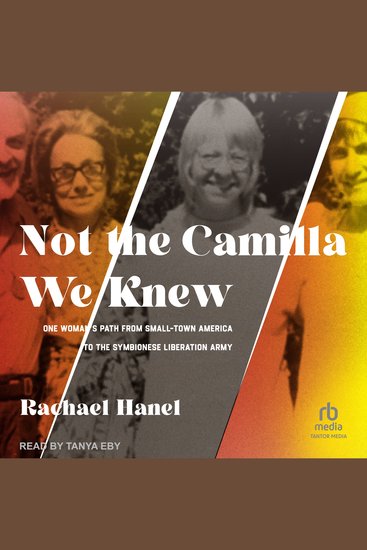
  • Not the Camilla We Knew - One Woman's Path from Small-town America to the Symbionese Liberation Army - cover

    Not the Camilla We Knew - One...

    Rachael Hanel

    • 0
    • 0
    • 0
    Behind every act of domestic terrorism there is someone's child whose life took a radical turn for reasons that often remain mysterious. Camilla Hall is a case in point: a pastor's daughter from small-town Minnesota who eventually joined the ranks of radicals in the notorious Symbionese Liberation Army before dying in a shootout with Los Angeles Police in May 1974. How could a "good girl" become one of the most wanted domestic terrorists in the United States? Rachael Hanel tells her story here, revealing both the deep humanity and the extraordinary circumstances of Camilla Hall's life. 


    Her path from her Minnesota home to her final, radical SLA family featured years as an artist and activist—in welfare offices, political campaigns, union organizing, culminating in a love affair that would be her introduction to the SLA. Through research and interviews, Hanel pieces together Camilla's transformation. 


    Camilla Hall's story is of interest for what it reveals about the forces of radicalization. But as Hanel ventures ever further into Camilla's past, her book becomes an intriguing, disturbing, and ultimately deeply moving journey into the dark side of America's promise. 


    Contains mature themes.
    Show book
  • Next Level Plot Structure - How to Write a Better Novel Using Advanced Storytelling Techniques - cover

    Next Level Plot Structure - How...

    K.M. Weiland

    • 0
    • 0
    • 0
    Elevate Your Storytelling with Expert Plot Structure 
    Unlock the secrets of compelling storytelling with Next Level Plot Structure, a brand-new guide from K.M. Weiland, author of the popular Structuring Your Novel. This comprehensive resource delves deep into the intricacies of plot structure, revealing the rich vein of narrative techniques and philosophical underpinnings that have shaped storytelling throughout history.Delve beyond plot beats to explore deeper symmetry and symbolism in story.Discover how every plot beat and scene is composed of two mirroring halves, contributing to the narrative arc.Introduce readers to chiastic structure, a mesmerizing mirroring technique that unites the two halves of a story.Master the dual beats of each major plot point to create dramatic scene arcs.Explore innovative ways to structure scenes to keep readers engaged and eager to turn the page.Examine the symbolic significance of a story's four "worlds" and their influence on plot and character arcs.Evade formulaic story structures by understanding the deeper meaning and purpose of each plot element. 
    Whether you're a seasoned writer or just starting out, Next Level Plot Structure provides invaluable insights and practical techniques to help you take your storytelling to new heights.
    Show book
  • Suekee The Sugar Monster - cover

    Suekee The Sugar Monster

    Carmen Clark

    • 0
    • 0
    • 0
    Join Suekee and her friends on a journey to discover how to keep a Sugar Monster's rampage at bay.Suekee's adventure aims to teach children the importance of eating a balanced meal, with fun and healthy ways to enjoy sweets and manage their sugar cravings.Written by a nutritionist to help empower children to make better dietary choices.
    Show book
  • A Short History of Tomb-Raiding - The Epic Hunt for Egypt’s Treasures - cover

    A Short History of Tomb-Raiding...

    Maria Golia

    • 0
    • 0
    • 0
    A spine-tingling exploration of a venture as ancient as the pyramids themselves. 


    To secure a comfortable afterlife, ancient Egyptians built fortress-like tombs and filled them with precious goods, a practice that generated staggering quantities of artifacts over the course of many millennia—and also one that has drawn thieves and tomb-raiders to Egypt since antiquity. Drawing on modern scholarship, reportage, and period sources, this book tracks the history of treasure-seekers in Egypt and the social contexts in which they operated, revealing striking continuities throughout time. Listeners will recognize the foibles of today's politicians and con artists, the perils of materialism, and the cycles of public compliance and dissent in the face of injustice. In describing an age-old pursuit and its timeless motivations, A Short History of Tomb-Raiding shows how much we have in common with our Bronze Age ancestors.
    Show book
  • A Measure Short of War - A Brief History of Great Power Subversion - cover

    A Measure Short of War - A Brief...

    William C. Wohlforth, Jill Kastner

    • 0
    • 0
    • 0
    In 2016, the United States was stunned by evidence of Russian meddling in the US presidential elections. But it shouldn't have been. Subversion—domestic interference to undermine or manipulate a rival—is as old as statecraft itself. The basic idea would have been familiar to Sun Tzu, Thucydides, Elizabeth I, or Bismarck. 


    It came as a surprise in 2016 because the sole superpower had fallen asleep at the wheel. But what's really new? Have we entered a new age of vulnerability? To answer these questions, and to protect ourselves against future subversion, we need a clear-eyed understanding of what it is and how it works. 


    In A Measure Short of War, Jill Kastner and William C. Wohlforth provide just that, taking the listener on a compelling ride through the history of subversion, exploring two thousand years of mischief and manipulation to illustrate subversion's allure, its operational possibilities, and the means for fighting back against it. With vivid examples from the ancient world, the great-power rivalries of the nineteenth century, epic Cold War struggles, and more, A Measure Short of War shows how prior technological revolutions opened up new avenues for subversion, and how some democracies have been fatally weakened by foreign subverters while others have artfully defended themselves—and their democratic principles.
    Show book