¡Acompáñanos a viajar por el mundo de los libros!
Añadir este libro a la estantería
Grey
Escribe un nuevo comentario Default profile 50px
Grey
Suscríbete para leer el libro completo o lee las primeras páginas gratis.
All characters reduced
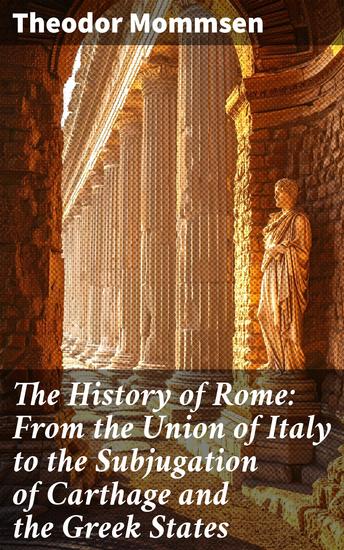
The History of Rome: From the Union of Italy to the Subjugation of Carthage and the Greek States - Unveiling Rome's Ascendance: Conquests Politics and Power - cover

The History of Rome: From the Union of Italy to the Subjugation of Carthage and the Greek States - Unveiling Rome's Ascendance: Conquests Politics and Power

Theodor Mommsen

Traductor William P. Dickson

Editorial: Good Press

  • 0
  • 0
  • 0

Sinopsis

In "The History of Rome: From the Union of Italy to the Subjugation of Carthage and the Greek States," Theodor Mommsen presents a meticulously crafted narrative that chronicles the transformative events of the Roman Republic from the late 4th century BC to the Roman conquest of Carthage and the Greek territories. Mommsen's literary style is characterized by its vivid prose and analytical rigor, blending historical detail with engaging storytelling. The work is situated within the broader literary context of 19th-century historiography, where Mommsen's unique perspective illuminates the socio-political dynamics of ancient Rome, presenting a richly textured view of its rise and imperial ambitions. Theodor Mommsen, a German classical scholar and politician, was awarded the Nobel Prize in Literature in 1902 for this very work, which reflects his deep engagement with Roman history and its lasting implications on Western civilization. His extensive studies in philology and archaeology informed his comprehensive approach to history, linking the political and military events of Rome with the cultural evolution of its society. Additionally, his commitment to civic duty and belief in progress may have influenced his interpretation of Rome as a model of governance and civilization. Readers seeking to deepen their understanding of Roman history will find Mommsen's work indispensable. With its scholarly depth and eloquent presentation, this book not only serves as a foundational text for aspiring historians but also appeals to general readers fascinated by the complexities of ancient Rome. Drawing from timeless historical insights, Mommsen's narrative invites reflection on the nature of power and its consequences, making it a compelling read for anyone interested in the legacies that shape our modern world.
Disponible desde: 12/08/2023.
Longitud de impresión: 527 páginas.
Otros libros que te pueden interesar

  • Rebuilding Democracy - Strategies for Countering Political Extremism - cover

    Rebuilding Democracy -...

    Thomas T. Taylor

    • 0
    • 0
    • 0
    Unravel the Extremes: A Journey Towards a More Balanced Democracy 
     
    In an era where political discourse is increasingly polarized, Thomas T. Taylor provides a beacon of hope. This book is a must-read for anyone concerned about rising extreme elements in American politics and yearning for a more balanced, inclusive democracy. 
     
    Taylor, known as "Mr. Friendly" in his hometown, has been a stalwart in local politics since his early twenties. He brings a unique perspective with a rich academic background in social psychology and political science. This book culminates his years of experience, theoretical knowledge, and personal insights. 
     
    "Rebuilding Democracy: Strategies for Countering Political Extremism" is more than just a book; it's a call to action. It offers hundreds of actionable items readers can implement to make a difference. It encourages readers to adopt multiple viewpoints, challenge their biases, and engage with ideologies that may diverge from their own. The book is a practical guide to understanding and combating political extremism, fostering a more balanced and equitable political discourse. 
     
    Don't just stand by as a spectator. Join Taylor on this journey towards a more balanced democracy. Learn how to critique even your in-groups, resist the traps of "both side-isms," and navigate the complexities of our political landscape. Together, we can save and rebuild our democracy. Take the first step today.
    Ver libro
  • Master the Art of Influence: Speak and Captivate Instantly - "Elevate your speaking skills with dynamic audio lessons crafted to boost your influence and captivation!" - cover

    Master the Art of Influence:...

    Clinton Marwood

    • 0
    • 0
    • 0
    Master the Art of Influence: Speak and Captivate Instantly   
    ⭐⭐ Simplified Guide & Explanations Included ⭐⭐   
    Are you striving to advance in your career and enhance your expertise in powerful communication skills? 
    Are you in search of an all-encompassing guide that equips you with all the essentials to transform conversations and relationships through effective communication? 
    Your quest ends here! 
    This guide is your ultimate resource for deepening your understanding, honing your skills, and engaging in practical exercises. With this, you're set up for success. 
    Updated for the latest in powerful communication strategies. 
    Key features of this enhanced guide include: 
    - In-depth insights into the art of influence and impactful communication.   
    - Comprehensive explanation of transforming conversations and relationships.   
    - Proven strategies for preparation and effective communication techniques.   
    Our guide stands out with its thorough coverage, which is vital for achieving your communication goals. Concepts are explored in detail rather than merely glossed over.   
    Structured for clarity and ease of understanding, our guide on mastering communication ensures smooth transitions between topics. Say goodbye to complex terminology and embrace clear, concise, and technically accurate content.   
    So, why wait? Click the BUY NOW button, secure your guide, and embark on your journey to mastering the art of influence and captivating communication!
    Ver libro
  • The Digital Paradigm Shift - A Groundbreaking Machine's Impact on Civilization - cover

    The Digital Paradigm Shift - A...

    John Harpoon

    • 0
    • 0
    • 0
    The journey into the digital age began with the spark of human ingenuity and the desire to simplify complex tasks. Early civilizations laid the groundwork for computation by devising systems to manage trade, record history, and calculate astronomical events. These early tools, such as the abacus and mechanical calculators, may seem rudimentary by modern standards, yet they were the building blocks of a monumental transformation. 
    In the late 19th and early 20th centuries, the seeds of the digital age began to take root. Pioneers like Charles Babbage and Ada Lovelace envisioned the potential of programmable machines long before the technology to build them existed. Lovelace's notes on Babbage's Analytical Engine contained the first algorithm intended for implementation on a machine, earning her recognition as the world’s first computer programmer. Their ideas laid a conceptual foundation that would inspire future innovators. 
    The advent of World War II catalyzed the development of modern computing. The need for advanced cryptography, ballistics calculations, and logistical coordination drove governments and researchers to invest in computational technologies. Alan Turing, often referred to as the father of computer science, developed the Turing Machine, a theoretical construct that became a cornerstone of computer science. His work at Bletchley Park, cracking the German Enigma code, not only shortened the war but also showcased the immense potential of automated computation.
    Ver libro
  • The Shining Gateway - Illuminating the Path to Self-Mastery and Peace - cover

    The Shining Gateway -...

    James Allen, Tim Zengerink

    • 0
    • 0
    • 0
    What if you could illuminate a personal gateway that leads to inner strength, virtuous living, and enduring peace? 
    James Allen’s uplifting text explores the quest for self-mastery by emphasizing positive thought, ethical conduct, and spiritual harmony. Adapted for modern readers, The Shining Gateway underscores that each of us carries the capacity for profound transformation—a radiant journey that begins with how we choose to think, feel, and act. 
    What You’ll Discover in This Modern Translation: 
    - Key virtues that propel you toward higher living 
    - Techniques for sustaining a positive, resilient mindset 
    - The link between inner discipline and outer harmony 
    - Encouragement to see challenges as catalysts for self-growth 
    Imagine walking a bright, purposeful path every day—one in which your highest ideals guide each choice, cultivating a sense of deep fulfillment and tranquility. James Allen’s timeless guidance helps you unlock the shining gateway within. 
    Enter the radiant path. Get your copy now and kindle the inner light that leads to self-mastery and peace.
    Ver libro
  • Exit West by Mohsin Hamid (Book Analysis) - Detailed Summary Analysis and Reading Guide - cover

    Exit West by Mohsin Hamid (Book...

    Bright Summaries

    • 0
    • 0
    • 0
    Unlock the more straightforward side of Exit West with this concise and insightful summary and analysis!
    This engaging summary presents an analysis of Exit West by Mohsin Hamid, which imagines a world where doors can instantly transport people across the globe. The novel focuses on Saeed and Nadia, who are fleeing civil war in their native country and use the doors to travel to new countries, where the inhabitants' responses range from violent nativist riots to official clampdowns to acceptance and integration. Mohsin Hamid is a Pakistani writer and brand consultant. He is known in particular for his novels The Reluctant Fundamentalist, which was shortlisted for the 2007 Man Booker Prize, and Exit West, which was shortlisted for the 2017 Man Booker Prize and was named one of the New York Times' 10 Best Books of 2017.
    Find out everything you need to know about Exit West in a fraction of the time!
    This in-depth and informative reading guide brings you:
    •A complete plot summary
    •Character studies
    •Key themes and symbols
    •Questions for further reflection
    Why choose BrightSummaries.com?
    Available in print and digital format, our publications are designed to accompany you on your reading journey. The clear and concise style makes for easy understanding, providing the perfect opportunity to improve your literary knowledge in no time.
    See the very best of literature in a whole new light with BrightSummaries.com!
    Ver libro
  • Chavín Civilization - The Religious Center That Unified the Andes - cover

    Chavín Civilization - The...

    Rolf Hedger

    • 0
    • 0
    • 0
    The Chavín civilization, one of the earliest and most influential cultures of ancient Peru, emerged in the Andean highlands around 900 BCE. It was a formative force in pre-Columbian history, laying the groundwork for later civilizations that dominated the region. The rise of Chavín was deeply connected to its strategic location, the innovations of its people, and the unique blend of religious and cultural influences that shaped its identity. 
    The Andean region, with its diverse geography of mountains, valleys, and coastal plains, played a crucial role in the development of early societies. The people who would come to form the Chavín civilization first settled in highland areas, where they mastered agricultural techniques suited to the challenging environment. The cultivation of staple crops such as maize, potatoes, and quinoa allowed for population growth and the establishment of permanent settlements. Llamas and alpacas provided transportation, wool, and meat, further supporting the stability of these early communities. Over time, these settlements evolved into more complex societies, characterized by social hierarchies and specialized labor. 
    One of the key factors that contributed to the emergence of the Chavín civilization was its strategic position at the crossroads of major trade routes. Chavín de Huántar, the civilization’s most important ceremonial center, was located in a valley that connected the coast, highlands, and jungle regions. This prime location allowed Chavín culture to serve as a unifying force in the Andes, facilitating the exchange of goods, ideas, and religious beliefs among different groups. As traders and pilgrims traveled to Chavín de Huántar, they encountered a sophisticated society with an advanced knowledge of art, architecture, and religion, all of which helped spread Chavín influence throughout the region.
    Ver libro