¡Acompáñanos a viajar por el mundo de los libros!
Añadir este libro a la estantería
Grey
Escribe un nuevo comentario Default profile 50px
Grey
Suscríbete para leer el libro completo o lee las primeras páginas gratis.
All characters reduced
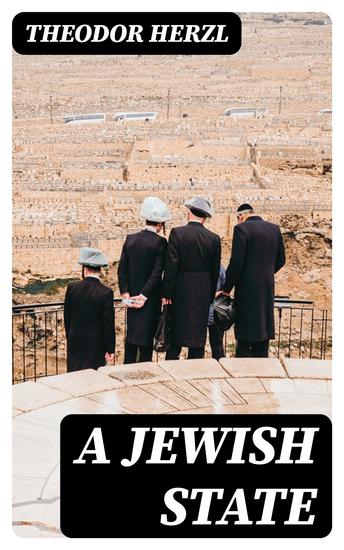
A Jewish State - cover

A Jewish State

Theodor Herzl

Traductor Jacob De Haas, Sylvie d'Avigdor

Editorial: DigiCat

  • 0
  • 0
  • 0

Sinopsis

In "A Jewish State," Theodor Herzl presents a compelling and visionary blueprint for the establishment of a Jewish homeland, articulated in a fervent literary style that melds passionate advocacy with pragmatic solutions. Written in 1896 and contextualized within the rising tides of nationalism and anti-Semitism in Europe, Herzl's work argues for the political and social ramifications of establishing a sovereign Jewish state as a refuge for the Jewish people. It offers a blend of polemic, manifesto, and sociology, challenging contemporary audiences to confront the issues of Jewish identity and national self-determination. Theodor Herzl, often referred to as the father of modern political Zionism, was a Hungarian journalist and playwright whose personal experiences with anti-Semitism galvanized his commitment to Jewish statehood. His encounters with the pervasive discrimination against Jews in Europe, particularly during the Dreyfus Affair in France, profoundly influenced his thought and activism, leading him to convene the First Zionist Congress in 1897. Herzl's profound intellectual engagement with themes of national identity and social justice is palpably evident throughout his writings. This indispensable work is recommended for readers interested in Jewish history, political movements, or the evolution of nationalist thought. Herzl's prescient ideas continue to resonate today, making "A Jewish State" not only a foundational text of Zionism but also a critical work for understanding contemporary discussions about identity and belonging.
Disponible desde: 10/08/2022.
Longitud de impresión: 64 páginas.

Otros libros que te pueden interesar

  • The Principal Speeches of Demosthenes - A Selection - cover

    The Principal Speeches of...

    Demóstenes

    • 0
    • 0
    • 0
    Demosthenes (384-322 BCE) is regarded as one of the greatest orators of Classical times. This view has persisted through the centuries even though his rousing speeches warning of the dangers of Macedonian expansion - firstly guided by Philip II and then Alexander the Great - failed to stem the course of continued military success. 
     
    A contemporary of Plato and Aristotle, it is said that Demosthenes undertook arduous measures to cure himself of a stammer by speaking with pebbles in his mouth and perfecting breath control. Starting as a speech writer, he made his mark at an unusually young age (for the time), delivering his first major public speech at the age of 30, advising Athens to build its naval fleet as a defence against the Persians. In fact, it was the ambition of Philip of Macedon that would prove the principal threat. This was recognised by Demosthenes, as shown by the main speeches included in this collection. 
     
    In the 'Three Olynthiac Orations', Demosthenes outlined the tactics of Philip’s aggression towards Olynthus, an ally of Athens. He urged support for the smaller state, but his words went unheeded until it was too late. Demosthenes’s increasingly unrestrained language - at one point he calls Philip ‘a barbarian’ - did not endear him to the Macedonian regime. 
     
    The 'Olynthiac Orations' are followed by the 'Three Philippics', which chart further military activity by the aforementioned Philip. In between the second and third 'Philippics' comes ‘On the Peace’: a speech given during a short diplomatic space engineered by Philip, but which Demosthenes clearly highlighted as an armistice rather than anything permanent. This ‘Philip’ section ends with ‘The Oration on the Letter'. Philip sent a letter to Athens, which implied that war, again, was imminent. Demosthenes responded with characteristic boldness. 
     
    The final speech on this recording is ‘On the Crown’, addressing a very different matter. The Athenian statesman Ctesiphon proposed that Demosthenes should be honoured with the ‘golden crown’ for his service to the city. This was opposed by Aeschines, a long-standing enemy of Demosthenes in Athenian politics. In the court case that followed (330 BCE), Demosthenes successfully defended Ctesiphon in a speech later described as ‘the greatest speech of the greatest orator in the world'. 
     
    Each of the orations in this collection is preceded with an introduction setting the scene, and outlining the context in which they were delivered. This also gives a concise picture of Athens at this difficult point in its history. Eight years later, when in danger of being captured and imprisoned by the young Alexander who was angered by decades of eloquent and unrestrained opposition, Demosthenes committed suicide. All the speeches are prefaced by the historical setting. Translations by Arthur Wallace Pickard and Charles Rann Kennedy.
    Ver libro
  • How Ronald Reagan Changed My Life - cover

    How Ronald Reagan Changed My Life

    Anónimo

    • 0
    • 0
    • 0
    On February 6, 2001, my nine-year-old daughter happened to wander into the room during a television segment marking Ronald Reagan's ninetieth birthday. She watched for a moment. Then she turned to me and asked, ""Dad, is that the President you worked for?"" 
    What answer could I give her? How could I make her see? I wanted my daughter to recognize that the world she inhabited was freer and more prosperous because of that old, old man on television. But I also wanted her to grasp my personal debt to him, to understand all that he taught me-how to work and how to relax, how to think and how to use words, how to be a good husband, how to approach life itself... 
    I needed to tell my children how Ronald Reagan changed my life. 
    In 1982, as a young man, Peter Robinson was hired as a speechwriter in the Reagan White House. During the six years that followed, he was one of a core group of writers who became informal experts on Reagan, absorbing not just his political positions but his personality, manner, and way of carrying himself And the example Reagan set-as a confident, passionate, principled, generous-spirited older man-molded Robinson's outlook just as he was coming into his own. ""Hard work. A good marriage. A certain lightness of touch,"" he writes. ""The longer I studied Ronald Reagan, the more lessons I learned."" 
    At the core of How Ronald Reagan Changed My Life are ten of the life lessons Robinson learned from the fortieth President-principles that have guided his own life ever since. But it also offers a warm and unforgettable portrait of a great yet ordinary man who touched the individuals around him as surely as he did his millions of admirers around the world. 
    Drawing on journal entries from his days at the White House, as well as interviews with those who knew the President best, Robinson etches his portrait with fresh observations, telling detail, and that ""certain lightness of touch"" that recalls the master himself The result is nothing less than a love story-an account of the profound respect and affection that one young man came to feel for the President who changed his life forever.
    Ver libro
  • Utopia - cover

    Utopia

    Thomas Moore

    • 0
    • 0
    • 0
    Utopia (Libellus vere aureus, nec minus salutaris quam festivus, de optimo rei publicae statu deque nova insula Utopia, "A little, true book, both beneficial and enjoyable, about how things should be in the new island Utopia") is a work of fiction and socio-political satire by Thomas More (1478–1535), written in Latin and published in 1516. The book is a frame narrative primarily depicting a fictional island society and its religious, social, and political customs. Many aspects of More's description of Utopia are reminiscent of life in monasteries.
    Famous works of the author Thomas More: Published during More's life A Merry Jest, Utopia, Latin Poems, Letter to Brixius, Responsio ad Lutherum, A Dialogue Concerning Heresies, Supplication of Souls, Letter Against Frith, The Confutation of Tyndale's Answer, Apology, Debellation of Salem and Bizance, The Answer to a Poisoned Book.
    Ver libro
  • Cross Purposes - Christianity's Broken Bargain with Democracy - cover

    Cross Purposes - Christianity's...

    Jonathan Rauch

    • 0
    • 0
    • 0
    What happens to American democracy if Christianity is no longer able, or no longer willing, to perform the functions on which our constitutional order depends? In this provocative book, the award-winning journalist Jonathan Rauch—a lifelong atheist—reckons candidly with both the shortcomings of secularism and the corrosion of Christianity. Thin Christianity, as Rauch calls the mainline church, has been unable to inspire and retain believers. Worse, a Church of Fear has distorted white evangelicalism in ways that violate the tenets of both Jesus and James Madison. What to do? For answers, Rauch looks to a new generation of religious thinkers, as well as to the Church of Jesus Christ of Latter-day Saints, which has placed the Constitution at the heart of its spiritual teachings. 


    In this timely critique Rauch addresses secular Americans who think Christianity can be abandoned, and Christian Americans who blame secular culture for their grievances. The two must work together to confront our present crisis. He calls on Christians to recommit to the teachings of their faith that align with Madison, not MAGA, and to understand that liberal democracy, far from being oppressive, is uniquely protective of religious freedom. At the same time, he calls on secular liberals to understand that healthy religious institutions are crucial to the survival of the liberal state.
    Ver libro
  • Landslide - The inside story of the 2024 election - cover

    Landslide - The inside story of...

    Tim Ross, Rachel Wearmouth

    • 0
    • 0
    • 0
    On 22 May 2024, Rishi Sunak stood outside 10 Downing Street and announced an early election, in an attempt to catch his opponents by surprise. Just minutes later, Tory hearts sank, with images of the Prime Minister soaking in the rain instantly defining his hapless campaign. The next six weeks delivered more mistakes, a betting scandal, apocalyptic Tory polls, bitter backroom arguments and finally the worst result in the Conservative Party's 190-year history.
    Keir Starmer's Labour, meanwhile, stormed to victory with one of the biggest landslides on record after fourteen years in the wilderness. But the party won with its fewest votes in almost a decade, raising questions about how popular Starmer really was. Scotland's voters abandoned the SNP, Ed Davey's Lib Dems surged to their best election ever and Nigel Farage once again blew up the Conservative Party's plans.
    This gripping account by seasoned Westminster journalists Tim Ross and Rachel Wearmouth tells the full inside story of the key tactics and powerful forces that delivered the most seismic upheaval in a generation. What role did Starmer's character play in his party's success? How did Labour's election machine engineer such a devastatingly efficient vote? Was there anything Sunak could have done to avert disaster? What does it all mean for the future of Britain?
    Blending exclusive interviews and explosive accounts from key players, Landslide sets out to answer these questions and more, revealing a dramatic and sometimes disturbing picture of British politics at a turbulent time.
    Ver libro
  • 100 Facts About Being an Informed Voter - English to Spanish - cover

    100 Facts About Being an...

    Science-Based Language Learning Lab

    • 0
    • 0
    • 0
    Introduction to the 100 Somethings Language Learning Series 
     
    Welcome to a revolutionary approach to language learning! This series helps you master Spanish by intertwining it with compelling topics like Being an Informed Voter. Each book centers on a theme (art, science, history) and presents 100 carefully chosen facts in both English and Spanish. 
     
    How It Works: 
     
    - Each fact is first introduced in Spanish, encouraging you to interpret it. 
     
    - The following page provides the fact in English and then repeats it in Spanish, aiding comprehension and memorization. 
     
    - The second half flips this order—English first, then Spanish, and English again—helping you practice translation in both directions for better mastery. 
     
    Benefits: 
     
    - Concise Learning: Focuses on one-sentence facts to ensure every word learned is impactful and directly related to your interests, making them easier to remember. 
     
    - Reinforcement: Alternating languages for each fact naturally strengthens vocabulary and grammar. 
     
    - Engagement: Learning vocabulary through topics you're passionate about keeps the process dynamic and relevant. 
     
    - Dual Knowledge: You enrich your understanding of a specific subject while learning a new language. 
     
    This series is tailored for learners who thrive on clear, targeted information, making it both educational and enjoyable. Whether you’re a beginner or expanding your linguistic skills, this series promises an effective and engaging educational journey. Embrace these 100 facts and let your passions drive your progress in mastering a new language!
    Ver libro