Junte-se a nós em uma viagem ao mundo dos livros!
Adicionar este livro à prateleira
Grey
Deixe um novo comentário Default profile 50px
Grey
Assine para ler o livro completo ou leia as primeiras páginas de graça!
All characters reduced
Letters As Archive - cover
LER

Letters As Archive

Theo Rourke

Tradutor A AI

Editora: Publifye

  • 0
  • 0
  • 0

Sinopse

Letters As Archive explores the untapped potential of personal correspondence as invaluable historical documents. Challenging traditional historical methodologies, the book champions letters as archives that capture individual experiences and reflect broader social and cultural norms. Did you know personal letters can offer insights into migration patterns or reveal attitudes during times of war, providing firsthand accounts often missing from official records? By examining these primary sources, the book advocates for a more inclusive understanding of the past, amplifying voices often excluded from mainstream historical narratives.

 
The book unfolds systematically, first establishing a theoretical framework for analyzing letters as historical archives. Subsequent chapters delve into specific themes and case studies, such as the role of letters in shaping family history or documenting social upheaval. This approach offers practical guidance on archival methods and textual analysis, emphasizing ethical considerations.

 
Ultimately, Letters As Archive encourages a decentralized approach to historical inquiry, urging scholars to consider personal correspondence as a vital source of historical knowledge.
Disponível desde: 05/05/2025.
Comprimento de impressão: 57 páginas.
Outros livros que poderiam interessá-lo

  • Athenian Agora and Roman Forum The: The Beating Hearts of the Ancient World’s Most Famous Cities - cover

    Athenian Agora and Roman Forum...

    Editors Charles River

    • 0
    • 0
    • 0
    The center of political and commercial interaction in the Ancient Greek polis was the agora. The word essentially means a gathering place or an open space, and in all Greek city states, the agora was central to all aspects of daily life and commerce. As the agora developed as a civic space, particularly from the 6th century BCE onward in Athens, the architectural splendor of the buildings associated with it became an ever more obvious demonstration of the power and glory of Athenian democracy. In its earliest forms, an agora in maritime cities was invariably situated near the sea, while in inland urban centers, it was usually located at the foot of the hill that normally provided the city’s ultimate defense. The agora was always the oldest part of any city and, as such, and as well as being the commercial hub of the area, also became the center of the religious and political life of the polis. In Homer’s time, an agora might have seats for the comfort of the citizens that had assembled to consult with one another. The city’s oldest sanctuaries were always located either in or very close to the agora itself, and the first festive games were held in its open space.  
    The Roman Empire is the most famous in history, and the center of the far-reaching empire’s activities was located in the Forum, a low area between the Capitoline and Palatine hills in Rome. The topography held a great deal of significance for Romans, and consequently so many layers of myth were laid on top of the landscape and buildings that it is difficult to separate legend from actual historical fact. As a low-lying area near the Tiber river, the Forum was subject to much flooding, and even into the 20th century, the Forum area could flood upwards of over 40 feet above sea level. This would factor significantly in the imagination of Romans, who later ascribed the flooding with saving the city’s founders, Romulus and Remus, from execution.
    Ver livro
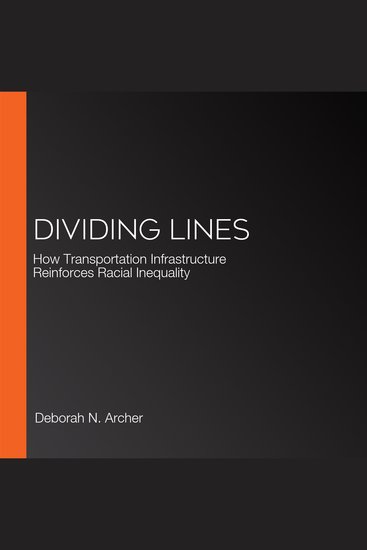
  • Dividing Lines - How Transportation Infrastructure Reinforces Racial Inequality - cover

    Dividing Lines - How...

    Deborah N. Archer

    • 0
    • 0
    • 0
    Our nation's transportation system is crumbling. But as acclaimed scholar and ACLU president Deborah Archer warns in Dividing Lines, before we can think about rebuilding and repairing, we must consider the role race has played in transportation infrastructure, from the early twentieth century and into the present day. 


    As Archer demonstrates, the success of the Civil Rights movement and the fall of Jim Crow in the 1960s did not mean the end of segregation. With state-sanctioned racism no longer legal, officials across the country turned to transportation infrastructure to keep Americans divided. A wealthy white neighborhood could no longer be "protected" by racial covenants and segregated shops, but a multilane road, with no pedestrian crossings, could be built along its border to make it difficult for people from a lower-income community to visit. Highways could not be routed through Black neighborhoods based on the race of their residents, but those neighborhoods' lower property values—a legacy of racial exclusion—could justify their destruction. 


    Drawing on a wealth of sources, including interviews with people who now live in the shadow of highways and other major infrastructure projects, Archer presents a sweeping, national account—from Atlanta and Houston to Indianapolis and New York City—of our persistent divisions.
    Ver livro
  • Follow First Lead Second - Leadership is for Everyone - cover

    Follow First Lead Second -...

    Max King

    • 0
    • 0
    • 0
    There is the widespread belief that management and leadership are inextricably linked, that every manager is (or should be) a good leader. As a result, management leadership has been elevated to a cause worthy of promotion, and leadership as a term has become a mantra chanted by all and sundry, with numerous voices proclaiming numerous theories, many of which are spoken as facts, particularly by those who are disciples of this management-leadership cause. Examples of their output can be found in any management texts, in texts specializing in engineering management, and, as one might expect, in texts devoted exclusively to the leading cause. Numerous literary fallacies and paradoxes will be examined, and an unusual literary source will be used to illustrate various leadership styles.The concept of leadership will be applied to engineer positions, and some potentially divisive conclusions will be presented.Leadership is a critical field because it affects the entire world. In other words, it is a vital management function that enables organizations to achieve maximum efficiency and effectiveness. Numerous individuals inquire why we should pursue this field of study or why this assignment is necessary. Not only is leadership a position, but it is also a process that shapes how people and organizations interact. All nations, business enterprises, educational institutions, and organizations succeed primarily due to effective leadership.
    Ver livro
  • Reading Behind Bars - A True Story of Literature Law and Life as a Prison Librarian - cover

    Reading Behind Bars - A True...

    Jill Grunenwald

    • 0
    • 0
    • 0
    A must-read prisoner memoir for fans of Orange is the New Black 
     
    “A fascinating look into a world many of us never see, and a powerful story about one woman’s journey to find her own strength, with a clear message of the importance of books and information for all.” —Booklist (American Library Association), starred review 
     
    Shortlisted for the 2020 Social Justice & Advocacy Book Award by In the Margins Book Awards. 
     
    In December 2008, twentysomething Jill Grunenwald graduated with her master’s degree in library science, ready to start living her dream of becoming a librarian. But the economy had a different idea. As the Great Recession reared its ugly head, jobs were scarce. After some searching, however, Jill was lucky enough to snag one of the few librarian gigs left in her home state of Ohio. The catch? The job was behind bars as the prison librarian at a men’s minimum-security prison. Talk about baptism by fire. 
     
    As an untested twentysomething woman, to say that the job was out of Jill’s comfort zone was an understatement. She was forced to adapt on the spot, speedily learning to take the metal detectors, hulking security guards, and colorful inmates in stride. Over the course of a little less than two years, Jill came to see past the bleak surroundings and the orange jumpsuits and recognize the humanity of the men stuck behind bars. They were just like every other library patron—persons who simply wanted to read, to be educated and entertained through the written word. By helping these inmates, Jill simultaneously began to recognize the humanity in everyone and to discover inner strength that she never knew she had. 
     
    At turns poignant and hilarious, Reading behind Bars is a perfect read for fans of Orange is the New Black and Shakespeare Saved My Life.
    Ver livro
  • Engaging Strategies for Healthy Gaming with Kids - "Revitalize your approach to gaming! Discover engaging audio lessons that foster healthier habits in your children!" - cover

    Engaging Strategies for Healthy...

    Augustus Verrow

    • 0
    • 0
    • 0
    Engaging Strategies for Healthy Gaming with Kids 
    ⭐⭐ A Simplified Guide with Explanations ⭐⭐ 
    Are you ready to enhance your parenting journey and foster a balanced gaming experience for your children? 
    Searching for a thorough guide that encompasses everything you need for promoting healthy gaming habits in kids? 
    Your quest ends here! 
    This audiobook acts as your ultimate resource for enriching your understanding, honing your skills, and engaging in effective practices. With this guidance, you're set for success. 
    Key Features of this Comprehensive Guide: 
    - In-depth insights into fostering healthy gaming habits  
    - Clear understanding of gaming dynamics for kids  
    - Practical strategies for promoting balanced gaming experiences  
    Our guide stands out through its extensive coverage, which is crucial for your success. Concepts are explored in detail, ensuring that you grasp the intricacies involved. 
    Please note that this guide is an independent resource and is not affiliated with any official gaming organizations. 
    Crafted with a clear structure and straightforward language, our guide guarantees smooth transitions between topics. Say farewell to complex jargon and embrace clear, precise, and informative content. 
    So, why delay? Click the BUY NOW button, secure your guide, and start your journey towards promoting healthy gaming habits for your kids!
    Ver livro
  • Nazi Germany’s Conquest of Western Europe: The Negotiations and Campaigns that Let Hitler Conquer the Continent Before and During World War II - cover

    Nazi Germany’s Conquest of...

    Editors Charles River

    • 0
    • 0
    • 0
    Europe’s attempts to appease Hitler, most notably at Munich in 1938, failed, as Nazi Germany swallowed up Austria and Czechoslovakia by 1939. Italy was on the march as well, invading Albania in April of 1939. The straw that broke the camel's back, however, was Germany's invasion of Poland on September 1 of that year. Two days later, France and Great Britain declared war on Germany, and World War II had begun in earnest. 
    Of course, as most people now know, the invasion of Poland was merely the preface to the Nazi blitzkrieg of most of Western Europe, which would include Denmark, Belgium, and France by the summer of 1940. The resistance put up by these countries is often portrayed as weak, and the narrative is that the British stood alone in 1940 against the Nazi onslaught, defending the British Isles during the Battle of Britain and preventing a potential German invasion. 
    In particular, the campaign in Poland is remembered as one in which an antiquated Polish army was quickly pummeled by the world’s most modern army. Polish lancers charging in a valiant yet idiotic attack against German tanks is the only image from the 1939 Nazi-Soviet invasion of Poland remaining in the popular imagination today. Originating as a piece of Nazi propaganda, paradoxically adopted by the Poles as a patriotic myth, the fictional charge obscures the actual events of September 1939. Outnumbered, outgunned, and under-equipped, the Polish army nevertheless inflicted heavy losses on the invading Wehrmacht. In fact, only the unexpected advance of Soviet forces from the east put a quick end to the struggle and saw the Polish republic partitioned again after just 20 years of independence. Nonetheless, the campaign that started World War II was a bloody sign of things to come as the conflict engulfed the globe.
    Ver livro