Begleiten Sie uns auf eine literarische Weltreise!
Buch zum Bücherregal hinzufügen
Grey
Einen neuen Kommentar schreiben Default profile 50px
Grey
Jetzt das ganze Buch im Abo oder die ersten Seiten gratis lesen!
All characters reduced
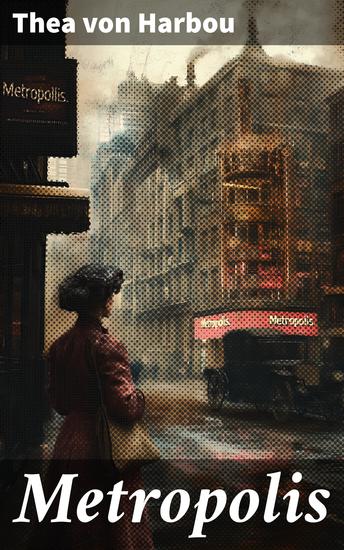
Metropolis - cover

Metropolis

Thea von Harbou

Verlag: Good Press

  • 0
  • 0
  • 0

Beschreibung

In "Metropolis," Thea von Harbou presents a compelling narrative set in a dystopian future where stark class divisions manifest through a towering, industrialized city. The novel is characterized by its expressionistic style, employing vivid imagery and allegorical motifs that critique early 20th-century society, particularly reflecting the tensions of the Weimar Republic. Through its complex characters and intricate plot, the text explores themes of technology, control, and the human condition, probe the existential dilemmas faced by individuals trapped within the mechanized world. Thea von Harbou, a screenwriter and novelist, was intricately linked to the German film industry, particularly through her collaborations with her partner Fritz Lang. Her experiences with the burgeoning technological advances and societal upheaval of her time significantly informed her vision in writing "Metropolis." Influenced by her fascination with the interplay of art and industry, as well as her understanding of the socio-political landscape, von Harbou created a visionary work that anticipates contemporary discussions on automation and societal inequities. "Metropolis" is highly recommended for readers intrigued by speculative fiction that delves into the psychological and ethical implications of a mechanized existence. Its rich narrative and profound themes continue to resonate today, offering insights into the challenges of modern civilization and prompting reflection on humanity's relationship with technology.
Verfügbar seit: 02.03.2025.
Drucklänge: 90 Seiten.

Weitere Bücher, die Sie mögen werden

  • Miser in the Bush The - Story Time Episode 40 (Unabridged) - cover

    Miser in the Bush The - Story...

    Brothers Grimm

    • 0
    • 0
    • 0
    A farmer had a faithful and diligent servant, who had worked hard for him three years, without having been paid any wages. At last it came into the man's head that he would not go on thus without pay any longer; so he went to his master, and said, 'I have worked hard for you a long time, I will trust to you to give me what I deserve to have for my trouble.' The farmer was a sad miser, and knew that his man was very simple-hearted; so he took out threepence, and gave him for every year's service a penny. The poor fellow thought it was a great deal of money to have, and said to himself, 'Why should I work hard, and live here on bad fare any longer? I can now travel into the wide world, and make myself merry.' With that he put his money into his purse, and set out, roaming over hill and valley.
    Zum Buch
  • War and Peace - Book 8: 1811-12 (Unabridged) - cover

    War and Peace - Book 8: 1811-12...

    Leo Tolstoy

    • 0
    • 0
    • 0
    War and Peace is a literary work mixed with chapters on history and philosophy by the Russian author Leo Tolstoy. It was first published serially, then published in its entirety in 1869. It is regarded as one of Tolstoy's finest literary achievements and remains an internationally praised classic of world literature.
    Book 8: 1811-12: After Prince Andrew's engagement to Natásha, Pierre without any apparent cause suddenly felt it impossible to go on living as before. Firmly convinced as he was of the truths revealed to him by his benefactor, and happy as he had been in perfecting his inner man, to which he had devoted himself with such ardor-all the zest of such a life vanished after the engagement of Andrew and Natásha and the death of Joseph Alexéevich.
    Zum Buch
  • Brave New World Interviews & Purports The - Talks by Aldous Huxley - cover

    Brave New World Interviews &...

    Geoffrey Giuliano

    • 0
    • 0
    • 0
    "There is only one corner of the universe you can be certain of improving, and that's your own self." 
     
    "One of the great attractions of patriotism - it fulfills our worst wishes." 
     
    "The secret of genius is to carry the spirit of the child into old age, which means never losing your enthusiasm." Aldous Huxley 
     
    Aldous Huxley was an English writer and philosopher. He wrote nearly fifty books, both novels and non-fiction works—as well as wide-ranging essays, narratives, and poems. 
    Born into the prominent Huxley family, he graduated from Oxford, with an undergraduate degree in English literature. Early in his career, he published short stories and poetry and edited the literary magazine Oxford Poetry, before going on to publish travel writing, satire, and screenplays. Huxley spent the latter part of his life in the United States, living in Los Angeles from 1937 until his death. By the end of his life, Huxley was widely acknowledged as one of the foremost intellectuals of his time. He was nominated for the Nobel Prize in Literature nine times and was elected Companion of Literature by the Royal Society of Literature in 1962. 
     
    Includes a rare treasury of ultra-rare previously unheard conversations with the esteemed intellectual.
    Zum Buch
  • The Green Flag - cover

    The Green Flag

    Arthur Conan Doyle

    • 0
    • 0
    • 0
    "The Green Flag," penned by Arthur Conan Doyle and initially featured in the June 1893 edition of the Pall Mall Magazine, unfolds a captivating tale. This narrative delves into intricate webs of mystery and suspense, showcasing Doyle's mastery in storytelling.
    Zum Buch
  • The Painted Veil - cover

    The Painted Veil

    William Somerset Maugham

    • 0
    • 0
    • 0
    The Painted Veil by W. Somerset Maugham is a story about a woman named Kitty, who marries Walter Fane so that she can live out her fantasies of being a lady in a grand household and meet wealthy people. The marriage to Walter Fane only lasts three years because he begins to cheat on her. Kitty leaves him for Shanghai, China to work as a doctor with the Red Cross Society.
    Zum Buch
  • A Capitalist - From their pens to your ears genius in every story - cover

    A Capitalist - From their pens...

    George Gissing

    • 0
    • 0
    • 0
    George Robert Gissing was born on November 22nd, 1857 in Wakefield, Yorkshire.  
    He was educated at Back Lane School in Wakefield. Gissing loved school. He was enthusiastic with a thirst for learning and always diligent.  By the age of ten he was reading Dickens, a lifelong hero. 
    In 1872 Gissing won a scholarship to Owens College. Whilst there Gissing worked hard but remained solitary. Unfortunately, he had run short of funds and stole from his fellow students. He was arrested, prosecuted, found guilty, expelled and sentenced to a month's hard labour in 1876. 
    On release he decided to start over.  In September 1876 he travelled to the United States. Here he wrote short stories for the Chicago Tribune and other newspapers. On his return home he was ready for novels. 
    Gissing self-published his first novel but it failed to sell.  His second was acquired but never published. His writing career was static.  Something had to change.  And it did. 
    By 1884 The Unclassed was published.  Now everything he wrote was published. Both Isabel Clarendon and Demos appeared in 1886. He mined the lives of the working class as diligently as any capitalist. 
    In 1889 Gissing used the proceeds from the sale of The Nether World to go to Italy. This trip formed the basis for his 1890 work The Emancipated. 
    Gissing's works began to command higher payments. New Grub Street (1891) brought a fee of £250.  
    Short stories followed and in 1895, three novellas were published; Eve's Ransom, The Paying Guest and Sleeping Fires. Gissing was careful to keep up with the changing attitudes of his audience.  
    Unfortunately, he was also diagnosed as suffering from emphysema. The last years of his life were spent as a semi-invalid in France but he continued to write. 1899; The Crown of Life. Our Friend the Charlatan appeared in 1901, followed two years later by The Private Papers of Henry Ryecroft. 
    George Robert Gissing died aged 46 on December 28th, 1903 after catching a chill on a winter walk.
    Zum Buch