
Junte-se a nós em uma viagem ao mundo dos livros!
Adicionar este livro à prateleira
Grey
Deixe um novo comentário Default profile 50px
Grey
Assine para ler o livro completo ou leia as primeiras páginas de graça!
All characters reduced
The Psychology of the Emotions - cover
LER

The Psychology of the Emotions

Th. Ribot

Editora: DigiCat

  • 0
  • 0
  • 0

Sinopse

In "The Psychology of the Emotions," Th. Ribot embarks on an incisive exploration of the complex interplay between the mind and emotions, positioning the work at the intersection of psychology and philosophy. Ribot employs a clear, analytical literary style, meticulously dissecting emotional phenomena through a scientific lens. By challenging contemporaneous theories and merging empirical findings with philosophical inquiries, he offers profound insights into the nature of emotions—arguing for their foundational role in human consciousness and behavior, while situating his discourse within the context of 19th-century psychological thought. Th. Ribot, a pioneering French psychologist and philosopher, significantly contributed to the development of modern psychological theories. His interest in the emotional life stemmed from his academic background in both psychology and philosophy, alongside personal experiences that shaped his understanding of human affect. Ribot's work reflects a broader intellectual movement aiming to establish psychology as a rigorous scientific discipline, drawing from natural sciences to unravel the intricacies of human sentiment. This authoritative text is recommended for scholars and enthusiasts alike, providing a comprehensive foundation for the study of emotions in psychological contexts. Ribot's nuanced analysis not only enriches our understanding of emotionality but also invites readers to reflect on their own emotional experiences, making it an essential read for anyone engaged in the fields of psychology, philosophy, or human behavior.
Disponível desde: 17/11/2023.
Comprimento de impressão: 445 páginas.

Outros livros que poderiam interessá-lo

  • At Your Command - cover

    At Your Command

    Neville Goddard

    • 0
    • 0
    • 0
    At Your Command by Neville Goddard is a foundational text in the realm of self-help and metaphysical literature. First published in 1939, this concise yet profound book explores the transformative power of imagination and belief in shaping one's reality.Goddard's central thesis is the idea that individuals have the inherent power to manifest their desires through focused intention and unwavering belief. He posits that the human imagination is a divine tool that can bring about tangible changes in the external world. By aligning one's thoughts and feelings with the desired outcome, Goddard asserts that anyone can command the circumstances of their life.The book is structured around key principles of manifestation, including:Assumption: The belief that assuming the feeling of the wish fulfilled is crucial to manifesting it in reality.Imagination: The power of vivid, detailed visualization in creating desired outcomes.Faith: An unwavering belief in the realization of one's desires, irrespective of current circumstances.Goddard employs a straightforward and direct style, making complex metaphysical concepts accessible to readers. He emphasizes practical application, encouraging readers to experiment with the principles to witness their effectiveness firsthand.At Your Command is not just a theoretical treatise but a practical guide that empowers readers to take control of their lives. Its timeless wisdom continues to resonate, offering a path to personal transformation and fulfillment through the conscious use of imagination and belief.This book remains a significant work for those interested in the law of attraction, self-improvement, and the exploration of human potential. Through Goddard's teachings, readers can discover the profound impact of their inner world on their external reality.
    Ver livro
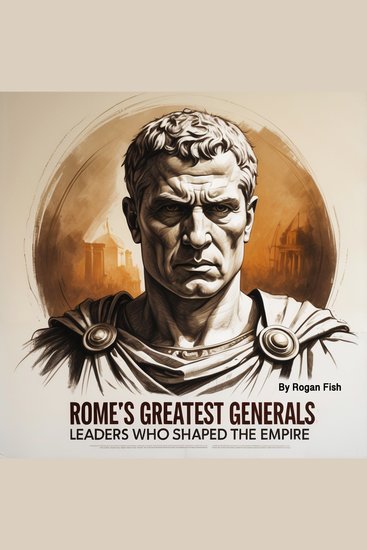
  • Rome's Greatest Generals - Leaders Who Shaped the Empire - cover

    Rome's Greatest Generals -...

    Rogan Fish

    • 0
    • 0
    • 0
    The rise of the Roman general was a gradual yet transformative process that shaped the very foundation of Rome’s military might. In the early days of the Roman Republic, military leadership was closely intertwined with social status and political influence. Unlike later periods where generals held almost absolute power, early Roman commanders were often aristocrats or elected officials whose primary duties lay not only in warfare but also in governance and civil administration. 
    One of the pivotal aspects that shaped the rise of the Roman general was the evolution of military traditions. Initially, Rome’s military structure was heavily influenced by the Etruscans and other neighboring cultures. Early Roman armies were comprised of citizen-soldiers who fought primarily to protect their homeland rather than for conquest. Generals were typically chosen from the patrician class, and their leadership was seen as both a duty and an honor. As Rome expanded, the need for a more organized and strategic military became apparent, leading to the emergence of commanders who were not just noblemen but skilled tacticians. 
    The social and political influences on the role of the general were significant. During the Republic, the Senate played a crucial role in appointing generals, often selecting consuls or appointed military tribunes. These leaders were expected to exemplify Roman virtues such as bravery, discipline, and piety. The successes of early generals not only brought personal glory but also bolstered their political careers. Victorious commanders could parlay their military achievements into political power, as evidenced by figures like Scipio Africanus, who leveraged his triumphs against Carthage to gain influence within the Senate.
    Ver livro
  • Akkadian Empire The: An Enthralling Overview of the Rise and Fall of the Akkadians - cover

    Akkadian Empire The: An...

    Enthralling History

    • 0
    • 0
    • 0
    Discover the remarkable history of the first ancient empire of Mesopotamia after the long-lived civilization of Sumer! 
    Where did Sargon the Great come from—this abandoned baby rescued from the river? 
    How did he grow up to daringly and dramatically conquer all of Mesopotamia and beyond? 
    What propelled his stunning ascent to rule the world’s first empire, which stretched from the Persian Gulf to the Mediterranean Sea? 
    What can we learn about the fascinating origins and culture of the Akkadians and their unprecedented rise? 
    What curse preceded the empire’s cataclysmic fall? 
    This extensively researched, authoritative history of the Akkadian Empire will unlock the little-known and awe-inspiring stories of the people who boldly changed the world. This easy-to-read, comprehensive, and engaging presentation with striking illustrations brings the Akkadian civilization to life. 
    Some of the fascinating questions you will explore include:   What prehistoric people lived in Mesopotamia at the dawn of time?   How did the world’s first cities vie for power?   What precipitated Sargon’s rise from gardener to cupbearer to king?   Why was Mesopotamia’s “Golden Age” golden?   What horrific drought impelled the empire’s collapse?   Why was the Akkadian military machine indomitable?   How did the Akkadian’s life-like sculptures rival classical Greece 1,600 years later?   Why was the first empire so short?   What gods did the Akkadians worship, and how did their religion impact their lives?   And much, much more! 
    Scroll up and click the “add to cart” button to learn more about the Akkadian Empire!
    Ver livro
  • Vrnda Devi's Kitchen Religion The Yoga Of Non-Violent Living - Adventures In Ethical Vegetarianism - cover

    Vrnda Devi's Kitchen Religion...

    Sripad Jagannatha Dasa

    • 0
    • 0
    • 0
    THE ANCIENT YOGIC SCIENCE OF NON-VIOLENT SPIRITUAL EATINGVrnda Devi's Kitchen Religion introduces the art andscience of conscious eating. Listeners willleam of the 5,000-year-old Vedic approach todiet with a respectful nod to modern nutritionalscience. Yoga sages speak of the threemodes of material nature, goodness, passion,and ignorance, and the foods whichdefine each. Those in the modes of passionand ignorance dull themselves with lifeless,processed fare which overwhelms the senses-like meat, fish, eggs, strong spices, and alcohol.Those who seek entry into the mode ofgoodness, however, understand the value of.consuming organic vegetables, fresh fruits,whole grains, nuts, and, pure, whole non-violentstrictly nonfactory farming milk.Vmda examines the negative effects of meat-based fare outlines the benefits of a vegetarian diet and explains how such a diet can help heal, strengthen, and purify the body. Here is everything you need to know about life-giving of simple living and high thinking from one of the world's most celebrated animal rights angels.Vrnda Devi, was a successful vegetarianrestauranteur and host of televisioncooking shows "Vrnda's Kitchen." Her celebratedspiritual master was A.C. Bhaktivedanta SwamiPrabhupada. Devi was a dedicated animal-rightsactivist and managed a ten-acre cowprotection facility (Goshalla) in New York. SripadJagannatha Dasa is her husband.
    Ver livro
  • The Chandogya Upanishad 101 - a modern practical guide plain and simple - cover

    The Chandogya Upanishad 101 - a...

    Matthew Barnes

    • 0
    • 0
    • 0
    Struggling to understand what life is all about? Why you are here, the reason for it all, the goal? 
    If so, the answers you are searching for may lie within this cherished work.  
    Dr. Matthew Barnes, chemist, biochemist, doctor, and bestselling author of The Emerald Tablet 101, The Bhagavad Gita 101, and The Tao Te Ching 101 presents his interpretation of the second of ten primary Hindu Upanishads, and he does so in a way that is powerful, yet unusually simple, straightforward, and easy to absorb. 
    In this work, you’ll learn:about the journey the Hindus believe we are all on, and what lies at the end.the purpose of our obstacles. (This explanation alone is worth the price of admission.)what made the difference for the Jesuses, Buddhas, and Muhammads of this world, and how you can become one of them. 
    “In the whole world, there is no study so beneficial and so elevating as that of the Upanishads. It has been the solace of my life. It will be the solace of my death.” -Arthur Schopenhauer, German philosopher. 
    Don’t just read this book, embody its teachings. Do so and another world of perception, and meaning, awaits. You will never experience another ordinary moment again. 
    What are you waiting for? 
    Scroll up and reserve your copy now!
    Ver livro
  • The Hundred Years’ War - History of the War between the French and English in the 14th Century - cover

    The Hundred Years’ War - History...

    Kelly Mass

    • 0
    • 0
    • 0
    The Hundred Years' War was a series of prolonged and intense conflicts between the kingdoms of England and France, spanning from 1337 to 1453. At its core, the war was rooted in a bitter dispute over the French throne, which was claimed by both the English royal House of Plantagenet and the French House of Valois. This disagreement over succession became more than a dynastic struggle; it evolved into a broader geopolitical and cultural clash, drawing in various powers from across Western Europe. The war became a defining event in medieval history, fundamentally shaping the course of European politics, society, and warfare. 
    The conflict was not a single, continuous battle but a series of engagements, truces, and temporary pauses in fighting, lasting a staggering 116 years. Over five generations, English and French rulers alternated between direct conflict and negotiated ceasefires, each side hoping to gain an upper hand in the long-running struggle. The war is commonly divided into three main phases: the Edwardian War (1337–1360), the Caroline War (1369–1389), and the Lancastrian War (1415–1453). These stages were marked by shifts in momentum and power, with the English initially achieving significant victories but eventually losing their dominance in the final stages of the war. 
    One of the most significant outcomes of the Hundred Years' War was its profound impact on European warfare. Both England and France introduced new military strategies and technologies, including the use of professional standing armies and the widespread deployment of artillery. These advancements marked a dramatic shift away from the feudal levies and knightly combat that had previously defined medieval warfare. The use of the longbow by English archers, for example, proved particularly effective in the decisive Battle of Crécy in 1346, and the war’s artillery, such as cannons and siege weapons, changed the way battles were fought.
    Ver livro