¡Acompáñanos a viajar por el mundo de los libros!
Añadir este libro a la estantería
Grey
Escribe un nuevo comentario Default profile 50px
Grey
Suscríbete para leer el libro completo o lee las primeras páginas gratis.
All characters reduced
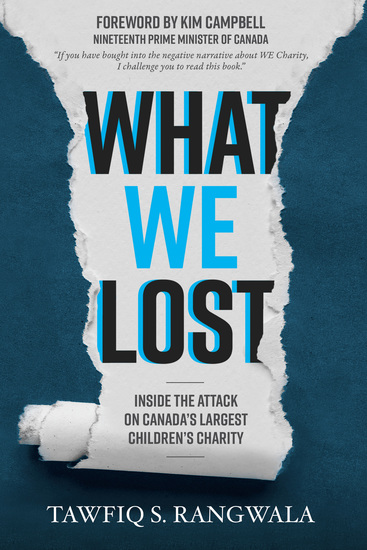
What WE Lost - Inside the Attack on Canada’s Largest Children’s Charity - cover

What WE Lost - Inside the Attack on Canada’s Largest Children’s Charity

Tawfiq S. Rangwala

Editorial: Optimum Publishing International

  • 0
  • 0
  • 0

Sinopsis

TORONTO STAR #1 BESTSELLER 
GLOBE AND MAIL AND AMAZON BESTSELLER
		 
WE Charity had changed the game. In its 25 years, the international development charity and youth empowerment movement impacted lives the world over. Innovation was at its core: while most charities focus on making the world a better place for our children, WE Charity focused on making better children for our world. Founded by the ubiquitous Kielburger brothers, WE Charity operated more like a Silicon Valley start-up than a traditional NGO. From creating stadium-filling events with A-list celebrity ambassadors to building schools, infrastructure, a hospital and even a university at lightning speed, the organization was always full-throttle.
		 
Its for-profit partner, ME to WE, filled shelves with socially-conscious products that allowed consumers to track the impact of their spending, invited young people and families to visit and work in communities WE Charity supported, and channelled proceeds back into the charity to make it self-sustaining.
		 
Unique and disruptive, WE generated energy, engagement, and accolades. But it also bred misunderstanding and, in some quarters, resentment. With a long history of propelling youth to act in support of myriad causes—making ”doing good doable,” the slogan went—WE Charity was the ideal candidate to administer the Canada Student Services Grant (CSSG) program. The program, if it had happened, involved matching students within non-profits in a summer in which Covid had stolen most job opportunities. And then, WE Charity in Canada was gone. It didn’t crumble. It crashed. Unwittingly caught in the crosshairs of a partisan fight that reflects the increasing ”Americanization” of Canadian politics, WE Charity was forced to shutter its doors in Canada.
		 
Once a media darling with politicians of all stripes clamouring to appear at its events, the charity was suddenly a pariah accused (falsely) of a litany of wrongdoings: political cronyism; governance failures; heavy-handed decision-making by executives; lining the pockets of the founders; manipulating children; mistreating donors; racism and international corruption. Many were shocked. Detractors were delighted. Led by fringe commentators, the media quickly piled on. Allies who spoke out were castigated and forced to take cover. But while most Canadians have heard of the so-called ”WE Charity Scandal”—at times forming strong views—few are able to recount the true facts.
		 
Misperceptions and confusion have ruled the day. And many of the most important voices—including those of educators and young people—have gone unreported and unheard. In this book, former WE board member and lawyer Tawfiq Rangwala unpacks the evidence and provides the critical context around the headline-grabbing controversies that have shaped the narrative. Drawing on the factual record, his personal experiences inside the organization, and extensive interviews with supporters and critics, Rangwala cuts through the fog and explains what really happened, why it happened, and who should be held to account. The author goes even deeper with insightful, compassionate and heartbreaking interviews with WE supporters, benefactors and the politicians that used the awarding of the contract during the global pandemic crisis to paint a picture of conflicts of interest and special favours by the Prime Minister. Along the way, we learn what has been lost and the personal cost to Canadians and people around the world.
		 
More than just a story of the rise and fall of an iconic global charity, this is a cautionary tale of the collateral damage that can be levelled by unchecked partisan politics, social media pundits, and sensationalist headlines. In the end, Canadians are left to ponder whether the real ”scandal” is the demise of WE Charity and the values of fair play and due process that most of us hold dear.
Disponible desde: 07/04/2022.
Longitud de impresión: 384 páginas.

Otros libros que te pueden interesar

  • Summary of Jason Stanley’s How Fascism Works - cover

    Summary of Jason Stanley’s How...

    Falcon Press

    • 0
    • 0
    • 0
    Buy now to get the main key ideas from Jason Stanley’s How Fascism Works 
      
    In How Fascism Works (2018), Jason Stanley explores how fascist politicians reach power, the conditions they thrive in, and the beliefs that most fascist movements are built upon. Stanley examines how fascism distorts nationalism, employs propaganda and lies, demeans education, and preys on minorities. Fascist movements may take different nationalist forms, but they share the same goal: to turn a liberty-focused nation into one where they make all the rules.
    Ver libro
  • The Wagner Group - Yevgeny Prigozhin's Mercenaries and Their Ties to Vladimir Putin - cover

    The Wagner Group - Yevgeny...

    Owen Wilson

    • 0
    • 0
    • 0
    Few military organisations have had a greater importance than the Wagner Group: at a cursory glance no more than a disreputable private mercenary group dedicated to committing war crimes yet also, astonishingly, the challengers of the Kremlin on 23-24 June, 2023-unheard of in over two decades of Vladimir Putin's rule. From its inception in 2014 this nebulous organisation operating from Russia was intentionally cloaked in questions. How was it able to operate alongside Russia's top government officials? How could it deploy the logistical systems of the Russian army up to and including ordering air attacks with fighter planes of the Russian Federation, despite the deep antipathy of Russia's powerful defence minister Sergei Shoigu? Why did the Kremlin provide such an ample helping hand to its leader, Yevgeny Prigozhin, for over a decade? In this compelling book, former Financial Times journalist Owen Wilson investigates the Wagner Group and their ties to Vladimir Putin. It skilfully sets out its history and the dramatic death of Yevgeny Prigozhin to cast a searching light on the person who ultimately stands behind the group.
    Ver libro
  • Proximity Politics - How Distance Shapes Public Opinion and Political Behaviors - cover

    Proximity Politics - How...

    Jeronimo Cortina

    • 0
    • 0
    • 0
    Republicans who live closer to the U.S.-Mexico border are less likely to support constructing a wall than those who live farther away. After a mass shooting, gun sales and permit applications skyrocket in nearby communities. Experiencing an extreme weather event like a hurricane or flood can encourage someone to attribute climate change to human activity. Why do we react so differently to faraway events and ones that take place on our doorsteps, and what does this reveal about our political landscape? 
     
    Proximity Politics is an examination of the role of distance in shaping attitudes, behaviors, and understandings of the world. Jeronimo Cortina documents the crucial ways space and place influence public opinion. He demonstrates that the closer someone is to an event, social group, or policy, the likelier they are to have first-hand, specific, grounded knowledge of the subject. Conversely, distance leads to detachment, making it more likely that decontextualized or unreliable information and individual or group biases will prevail. Considering a range of case studies, Cortina unravels how spatial, emotional, temporal, social, and cultural distances affect public opinion. Bringing together quantitative and qualitative data, Proximity Politics shows that even in today's interconnected world, we are still profoundly influenced by what happens next door.
    Ver libro
  • Radio Treason - The Trials of Lord Haw-Haw the British Voice of Nazi Germany - cover

    Radio Treason - The Trials of...

    Rebecca West, Katie Roiphe

    • 0
    • 0
    • 0
    The gripping courtroom drama of a Brooklyn-born Englishman who became the voice of Nazi Germany, by "one of the most brilliant and erudite journalists of the century" (The New York Times). 


    In 1945, the New Yorker commissioned star reporter Rebecca West to cover the London trial of William Joyce, who stood accused by the British government of aiding the Third Reich. Joyce was alleged to have hosted a radio program, Germany Calling, devoted to Nazi propaganda and calls for a British surrender. 


    The legal case against Joyce (known as "Lord Haw-Haw" for his supposedly posh accent) proved to be tenuous and full of uncertainties. Yet each new piece of evidence added to West's timeless portrait of a social reject who turned to the far right, who rose through the ranks without ever being liked, and who sought validation through a set of shared hatreds—of elites, of communists, and especially of Jews. 


    As a work of psychological suspense, Rebecca West's Radio Treason anticipates Truman Capote, Janet Malcolm, and Joan Didion at their best. As a study in political extremism, as Katie Roiphe writes in her foreword, "It is as if Lord Haw-Haw has been transported from her time into ours."
    Ver libro
  • NAZI MOVIES AS PROPAGANDA MACHINE - How Goebbels Changed the German Film Industry Into an Ideological Weapon - cover

    NAZI MOVIES AS PROPAGANDA...

    Davis Truman

    • 0
    • 0
    • 0
    The German film industry transformed from a collection of independent studios into a division of the Nazi Party between 1933 and 1945. German film became a crucial component of the Nazi campaign to ideologically indoctrinate the German populace as part of the Ministry for Popular Enlightenment and Propaganda, led by Joseph Goebbels. However, the business kept up its prior commercial practices and made movies aimed at paying German consumers. Even though Goebbels worked hard to turn German cinema into an ideological weapon, the theater served as a popular consumer marketplace, and the various film tastes of German moviegoers continued to affect the kinds of films made. Therefore, filmmaking in Nazi Germany was influenced by popular taste and Goebbels' ideological objectives. 
    This book will look at several movies that demonstrate Goebbel's evolving propaganda objectives and the changing preferences of the German audience for movies during the Nazi era. Box office statistics from the years before and after the start of World War II offer unique insight into German film consumption and serve to highlight the extent to which the general public supported the war in Germany.
    Ver libro
  • We the Elites - Why the US Constitution Serves the Few - cover

    We the Elites - Why the US...

    Robert Ovetz

    • 0
    • 0
    • 0
    Written by fifty-five of the richest white men, and signed by only thirty-nine of them, the US constitution is the sacred text of American nationalism. Popular perceptions of it are mired in idolatry, myth, and misinformation—many Americans have opinions on the constitution but have little idea what it says. This book examines the constitution for what it is—a rule book for elites to protect capitalism from democracy. Social movements have misplaced faith in the constitution as a tool for achieving justice when it actually impedes social change through the many roadblocks and obstructions we call 'checks and balances'. This stymies urgent progress on issues like labor rights, poverty, public health, and climate change, propelling the American people and rest of the world towards destruction. Robert Ovetz's reading of the constitution shows that the system isn't broken. Far from it. It works as it was designed to.
    Ver libro