Junte-se a nós em uma viagem ao mundo dos livros!
Adicionar este livro à prateleira
Grey
Deixe um novo comentário Default profile 50px
Grey
Assine para ler o livro completo ou leia as primeiras páginas de graça!
All characters reduced
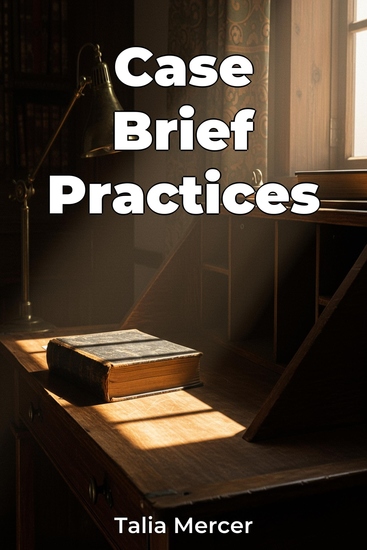
Case Brief Practices - cover
LER

Case Brief Practices

Talia Mercer

Tradutor A AI

Editora: Publifye

  • 0
  • 0
  • 0

Sinopse

Case Brief Practices offers a comprehensive guide to mastering case briefing, a critical skill for anyone in legal education or the legal profession. The book emphasizes the importance of this skill in understanding complex legal concepts and developing strong analytical skills. It is structured around the standardized format of case briefs, the logical structuring of legal arguments, and the development of analytical skills, all essential for effective legal reasoning.

 
The book highlights the historical context of case law, showing how precedent has evolved and why efficient methods of legal analysis are increasingly important. It also explains necessary background knowledge, such as legal terminology and court structures. Using examples from landmark cases and practical exercises, the book guides readers through understanding the facts, issues, holding, reasoning, and disposition in a case. This approach helps readers identify key legal rules and construct persuasive legal arguments.

 
What makes this book unique is its focus on practical application, demystifying complex legal concepts through innovative methodologies. Case Brief Practices begins with an introduction to fundamental concepts and progresses to practical applications in various legal settings, providing a structured learning journey for law students and legal professionals alike, making it an invaluable resource for mastering legal analysis.
Disponível desde: 07/04/2025.
Comprimento de impressão: 97 páginas.
Outros livros que poderiam interessá-lo

  • Anne Frank's Diary: A Testament of Hope and Resilience - Unveiling the Untold Story of a Young Girl's Courage in the Face of Darkness - cover

    Anne Frank's Diary: A Testament...

    Mike Tisty

    • 0
    • 0
    • 0
    Step into the world of Anne Frank, where the power of hope transcends the darkest shadows of history. In "Anne Frank's Diary: A Testament of Hope and Resilience," journey alongside a young girl whose indomitable spirit and unwavering optimism defied the horrors of the Holocaust.This poignant exploration delves into the pages of Anne Frank's diary, offering a profound insight into the mind of a courageous soul navigating the complexities of adolescence amid the harrowing backdrop of World War II. As her words unfold, a testament of hope emerges — a beacon that shines even in the bleakest moments.Discover the resilience that allowed Anne to transform her confined hiding place into a sanctuary of dreams and aspirations. Through the lens of her poignant prose, witness the ordinary moments that took on extraordinary significance, as Anne's diary becomes a timeless tribute to the human spirit's capacity to endure.This book meticulously examines the historical context, providing a comprehensive backdrop to Anne's narrative. It captures the essence of her unwavering hope, demonstrating how her diary transcends time, resonating with readers across generations."Anne Frank's Diary: A Testament of Hope and Resilience" invites you to reflect on the enduring power of the human spirit. It's a journey through the heart of darkness, illuminated by the flicker of hope that Anne so bravely kept alive. Join us in revisiting this remarkable testament to resilience, understanding, and the unwavering belief that, even in the face of adversity, hope has the power to triumph.So, don't miss the chance and grab your copy today!!
    Ver livro
  • Urban Transportation - Solutions for Sustainable Mobility - cover

    Urban Transportation - Solutions...

    Lyric Vale

    • 0
    • 0
    • 0
    Urban transportation plays a pivotal role in shaping the way cities function, impacting everything from daily commuting to the overall economic and environmental health of urban areas. In modern society, cities are becoming increasingly crowded, with more people migrating to urban centers in search of opportunities, better infrastructure, and access to services. As populations swell, urban transportation systems have struggled to keep pace with demand, leading to issues such as congestion, pollution, and inefficiency. 
    Historically, urban transportation has evolved in response to changing needs and technological advancements. Early cities relied on walking and horse-drawn carriages, but with the rise of industrialization, motorized transport took over. Streetcars, buses, and eventually cars became the main modes of transport in urban environments. However, as cities expanded and the number of vehicles grew, so did the problems associated with these systems. Traffic congestion became a daily reality in many metropolitan areas, with commuters spending hours stuck in traffic, wasting time, and burning fuel. 
    Environmental concerns further compounded the issue. The increasing number of vehicles on the road, many of which run on fossil fuels, has significantly contributed to air pollution, climate change, and the depletion of natural resources. As cities continue to grow, the challenge of balancing transportation needs with environmental sustainability has become more urgent. In response, there has been a global push to shift toward more sustainable, efficient, and inclusive transportation systems.
    Ver livro
  • How to Think More and Better - Being Reasonable in Unreasonable Times - cover

    How to Think More and Better -...

    William B. Irvine

    • 0
    • 0
    • 0
    William B. Irvine, author of the popular book "A Guide to the Good Life," offers much needed philosophical advice on how to become a more rational and critical thinker in today's emotionally-driven and complex world. 
      
    Even the most reasonable of us can be selective about when we think reasonably. We may realize that the best thing to do is to take the advice of our doctor when facing a medical issue. When shopping for a new car or appliance we might carefully assess online reviews and weigh our options calmly before making an informed decision. But when it comes to things that feel more fraught—voting, navigating a challenge in our family, figuring out what to do in a difficult professional situation—we might throw this approach out the window, dismissing facts and patterns that form a body of evidence, and trust our gut. (Of course, there is a time and place for this, but not every big decision is purely a matter of the heart.) Likewise, when we think about big ideas, about right and wrong, or about concepts so complex they make anyone's head spin, we can freeze, jumping to conclusions rather than wading into the details, or considering the existing arguments that others offer as a trail through challenging terrain. How can we do better? How can we train our minds to be more consistent? How can we practice using the best of our rational abilities when it matters most? 
      
    How to Think More and Better offers a philosopher's advice on becoming a more rational and critical thinker, rather than relying on emotions or hearsay to reach important decisions. It trains the reader in open-minded critical thinking. This thinking is crucial in a time of political polarization, social media, politicized news media, and echo chambers, to help us pursue truth and understanding in a world of rabbit holes, echo chambers, and disinformation. Irvine explains the prevalence of emotion-driven thinking is often at the expense of engagement with evidence, and then lays out strategies readers can use to train themselves to think more critically, drawn from what worked for him in the classroom. He also covers important areas to aid intellectual self-transformation, such as Mindcare and Mindcleaning.  
      
    With practice, most people can become evidence-based thinkers. Seemingly intractable contemporary problems might be solved if we all start engaging more in this kind of slow and careful thinking, considering arguments and evidence even from those on opposite sides of key debates. 
      
    "William B. Irvine is the voice of reason—and reasoned thinking—in a world that feasts on attention and spectacle and drama. How to Think More and Better is a guide to recovering our senses not only as citizens, but as judicious and thoughtful human beings."—Tom Nichols, author of The Death of Expertise
    Ver livro
  • The Future Starts Now - Expert Insights into the Future of Business Technology and Society - cover

    The Future Starts Now - Expert...

    Anônimo

    • 0
    • 0
    • 0
    Featuring contributions from an international array of futurists, The Future Starts Now provides fascinating insights and guidance into how society and business will transform in the years to come. 


    The future is an uncertain, uncomfortable prospect for employees, employers, and society at large. A flurry of unprecedented events have proven that, despite what some politicians and economists may tell us, the future is not set in stone. In light of this uncertainty, The Future Starts Now looks toward the various innovations and technologies that may shape our future. Authors Theo Priestley and Bronwyn Williams have brought together the world's leading futurists to articulate and clarify the current trajectories in technology, economics, politics, and business. 


    This is a comprehensive history of tomorrow, exploring groundbreaking topics such as AI, privacy, education, and the future of work. While the guidance, insight, and predictions are fascinating for anyone curious about what the future may hold, the book also functions as an invaluable guide for business professionals looking to steer their career or their organization with foresight and confidence.
    Ver livro
  • Servants of Allah - African Muslims Enslaved in the Americas - cover

    Servants of Allah - African...

    Sylviane A. Diouf

    • 0
    • 0
    • 0
    Servants of Allah presents a history of African Muslims, following them from West Africa to the Americas. Although many assume that what Muslim faith they brought with them to the Americas was quickly absorbed into the new Christian milieu, as Sylviane A. Diouf demonstrates in this meticulously researched, groundbreaking volume, Islam flourished during slavery on a large scale. She details how, even while enslaved, many Muslims managed to follow most of the precepts of their religion. Literate, urban, and well-traveled, they drew on their organization, solidarity and the strength of their beliefs to play a major part in the most well-known slave uprisings. But for all their accomplishments and contributions to the history and cultures of the African Diaspora, the Muslims have been largely ignored. Servants of Allah—a Choice 1999 Outstanding Academic Title—illuminates the role of Islam in the lives of both individual practitioners and communities and shows that though the religion did not survive in the Americas in its orthodox form, its mark can be found in certain religions, traditions, and artistic creations of people of African descent. This fifteenth anniversary edition has been updated to include new materials and analysis, a review of developments in the field, and prospects for new research.
    Ver livro
  • Lost Civilizations of Mesoamerica - Quest for the Ancient Origins of the Olmecs and other Mysterious Cultures - cover

    Lost Civilizations of...

    Norah Romney

    • 0
    • 0
    • 0
    The phenomenon of the Olmec Heads and their Mysterious origins is observed in the Coast of the Gulf of Mexico, in the early pre-classic period, with the development of the Olmec culture. The first representations of political power are witnessed there, expressed through monumental sculpture and large-scale architecture. The dominant figure of the rulers appears and alludes to forms of government exercised by individuals who can convene to populations through ideological management and other coercion mechanisms. 
    The socio-political complexity thus emerged encouraged the development of similar forms in other areas of Mesoamerica, which would later lead to the appearance of the first stratified societies made up of actual states, such as the cases of Teotihuacan in the Mexican highlands, Monte Albán in Oaxaca and the city-states of the Maya area during the classical period. The corollary of this process was made up by some societies of the post-classic period that reached supra-state levels, as happened with the Mexica who settled in the Mexican highlands and came to establish a true pan-Mesoamerica empire.
    Ver livro