Rejoignez-nous pour un voyage dans le monde des livres!
Ajouter ce livre à l'électronique
Grey
Ecrivez un nouveau commentaire Default profile 50px
Grey
Abonnez-vous pour lire le livre complet ou lisez les premières pages gratuitement!
All characters reduced
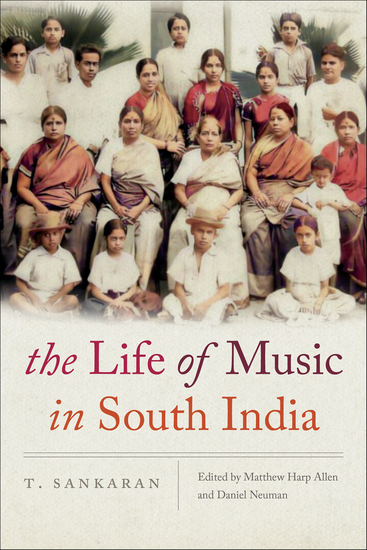
The Life of Music in South India - cover

The Life of Music in South India

T. Sankaran

Maison d'édition: Wesleyan University Press

  • 0
  • 0
  • 0

Synopsis

This book offers an account of Carnatic music culture drawing on the knowledge of T. Sankaran, a musician raised in an illustrious non-Brahmin devadasi family, and his long affiliation with cultural institutions including All India Radio (AIR) and the Tamil Isai Sangam (Tamil Music Academy). Sankaran examines the cultural and social matrix in which Carnatic music was cultivated and consumed in mid-twentieth century India, including the ways that musicians negotiated caste politics and the double standard for male and female musicians. The memoir provides insight into the way AIR worked as a modern, bureaucratic institution, and how the opening of government music colleges interacted with caste politics and shifted women's participation in public performance. The book is polyvocal, as Sankaran's writing is interwoven with passages from Daniel M. Neuman's book The Life of Music in North India, which inspired Sankaran's project, as well as transcripts from interviews with Sankaran by Matthew Allen. Includes rare archival photos.
Disponible depuis: 10/10/2023.
Longueur d'impression: 279 pages.

D'autres livres qui pourraient vous intéresser

  • Great Zimbabwe - Stone Cities Trade Networks and the Mystery of Southern Africa - cover

    Great Zimbabwe - Stone Cities...

    Rolf Hedger

    • 0
    • 0
    • 0
    The rise of Great Zimbabwe was shaped by geography, economic opportunities, and social organization, allowing it to become one of Africa’s most influential civilizations. Emerging around the 9th century, the settlement developed into a thriving political and economic center by the 11th century, reaching its peak between the 13th and 15th centuries. Its growth was fueled by abundant natural resources, a strategic location, and participation in regional and international trade. 
    The Zimbabwean plateau, with its fertile soil and favorable climate, provided ideal conditions for agriculture. The Shona people, who founded Great Zimbabwe, cultivated sorghum and millet, which sustained the growing population. In addition to farming, cattle herding played a crucial role in the economy. Cattle were a measure of wealth and social status, serving as currency in trade and marriage negotiations. The presence of large herds further reinforced the power of the elite, who controlled access to grazing lands and water sources. 
    Beyond agriculture, Great Zimbabwe’s location made it a key player in long-distance trade. The city was situated between the goldfields of southern Africa and the coastal trade hubs of the Swahili city-states. Gold mining became a major economic activity, with miners extracting the metal from riverbeds and underground deposits. This gold was traded with merchants from Kilwa, Sofala, and other Swahili ports, where it was exchanged for luxury goods such as Persian ceramics, Chinese porcelain, and Indian textiles. The wealth generated from trade allowed Great Zimbabwe to expand, attracting artisans, traders, and skilled laborers.
    Voir livre
  • A Rare Recording of James Joyce Reading From His Novel Finnegan's Wake - cover

    A Rare Recording of James Joyce...

    James Joyce

    • 0
    • 0
    • 0
    James Augusta Joyce (February 2, 1882 - January 13, 1941), born in Dublin, was an Irish novelist, poet, and literary critic. He contributed to the modernist avant-garde movement and is regarded as one of the most influential and important writers of the twentieth century. The following recording was made in 1929 by C.K. Odgen in the studio of the Orthological Society in Cambridge during which Joyce read from his novel, “Finnegans Wake.”
    Voir livre
  • The Battle of the Bulge - Hitler's Last Offensive in the Ardennes Forest - cover

    The Battle of the Bulge -...

    Sage Winters

    • 0
    • 0
    • 0
    In the winter of 1944, as the Allies closed in on Nazi Germany from both the west and east, Adolf Hitler’s regime found itself increasingly cornered. Desperate to reverse the tide of the war, Hitler launched one last, audacious offensive: the Battle of the Bulge. Known as Germany’s last major push against the Allied forces, the battle took place in the dense forests of the Ardennes region in Belgium, Luxembourg, and France. This surprise attack, initiated on December 16, 1944, was meant to divide the Allied armies, capture vital port cities like Antwerp, and cripple the Allied war effort. In his final attempt to change the course of the war, Hitler gambled everything—hoping to break the deadlock and buy time for his collapsing forces. 
      
    The Battle of the Bulge was an enormous, high-stakes operation that relied on surprise, speed, and overwhelming force. The Ardennes was chosen not only for its strategic location but also because it was considered an unlikely place for a large-scale attack. The Allies, exhausted from months of fighting and underestimating the potential of a German counteroffensive, were caught off guard. The weather, heavy with snow and fog, further complicated the Allied defense and gave the Germans an initial advantage. Hitler believed that a swift, unexpected strike through the dense forests would disorient the Allies, creating confusion and panic, and ultimately forcing a favorable settlement. 
      
    However, this final gamble was doomed to fail. Despite the initial successes of the German forces, the battle’s outcome ultimately hinged on the determination of the Allied soldiers, the rapid mobilization of reinforcements, and the logistical prowess of the Allies.
    Voir livre
  • Columbian Exchange The: A Captivating Guide to the Transatlantic Transfer of People Plants Animals Ideas Resources and More Between the Americas and Europe - cover

    Columbian Exchange The: A...

    Captivating History

    • 0
    • 0
    • 0
    How two worlds became one. 
    In this audiobook, you will understand how Christopher Columbus proposed something new: reaching the riches of the East Indies by sailing west from Europe. The rulers of Spain agreed to support his risky venture, and he sailed off in 1492. He unexpectedly ran into two continents nobody in Europe knew about. He didn’t discover the continents; that had been done centuries before. 
    Discover how the Old World of Eurasia and Africa began a monumentally important exchange of people, ideas, crops, animals, and diseases that changed history and humanity forever. This extended stitching together of the two hemispheres is called the Columbian Exchange. 
    You’ll be fascinated by how Europeans did not know if the fifty million indigenous Americans were human and how a pope issued a proclamation in 1534 that the American native peoples actually had souls. 
    You’ll learn how the initial contacts led to one of the greatest catastrophes in all of human history and how smallpox enabled Cortes and the Spanish to conquer the Aztec Empire, which was bigger than Spain. 
    In this captivating audiobook, you will learn about the following:Japanese samurai who guarded silver shipments in Mexico in the 1600s;Catarina de San Juan, who began life as a Muslim girl in India and ended as a popular saint in Mexico;The immense amount of silver from Peru and Mexico, which fueled Spain’s Golden Century and led to repeated bankruptcy;American chili peppers giving some heat to cuisines from Hungary to Korea;Crops domesticated by indigenous Americans enabling China to double its population;Disease from the Americas making millions of Europeans miserable, including Henry VIII, Casanova, Ivan the Terrible, and Beethoven; 
    Be sure to click the “add to cart” button so you can start learning about this world-shaking event in history!
    Voir livre
  • Ukraine in Central and Eastern Europe - Kyiv's Foreign Affairs and the International Relations of the Post-Communist Region - cover

    Ukraine in Central and Eastern...

    Sebastian Schäfer

    • 0
    • 0
    • 0
    This volume examines which interests and motivations some select countries in East-Central Europe and the Caucasus have towards Ukraine.
    Voir livre
  • God Save Benedict Arnold - The True Story of America's Most Hated Man - cover

    God Save Benedict Arnold - The...

    Jack Kelly

    • 0
    • 0
    • 0
    Benedict Arnold committed treason—for more than two centuries, that's all that most Americans have known about him. 


    Yet Arnold was much more than a turncoat—his achievements during the early years of the Revolutionary War defined him as the most successful soldier of the era. God Save Benedict Arnold tells the gripping story of Arnold's rush of audacious feats—his capture of Fort Ticonderoga, his Maine mountain expedition to attack Quebec, the famous artillery brawl at Valcour Island, the turning-point battle at Saratoga—that laid the groundwork for our independence. 


    Arnold was a superb leader, a brilliant tactician, a supremely courageous military officer. He was also imperfect, disloyal, villainous. One of the most paradoxical characters in American history, and one of the most interesting. God Save Benedict Arnold does not exonerate him for his treason—the stain on his character is permanent. But Kelly's insightful exploration of Arnold's career as a warrior shines a new light on this gutsy, fearless, and enigmatic figure. In the process, the book offers a fresh perspective on the reasons for Arnold's momentous change of heart.
    Voir livre