Unisciti a noi in un viaggio nel mondo dei libri!
Aggiungi questo libro allo scaffale
Grey
Scrivi un nuovo commento Default profile 50px
Grey
Iscriviti per leggere l'intero libro o leggi le prime pagine gratuitamente!
All characters reduced
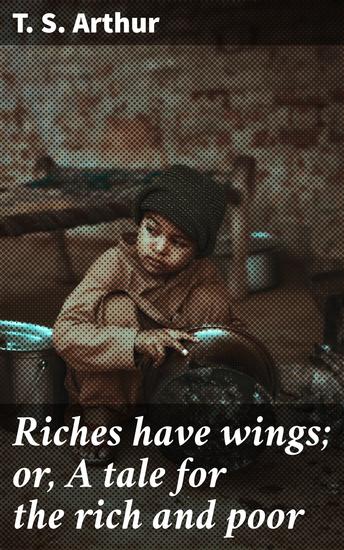
Riches have wings; or A tale for the rich and poor - Navigating the Perils of Wealth: A Moral Tale on Riches and Happiness - cover

Riches have wings; or A tale for the rich and poor - Navigating the Perils of Wealth: A Moral Tale on Riches and Happiness

T. S. Arthur

Casa editrice: Good Press

  • 0
  • 0
  • 0

Sinossi

In "Riches Have Wings; or, A Tale for the Rich and Poor," T. S. Arthur delves into the moral landscape of wealth and its transient nature through a compelling narrative that intertwines the lives of both affluent and destitute characters. Arthur employs a clear, straightforward prose style that allows for deep emotional resonance, reflecting the mid-19th century's social realism. This novel stands as a critique of materialism and a reminder of the ethical responsibilities that accompany financial success, echoing prevalent themes in Victorian literature regarding social class and personal integrity. T. S. Arthur, an influential figure in America'Äôs literary scene, was known for his didactic storytelling aimed at moral upliftment. Having witnessed the societal disparities of his time, Arthur's experiences and observations profoundly shaped his writing. His background in working-class culture and commitment to social reform inspired this tale, showcasing his belief in the importance of empathy and understanding across economic divides. I highly recommend "Riches Have Wings" to readers interested in classic literature that explores the complexities of wealth and morality. This thought-provoking narrative not only entertains but also challenges us to reflect on our own values in relation to wealth, making it a relevant read for contemporary audiences.
Disponibile da: 10/07/2023.
Lunghezza di stampa: 94 pagine.

Altri libri che potrebbero interessarti

  • Désirée's Baby - From their pens to your ears genius in every story - cover

    Désirée's Baby - From their pens...

    Kate Chopin

    • 0
    • 0
    • 0
    Katherine O'Flaherty was born on the 8th February 1850 in St Louis, Missouri to parents of French and Irish descent. 
    At age 5, she was sent to the Sacred Heart Academy and, apart from a 2 year period at home when her father died, remained there until graduating in 1868.  Whilst there she began writing and became an avid reader of almost anything that crossed her path.   
    Kate married Oscar Chopin in 1870 and the couple moved to New Orleans, and later to the rural setting of Cloutierville, Louisiana to raise their 6 children.  
    In 1882 her husband died leaving her in a deep trench of debt.  Despite her best efforts to turn the businesses around they were sold, and she moved the family back to St Louis and the financial help of her mother.  Sadly, her mother died within the year.  Kate, now struggling with depression, pushed herself to write and gained a local reputation as a writer of short stories that captured the local color and vibrancy of her surroundings.  
    By the early 1890’s her short stories were published nationally.  With this widespread audience also came negative reviews, controversy, and cries of immorality as themes such as interracial relationships, the rights of women and other burning issues of the day were written about. 
    Despite the criticism, which unnerved her, she continued to write though in the main her works, around 100 short stories and two novels, were not attributed with any literary worth. 
    Kate Chopin died from a brain haemorrhage in St Louis Missouri on the 22nd of August 1904.  She was 54. 
    For much of the 20th Century her work was forgotten and out of print.  It was only in early 1970’s, with the rise of feminism and the call for a more just society that she was given the status her works had long described and shone a literary light at.  She is now safely revered as one of America’s great authors.
    Mostra libro
  • The Nether World - cover

    The Nether World

    George Gissing

    • 0
    • 0
    • 0
    The Nether World by George Gissing is a gritty portrayal of poverty and resilience in the slums of Victorian London. The novel follows the lives of the Hewett family, who struggle to survive amidst squalor and despair in a bleak underworld of urban destitution. Sidney Kirkwood, a compassionate figure, becomes entangled in their plight, particularly drawn to Clara Hewett, whose dreams of escape are stifled by her harsh surroundings. Meanwhile, the enigmatic Jane Snowdon endures exploitation and hardship, embodying the vulnerability of women in such conditions. Gissing unflinchingly examines the dehumanizing effects of poverty, the moral compromises it forces, and the elusive hope for redemption. While love and ambition flicker briefly, they are often crushed by circumstance. The Nether World is a powerful critique of societal neglect and class inequality, blending stark realism with moments of quiet dignity. A somber yet deeply human work, it captures both the struggles and resilience of those trapped in life’s margins.
    Mostra libro
  • The Picture of Dorian Gray - cover

    The Picture of Dorian Gray

    Oscar Wilde

    • 0
    • 0
    • 0
    The Picture of Dorian Gray is an acclaimed novel by Oscar Wilde, first published in 1890. It tells the story of a handsome and wealthy young man, Dorian Gray, who discovers a portrait of himself. After making a wish to stay young and beautiful forever, the painting begins to age instead of him and Dorian must keep it hidden from the world. As he lives a life of pleasure and excess, the painting continues to reveal Dorian's true self and ultimate fate. With its themes of morality, innocence, and self-destruction, The Picture of Dorian Gray remains one of the most important and influential works of literature. 
    Oscar Wilde (1854-1900) was an Irish playwright, novelist, poet, and wit. He was one of the most prominent figures of the late Victorian era and a leading light of the Aesthetic Movement. Wilde is best known for his plays “The Importance of Being Earnest” and “An Ideal Husband”, as well as his novel “The Picture of Dorian Gray”. His work was heavily influenced by his Irish background, as well as his love of the theater. His witticisms and epigrams are still widely quoted today. Wilde was also an outspoken critic of Victorian morality, often challenging the conventions of the day. His personal life was also the subject of much controversy and he was imprisoned for two years for “gross indecency”. Wilde’s life and work have inspired generations of writers, artists, and thinkers. He is still regarded as one of the most influential writers in English literature.
    Mostra libro
  • A Man with Two Lives - From their pens to your ears genius in every story - cover

    A Man with Two Lives - From...

    Ambrose Bierce

    • 0
    • 0
    • 0
    Ambrose Gwinnett Bierce was born on 24th June 1842 at Horse Cave Creek in Meigs County, Ohio. His parents were poor but they introduced him to literature at an early age, instilling in him a deep appreciation of books, the written word and the elegance of language.  
    Growing up in Koscuisko County, Indiana poverty and religion were defining features of his childhood, and he would later describe his parents as “unwashed savages” and fanatically religious, showing him little affection but always quick to punish. He came to resent religion, and his introduction to literature appears to be their only positive effect. 
    At age 15 Bierce left home to become a printer’s devil, mixing ink and fetching type at The Northern Indian, a small Ohio paper. Falsely accused of theft he returned to his farm and spent time sending out work in the hopes of being published. 
    His Uncle Lucius advised he be sent to the Kentucky Military Institute. A year later he was commissioned as an Officer.  As the Civil War started Bierce enlisted in the 9th Indiana Infantry Regiment.  
    In April 1862 Bierce fought at the Battle of Shiloh, an experience which, though terrifying, became the source of several short stories. Two years later he sustained a serious head wound and was off duty for several months. He was discharged in early 1865.  
    A later expedition to inspect military outposts across the Great Plains took him all the way to San Francisco. He remained there to become involved with publishing and editing and to marry, Mary Ellen on Christmas Day 1871.  They had a child, Day, the following year.  
    In 1872 the family moved to England for 3 years where he wrote for Fun magazine. His son, Leigh, was born, and first book, ‘The Fiend’s Delight’, was published.  
    They returned to San Francisco and to work for a number of papers where he gained admiration for his crime reporting. In 1887 he began a column at the William Randolph Hearst’s San Francisco Examiner.  
    Bierce’s marriage fell apart when he discovered compromising letters to his wife from a secret admirer. The following year, 1889 his son Day committed suicide, depressed by romantic rejection. 
    In 1891 Bierce wrote and published the collection of 26 short stories which included ‘An Occurrence at Owl Creek Bridge’.  Success and further works including poetry followed.  
    Bierce with Hearst’s resources helped uncover a financial plot by a railroad to turn 130 million dollars of loans into a handout. Confronted by the railroad and asked to name his price Bierce answered “my price is $130 million dollars. If, when you are ready to pay, I happen to be out of town, you may hand it over to my friend, the Treasurer of the United States”.  
    He now began his first foray as a fabulist, publishing ‘Fantastic Fables’ in 1899.  But tragedy again struck two years later when his second son Leigh died of pneumonia relating to his alcoholism.  
    He continued to write short stories and poetry and also published ‘The Devil’s Dictionary’.  
    At the age of 71, in 1913 Bierce departed from Washington, D.C., for a tour of the battlefields where he had fought during the civil war. At the city of Chihuahua he wrote his last known communication, a letter to a friend. It’s closing words were “as to me, I leave here tomorrow for an unknown destination,” Ambrose Bierce then vanished without trace.
    Mostra libro
  • A Redeeming Sacrifice - From their pens to your ears genius in every story - cover

    A Redeeming Sacrifice - From...

    Lucy Ward Montgomery

    • 0
    • 0
    • 0
    The bookshelves of American literature are incredible collections that have gathered together centuries of very talented authors.  From this continent their fame spread and whilst among their number many are now forgotten or neglected their talents endure.  Among them is Lucy Ward Montgomery.
    Mostra libro
  • Hanuman - Son Of The Wind Beloved Of Ram - cover

    Hanuman - Son Of The Wind...

    Sripad Jaganantha Das

    • 0
    • 0
    • 0
    "Sripad Jagannatha Dasa guides us into the sacred heart space of this life-changing hymn as only a dedicated lifelong Ram bhakta may. A self-realized yogi - a wonderful trip!." The Yoga Journal 
     
    "I bow to the Hanuman who is swifter than the mind and wind. The sacred one who has controlled his senses, the one who is the epitome of learning and wisdom. Salutations to the son of the God of Air and chief of the Vanaras, I pray always to Lord Hanuman." 
     
    The Hanuman Chalisa is a Vedic devotional hymn (stotra) in praise of Hanuman authored by the poet sage Tulsi Das. The word "ch?l?s?" means the number forty in Sanskrit, as the Hanuman Chalisa has forty verses. Lord Hanuman is a great devotee of Sri Ram and one of the central characters in the epic, Ramayan. Hanuman is also an incarnation of Shiva. The qualities of Hanuman - his strength, courage, wisdom, celibacy, devotion to Lord Ram, and the many names by which he is known are all in the Hanuman Chalisa. Devotional recitation of this sacred prayer is done by millions every day. 
     
    Hanumanji is the greatest devotee of Sri Ram and an incarnation of the mighty Lord Shiva. He is therefore the epitome of ultimate devotion manifested with its full glory unchallenged in all times and places. By the power of his devotion to Sita Ram, he easily achieved supreme status as the perfect devotee and servitor. 
     
    Lord Hanuman is the eternal link between all devotees and Ram whom he serves, inspires, and protects. By honoring Hanuman one is blessed with all kinds of siddhis including power, valor, prosperity, and devotion. 
    Reciting or hearing the Hanuman Chalisa infuses one with unlimited energy and prana. This sacred mantra also increases a person's resilience and they emerge victorious in every challenging situation.
    Mostra libro