Junte-se a nós em uma viagem ao mundo dos livros!
Adicionar este livro à prateleira
Grey
Deixe um novo comentário Default profile 50px
Grey
Assine para ler o livro completo ou leia as primeiras páginas de graça!
All characters reduced
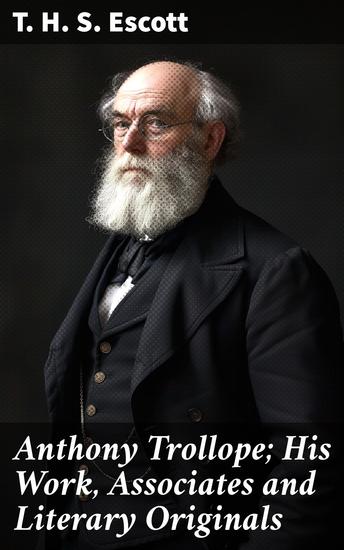
Anthony Trollope; His Work Associates and Literary Originals - Unveiling the Literary Legacy of a Victorian Novelist - cover
LER

Anthony Trollope; His Work Associates and Literary Originals - Unveiling the Literary Legacy of a Victorian Novelist

T. H. S. Escott

Editora: Good Press

  • 0
  • 0
  • 0

Sinopse

In "Anthony Trollope; His Work, Associates and Literary Originals," T. H. S. Escott delves into the intricate tapestry of one of Victorian literature's most fascinating figures. This scholarly examination not only dissects Trollope's prolific body of work but also situates it within the broader literary landscape of 19th-century England. Escott employs a careful blend of biographical analysis and literary criticism, providing insights into Trollope's themes, narrative techniques, and the socio-political influences that shaped his storytelling. With meticulous research, the book unveils the connections between Trollope and his contemporaries, enriching our understanding of his literary contributions and inspirations. T. H. S. Escott, a prominent Victorian biographer and historian, possessed a unique vantage point shaped by his deep engagement with the literary culture of his time. His familiarity with Trollope'Äôs works, alongside the author'Äôs own connections with influential figures in literature, informed Escott's nuanced perspective. This background, together with his critical acumen, equips Escott to illuminate Trollope's legacy and influence, offering readers a comprehensive framework through which to appreciate Trollope'Äôs narratives and characters. For readers intrigued by Victorian literature or those seeking to explore the works of Anthony Trollope, Escott'Äôs book stands as an essential scholarly resource. It invites literary enthusiasts to deepen their appreciation of Trollope's novels while also contextualizing his output within the larger currents of his era. This thoughtful analysis promises not only to enhance understanding but also to spark further interest in a writer who deftly captured the complexities of human experience.
Disponível desde: 18/11/2023.
Comprimento de impressão: 358 páginas.
Outros livros que poderiam interessá-lo

  • How to Be Unmothered - A Trinidadian Memoir - cover

    How to Be Unmothered - A...

    Camille U. Adams

    • 0
    • 0
    • 0
    For generations, the women of Camille U. Adams's family have left their daughters. Some follow the siren call of rum, the centuries-old vice which alighted on Trinidad's shores from European ships. Others flee the behind-closed-doors beatings of husbands, fathers, and brothers, rushing into any arms that offer refuge. Some simply disappear, their passage marked by unkept promises and open wounds. 


    As a young girl, Adams finds solace in Trinidad's whispering fever grass, sweet ixora flowers, and the cradling branches of the rose mango tree―all of their roots connecting her to the land's long memory. But where flora gives way to the rank pavement of Covigne Road, gunshots echo and men amass in the doorways of derelict garages, their mouths and hands promising violation. Home offers no safety: just an explosive father, cowed sisters, and a mother whose only reprieve is control. Cloying, suffocating, the maternal embrace threatens to blot out all else. Is it better to be choked, or not to be held at all? 


    Tormented by her mother's presence and haunted by her absence, Camille U. Adams's dazzling debut is a breathtaking account of survival and self-determination, reimagining the meaning of escape, its cost, and what comes after.
    Ver livro
  • Not So Sorry - Abusers False Apologies and the Limits of Forgiveness - cover

    Not So Sorry - Abusers False...

    Kaya Oakes

    • 0
    • 0
    • 0
    From religious communities to therapeutic spaces, the importance of forgiving those who’ve wronged us is often enshrined as an unqualified good. But what about horrifying cases of abuse, predatory behavior, or systemic wrong? Too often, when predators or abusers are exposed, the chorus comes immediately: “What about forgiveness?” In these cases, forgiveness places the onus on victims, diminishes real hurt and anger, lets perpetrators off the hook, and prevents justice from being done.  
     
    In Not So Sorry, journalist and culture critic Kaya Oakes tackles these questions with intelligence, nuance, and a bit of righteous anger. Ranging from Christian theology and world history to psychology and pop culture, Oakes takes us on a whirlwind tour of the many abuses of the concept of forgiveness, including the abuse scandals of the Catholic church, the outing of high-profile abusers like Larry Nassar, and white America’s obsession with false narratives of marginalized people granting forgiveness to oppressors. Ultimately, Oakes dares us to ask the necessary question: Is it ever better not to forgive? 
     
    “Kaya Oakes challenges those slippery, PR-constructed apologies that leave us rolling our eyes. But she does more than that. Throughout Not So Sorry, Kaya Oakes listens to the voices of victims, allows us to wrestle with our assumptions, and leads us on a path to restore justice.”—Rev. Carol Howard, author of Healing Spiritual Wounds: Reconnecting with a Loving God after Experiencing a Hurtful Church, and pastor of Bedford Presbyterian Church
    Ver livro
  • Totalitarianism Unmasked - Understanding the Mechanics of Absolute Political Control - cover

    Totalitarianism Unmasked -...

    Arlo Holders

    • 0
    • 0
    • 0
    Totalitarianism is a political system in which the state holds total control over every aspect of public and private life, leaving no room for opposition or individual freedoms. Unlike other forms of governance, where political competition and individual rights are somewhat preserved, totalitarianism demands absolute loyalty and conformity. The concept of totalitarianism emerged in the early 20th century, though its roots can be traced back to ancient and medieval periods. In its modern form, it is most closely associated with dictatorial regimes that arose in the aftermath of World War I and throughout the 20th century. 
    The term "totalitarian" was popularized by political theorists in the 1920s and 1930s, notably in relation to regimes like those of Mussolini in Italy and Hitler in Germany. These regimes, alongside those of Stalin in the Soviet Union and others in Asia and Eastern Europe, showcased the terrifying potential of absolute political control. A hallmark of totalitarian states is the extensive centralization of power in the hands of a single leader or party. This centralization permeates every part of governance, from the military to the legal system, and extends into the social and cultural spheres, where the government seeks to dictate values, beliefs, and behaviors. 
    One of the key distinguishing features of totalitarianism is the suppression of political opposition. Under totalitarian rule, political pluralism is eradicated, and those who challenge the ruling authority are subject to imprisonment, torture, or execution. This is often achieved through the use of secret police, military forces, and legal systems designed to stifle dissent and maintain control. Another significant aspect is the pervasive use of propaganda to control the population's beliefs and perceptions.
    Ver livro
  • Care - The Highest Stage of Capitalism - cover

    Care - The Highest Stage of...

    Premilla Nadasen

    • 0
    • 0
    • 0
    Since the earliest days of the pandemic, care work has been thrust into the national spotlight. The notion of care seems simple enough. Care is about nurturing, feeding, nursing, assisting, and loving human beings. It is "the work that makes all other work possible." But as historian Premilla Nadasen argues, we have only begun to understand the massive role it plays in our lives and our economy. 


    Nadasen traces the rise of the care economy, from its roots in slavery, where there was no clear division between production and social reproduction, to the present care crisis, experienced acutely by more and more Americans. Today's care economy, Nadasen shows, is an institutionalized, hierarchical system in which some people's pain translates into other people's profit. 


    Yet this is also a story of resistance. Low-wage workers, immigrants, and women of color in movements from Wages for Housework and Welfare Rights to the Movement for Black Lives have continued to fight for and practice collective care. These groups help us envision how, given the challenges before us, we can create a caring world as part of a radical future.
    Ver livro
  • Marijuana Legalization - What Everyone Needs to Know® - cover

    Marijuana Legalization - What...

    Mark A.R. Kleiman, Beau Kilmer,...

    • 0
    • 0
    • 0
    Should we legalize marijuana? If we legalize, what in particular should be legal? Just possessing marijuana and growing your own? Selling and advertising? If selling becomes legal, who gets to sell? Corporations? Co-ops? The government? What regulations should apply? How high should taxes be? Different forms of legalization could bring very different results. 


    This second edition of Marijuana Legalization: What Everyone Needs to Know® discusses what is happening with marijuana policy, describing both the risks and the benefits of using marijuana, without taking sides in the legalization debate. The book details the potential gains and losses from legalization, explores the "middle ground" options between prohibition and commercialized production, and considers the likely impacts of legal marijuana on occasional users, daily users, patients, parents, and employers—and even on drug traffickers.
    Ver livro
  • Better Never to Have Been - The Harm of Coming into Existence - cover

    Better Never to Have Been - The...

    David Benatar

    • 0
    • 0
    • 0
    Most people believe that they were either benefited or at least not harmed by being brought into existence. Thus, if they ever do reflect on whether they should bring others into existence—rather than having children without even thinking about whether they should—they presume that they do them no harm. Better Never to Have Been challenges these assumptions. David Benatar argues that coming into existence is always a serious harm. Those who never exist cannot be deprived. However, by coming into existence one does suffer quite serious harms that could not have befallen one had one not come into existence. Drawing on the relevant psychological literature, the author shows that there are a number of well-documented features of human psychology that explain why people systematically overestimate the quality of their lives and why they are thus resistant to the suggestion that they were seriously harmed by being brought into existence. The author then argues for the "anti-natal" view—that it is always wrong to have children—and he shows that combining the anti-natal view with common pro-choice views about fetal moral status yield a "pro-death" view about abortion. Although counter-intuitive for many, that implication is defended, not least by showing that it solves many conundrums of moral theory about population.
    Ver livro