¡Acompáñanos a viajar por el mundo de los libros!
Añadir este libro a la estantería
Grey
Escribe un nuevo comentario Default profile 50px
Grey
Suscríbete para leer el libro completo o lee las primeras páginas gratis.
All characters reduced
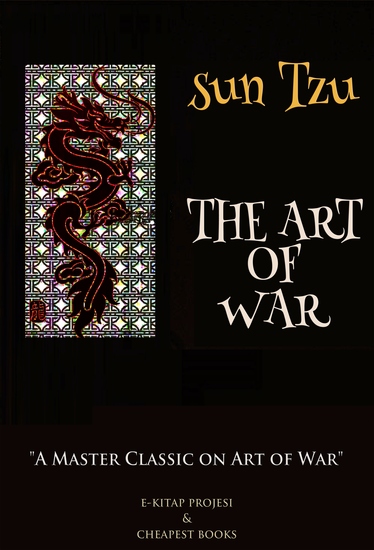
The Art of War - "A Master Classic on Art of War" - cover

The Art of War - "A Master Classic on Art of War"

Sun Tzu, Lionel Giles

Editorial: E-Kitap Projesi & Cheapest Books

  • 0
  • 0
  • 0

Sinopsis

The Art of War is an ancient Chinese military treatise dating from the Late Spring and Autumn Period (roughly 5th century BC). The work, which is attributed to the ancient Chinese military strategist Sun Tzu ("Master Sun", also spelled Sunzi), is composed of 13 chapters. Each one is devoted to an aspect of warfare and how it applies to military strategy and tactics.For almost 1,500 years it was the lead text in an anthology that would be formalised as the Seven Military Classics by Emperor Shenzong of Song in 1080. The Art of War remains the most influential strategy text in East Asian warfare and has influenced both Eastern and Western military thinking, business tactics, legal strategy and beyond.Scholars do not know how The Art of War came to beand whether or not Sun Tzu, if he existed, had anything to do with its creation. What they do know is that copies of the book, typically written on sets of sewn-together bamboo slats, ended up in the hands of politicians, military leaders and scholars across China. From there, translated copies of Sun Tzus work found their way to Korea and Japan. (The oldest Japanese version dates from the 8th century A.D.)For more than 1,000 years, rulers and scholars across Asia consulted The Art of War as they plotted their military maneuvers and imperial conquests. Japanese samurai, for example, studied it closely. However, it did not reach the Western world until the end of the 18th century, when a Jesuit missionary translated the book into French. (Historians say that the French emperor Napoleon was the first Western leader to follow its teachings.) It was finally translated into English in 1905.INTRODUCTION:Sun Tzu Wu was a native of the Ch`i State. His Art of War brought him to the notice of Ho Lu, King of Wu. Ho Lu said to him: I have carefully perused your 13 chapters. May I submit your theory of managing soldiers to a slight test?Sun Tzu replied: You may.Ho Lu asked: May the test be applied to women?The answer was again in the affirmative, so arrangements were made to bring 180 ladies out of the Palace. Sun Tzu divided them into two companies, and placed one of the King's favourite concubines at the head of each. He then bade them all take spears in their hands, and addressed them thus: I presume you know the difference between front and back, right hand and left hand?The girls replied: Yes.Sun Tzu went on: When I say Eyes front, you must look straight ahead. When I say Left turn, you must face towards your left hand. When I say Right turn, you must face towards your right hand. When I say About turn, you must face right round towards your back.Again the girls assented. The words of command having been thus explained, he set up the halberds and battle-axes in order to begin the drill. Then, to the sound of drums, he gave the order Right turn. But the girls only burst out laughing. Sun Tzu said: If words of command are not clear and distinct, if orders are not thoroughly understood, then the general is to blame.
Disponible desde: 18/12/2023.
Longitud de impresión: 100 páginas.

Otros libros que te pueden interesar

  • The Girl With Three Birthdays - An Adopted Daughter’s Memoir of Tiaras Tough Truths and Tall Tales - cover

    The Girl With Three Birthdays -...

    Patti Eddington

    • 0
    • 0
    • 0
    Patti Eddington always knew she was adopted, and her beloved parents seemed amenable enough to questions—but she never wanted to hurt them by expressing curiosity, so she didn't. The story of her mother cutting off and dying her hair when she was a toddler? She thought it was eccentric and funny, nothing more. When she discovered at fifteen that her birthday wasn't actually her birthday? She believed it when her mother said she'd changed it to protect her from the "nosy old biddies" who might try to discover her identity. 


    It wasn't until decades later, when a genealogy test led Patti to her biological family (including an aunt with a shocking story) and the discovery of yet another birthday, that she really began to integrate what she thought she knew about her origins. Determined to know the truth, she petitioned a court to unseal records that had been locked up for almost sixty years—and began to put the pieces of her past together, bit by bit. 


    Framed by a brief but poignant 1963 "Report of Investigation" based on a caseworker's one-day visit to Patti's childhood home, The Girl With Three Birthdays tells the story of an adoptee who always believed she was the answer to a couple's seventeen-year journey to become parents, until a manila envelope from a rural county court arrived and caused her to question . . . everything.
    Ver libro
  • Lurking Under the Surface - Horror Religion and the Questions that Haunt Us - cover

    Lurking Under the Surface -...

    Brandon R. Grafius

    • 0
    • 0
    • 0
    Horror can be a valuable conversation partner for the spiritual questions that animate so many of us. 


    Whether through a movie, television show, novel, or even myth, horror as a genre has always spoken to our deepest human fears and anxieties: fear of death, of the unknown, of knowing too much. Whether you're looking at classic narratives like Frankenstein, or contemporary films like Get Out, which explores racism and white guilt, horror provides a window into our culture and what makes us human. The same can be said of religion. 


    Horror movie buff and religion scholar Brandon Grafius finds common ground between these two seemingly disparate bedfellows—horror and religion—in Lurking under the Surface. What parallels can we draw between The Walking Dead and sacred texts? How do the stories of Hebrew Christian scriptures and apocalyptic films like A Quiet Place and Bird Box help us find hope when it's in short supply? When we treat them both seriously, we see that horror movies and religion lead us through the same sets of questions. Both explore questions of justice, hope, and our relationship to the world and the cosmos. And both offer us ways to make meaning out of the contradictory pieces of our world—a world filled with so much hope and so many recognizable fears lurking just beneath the surface.
    Ver libro
  • Aggressive Persuasion - Using Forceful Methods to Convince Others - cover

    Aggressive Persuasion - Using...

    Cito Harder

    • 0
    • 0
    • 0
    Aggressive persuasion operates on the principle that forceful, persistent, or manipulative tactics can shape the decisions and behaviors of others. Unlike subtle persuasion, which relies on logical argumentation and emotional appeal, aggressive persuasion often leverages pressure, intimidation, and dominance to compel compliance. Understanding the psychological mechanisms behind this type of influence reveals why it is so effective and how individuals can recognize when they are being subjected to it. 
    At the core of aggressive persuasion is the exploitation of cognitive biases. Human beings are wired to respond to authority, fear, and social pressure. Persuasive individuals who employ aggressive tactics often capitalize on these tendencies, creating scenarios where the target feels obligated, intimidated, or even fearful of rejecting the proposal. This can manifest in high-pressure sales environments, political discourse, or interpersonal relationships where one party exerts dominance over another to achieve their desired outcome. 
    One of the most effective psychological tactics in aggressive persuasion is creating urgency and scarcity. When individuals believe that an opportunity is limited or that immediate action is necessary, they are more likely to comply without fully analyzing the situation. This technique is common in marketing, where customers are pressured into making impulse purchases due to time-sensitive offers. In other contexts, such as negotiations or decision-making in high-stakes situations, creating urgency can cloud judgment and force individuals into agreements they might otherwise reject.
    Ver libro
  • A Light in the Northern Sea - Denmark's Incredible Rescue of Their Jewish Citizens During WWII - cover

    A Light in the Northern Sea -...

    Tim Brady

    • 0
    • 0
    • 0
    August 25, 1943. A lone bicyclist transports a cache of explosives, hidden in a beer crate, to a Copenhagen hall being readied to house German troops. In a violent blast, the would-be barracks is reduced to rubble. It's the boldest act yet of Holger Danske and the growing Danish resistance combating the oppressiveness of Hitler's Reich. 


    In 1940, on its way to conquering Western Europe, Germany coerced the Danish government into a "cooperative" agreement that lasted three long years until the increasing brazenness of the Resistance movement prompted a crackdown. Denmark's nearly 8000 Jews, who had so far been spared Hitler's wrath, now became the focus of his rage. A roundup was ordered to begin on October 1st, 1943, the first day of the Jewish New Year. 


    The only passage to safety was across the Oresund to Sweden. But no group existed to organize an escape. Until the last moment, Sweden didn’t agree to allow the refugees into the country; and the strait between the two nations was swarming with Gestapo. What happened next was a miracle. 95% of Denmark's Jews survived the Holocaust, the highest percentage in Europe. Here are the riveting true accounts of ordinary Danes who, using their modest resources, wiles, remarkable courage, and camaraderie, quietly orchestrated their escape.
    Ver libro
  • The Elephant Man - cover

    The Elephant Man

    Frederick Treves

    • 0
    • 0
    • 0
    This is a story in Victorian England of how in 1884 Frederick Treves, Surgeon and Lecturer in Anatomy at the London Hospital arranged for the "Elephant Man" (whose distorted grotesque face and deformed body made him a "freak") to visit the medical college next to the hospital for the purpose of a lecture.  They would later become friends and Treves the savior of the man named John Merrick. This is Treves' memoir.
    Ver libro
  • Dooro Vekhe Sant Jarnail Singh - cover

    Dooro Vekhe Sant Jarnail Singh

    Harpal Singh Pannu

    • 0
    • 0
    • 0
    The book "Duron Vekhe Sant Jarnail Singh Ji Bhindranwale" is written by Prof. Harpal Singh Pannu. He mentions in the beginning that he wrote exactly what he saw with his own eyes. He says, "It felt like Sant Jarnail Singh was my friend." But Sant Jarnail Singh was not anyone’s friend—he was a saint. A saint has no enemies or friends. I saw him as a great Sikh whose role in the Akali Dal was growing.
    Ver libro