¡Acompáñanos a viajar por el mundo de los libros!
Añadir este libro a la estantería
Grey
Escribe un nuevo comentario Default profile 50px
Grey
Suscríbete para leer el libro completo o lee las primeras páginas gratis.
All characters reduced
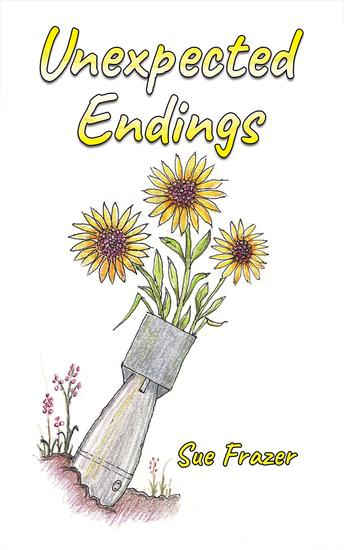
Unexpected Endings - cover

Unexpected Endings

Sue Frazer

Editorial: Austin Macauley Publishers

  • 0
  • 0
  • 0

Sinopsis

There are said to be two types of writers: those who meticulously plot their stories before ever setting pen to paper, and those who dive headfirst into a blank page, trusting that meaning will emerge through the process. I firmly belong to the latter group. When I began writing proper short stories – rather than scribbles on the backs of bus tickets – I never imagined they would one day form a collection. But as the stories accumulated, I realized there might be enough to satisfy the growing number of readers who had enjoyed them and were eager for more. My imagination is a restless and untamed force, often pulling me in unexpected directions, making each story a new adventure in creativity. I delight in experimenting with words, stretching and reshaping them into fresh contexts. Unexpected Endings is driven by this love of storytelling, blending my interests in science and folklore – two endless sources of inspiration. In this collection, you'll find stories like Azrael, where a goldfinch holds far more meaning than meets the eye, and Light and Dark, where nothing is quite what it seems.
Disponible desde: 08/11/2024.
Longitud de impresión: 78 páginas.

Otros libros que te pueden interesar

  • LAMDA Verse and Prose Anthology: Volume 20 - cover

    LAMDA Verse and Prose Anthology:...

    Exams LAMDA

    • 0
    • 0
    • 0
    This anthology presents the set selection of verse and prose pieces for Learners entering LAMDA Graded Examinations in Communication: Speaking Verse and Prose from Entry Level to Grade 8, and LAMDA Introductory Graded Examinations from Stage 1 to Stage 3 (Solo and Group).
    The collection includes 155 pieces in total: a range of celebrated poems alongside prose extracts from bestselling classic and contemporary novels. It also features original material written specifically for this anthology, including the winner and runners-up of LAMDA Learners' Poetry Prize 2023. Also included is a foreword by Joseph Coelho, Waterstones Children's Laureate 2022–24.
    For Learners taking LAMDA Examinations, this anthology offers a wide choice of themes, topics and worlds to explore. With many performance possibilities, it is a perfect resource to help Learners practise and develop their communication skills. For the general reader, it is the ideal starting point for discovering contemporary poets and novelists, such as Maya Angelou, Malorie Blackman, Sally Rooney and Michael Rosen, as well as reconnecting with celebrated writers of the past, including Jane Austen, T. S. Eliot and William Wordsworth.
    Ver libro
  • Damned If I Do - Stories - cover

    Damned If I Do - Stories

    Percival Everett

    • 0
    • 0
    • 0
    Damned If I Do is an exceptional new collection of short stories by Percival Everett, author of the highly praised and wickedly funny novel Erasure. 
     
    People are just naturally hopeful, a term my grandfather used to tell me was more than occasionally interchangeable with stupid. 
     
    A cop, a cowboy, several fly fishermen, and a reluctant romance novelist inhabit these revealing and often hilarious stories. An old man ends up in a high–speed car chase with the cops after stealing the car that blocks the garbage bin at his apartment building. A stranger gets a job at a sandwich shop and fixes everything in sight: a manual mustard dispenser, a mouthful of crooked teeth, thirty–two parking tickets, and a sexual–identity problem. 
     
    Percival Everett is a master storyteller who ingeniously addresses issues of race and prejudice by simultaneously satirizing and celebrating the human condition.
    Ver libro
  • The Fly in the Ointment - From their pens to your ears genius in every story - cover

    The Fly in the Ointment - From...

    D H Lawrence

    • 0
    • 0
    • 0
    David Herbert Lawrence was born on the 11th September 1885 in Eastwood, Nottinghamshire, a coal mining town where the reality of a harsh life was only useful as experiences for future literary works. 
    He was educated at Beauvale Board School and became the first local boy to receive a scholarship to attend Nottingham High School. After 3 years he became a junior clerk in Haywood’s surgical appliances factory. He was also attempting a literary career which, in the short term, led to a teacher training position in Eastwood and later a teaching qualification from University College, Nottingham.  
    Lawrence’s first efforts were poems, short stories and a draft of ‘The White Peacock’. Moving to London and a teaching position in Croydon his writing attracted the attention of Ford Madox Ford, editor of The English Review, and he commissioned him to write ‘Odour of Chrysanthemums’.  
    Wanting to write full-time he now began work on what would become ‘Sons and Lovers.   
    In 1912 he met the older and married mother-of-three Frieda Weekley. They eloped to Germany and here Lawrence could see for himself the growing tensions with France.  So keen was his interest that he was arrested and accused of being a British spy.  
    In early 1914 Frieda obtained her divorce and they returned to Britain to be married just days before the outbreak of war. Owing to her German parentage, and his own public dislike of militarism and violence, the couple were treated with contempt and suspicion throughout the war years.  
    Despite this he continued to write but his reputation in England was so tarnished and, mirrored by his own disdain for the country, he and Frieda left England in November 1919, first for Europe and then America via Ceylon and Australia. 
    They bought a ranch in Taos, New Mexico and visited Mexico several times. The third visit in March 1925 caused a near fatal attack of malaria. To convalesce they moved to Florence. Here he continued work on ‘Lady Chatterley’s Lover’ which for many years would cause controversy. A renewed interest in oil painting resulted in an exhibition in 1929 which was raided by the police and several works were confiscated.  
    D H Lawrence died of complications arising from a bout of tuberculosis on the 2nd of March 1930 in Vence, France.  He was 44.
    Ver libro
  • The Cats of Ulthar - From their pens to your ears genius in every story - cover

    The Cats of Ulthar - From their...

    H P Lovecraft

    • 0
    • 0
    • 0
    Howard Phillips Lovecraft is among the greatest American masters of fantasy and the supernatural.  
    Born in 1890, a native of Providence, Rhode Island, his health was uncertain from childhood and he led a sheltered early life. His semi-invalidism enabled him to read omnivorously, and as a shy imaginative child he began to invent what would in his adult life become a whole macabre fantastic world of his own, peopled by creatures out of his own weird imagination.  
    As an adult he was retiring, almost a recluse. Tall, thin and pale, but with bright alert eyes, he was much given to wandering his native city in the dark hours of the night, and he became a devoted student of its antiquities.  
    Although he began to write early he had nothing published until he was in his twenties. He set many of his stories around the imaginary town of Arkham, and invented an entire mythology of his own, its core being the demoniac cult of Cthulhu, based on the lore or legend that the world was at one time inhabited by another race who, in practising black magic, lost their foothold or were expelled, yet live on outside, ever ready to take possession of this earth again. 
    Since his early death in 1937 his stories have continued to attract attention and praise from an ever-growing audience.
    Ver libro
  • 3 Stories About - Women's Sexuality - A trio of classic tales perfect for a commute walk or quiet night in - cover

    3 Stories About - Women's...

    Katherine Mansfield, Charlotte...

    • 0
    • 0
    • 0
    There is something about the number 3.    
     
    The Ancient Greeks believed 3 was the perfect number, and in China 3 has always been a lucky number, and they know a thing or two.   
     
    Most religions also have 3 this and 3 that and, of course, in these more modern times, three’s a crowd may be too many, except when it’s a ménage à trois.  It seems good things usually come in threes. 
     
    Whatever history and culture says WE think 3, a hat-trick of stories, is a great number to explore themes and literary avenues that classic authors were so adept at creating. 
     
    From their pens to your your ears.   
     
    01 - 3 Stories About - Women's Sexuality 
    02 - Bliss by Katherine Mansfield 
    03 - The Giant Wisteria by Charlotte Perkins Gilman 
    04 - The Storm by Kate Chopin
    Ver libro
  • The Coffin Maker - From their pens to your ears genius in every story - cover

    The Coffin Maker - From their...

    Alexander Puschkin

    • 0
    • 0
    • 0
    Alexander Sergeyevich Pushkin was born on 26th May 1799 in Moscow into a family of Russian nobility. 
    Raised by nursemaids and French tutors in French he learnt Russian only via the household staff. 
    He graduated from the prestigious Imperial Lyceum, near St Petersburg and plunged into the vibrant and raucous intellectual youth culture of what was then the capital of the Russian Empire.  
    In 1820, he published his first long poem, ‘Ruslan and Ludmila’, with much controversy about both subject and style.  Pushkin was heavily influenced by the French Enlightenment and gravitated, with other literary radicals, towards social reform angering the Government. 
    His early literary work and reputation was poetic and written as he travelled around the Empire or engaged himself in various rebellions against the Ottoman Empire.  A clash with his own government after his poem, ‘Ode to Liberty’, was found among the belongings of the Decembrist Uprising rebels meant two years of internal exile at his mother's rural estate.  His friends and family continually petitioned for his release, sending letters and meeting with Tsar Alexander I and then Tsar Nicholas I.   
    In 1825, whilst at his Mother’s estate, Pushkin wrote his most famous play, the drama ‘Boris Godunov’.  
    Upon meeting with Tsar Nicholas I, Pushkin obtained his release and began work as the Tsar's Titular Counsel of the National Archives.  However, because of the earlier problems the tsar retained control of everything Pushkin published, and he was banned from travelling at will. 
    Around 1828, Pushkin met the 16-year-old Natalia Goncharova, one of the most talked-about beauties of Moscow.  After much hesitation, Natalia accepted his marriage proposal after she received assurances that the government had no intentions to persecute the libertarian poet.  When the Tsar gave Pushkin the lowest court title, Gentleman of the Chamber, he became enraged, feeling that the Tsar intended to humiliate him. 
    In the year 1831, during Pushkin's growing literary influence, he met Nikolai Gogol.  Recognising his gifts Pushkin supported him and published his short stories in his own magazine ‘The Contemporary’. 
    By the autumn of 1836, Pushkin was falling into greater and greater debt and facing scandalous rumours that his wife was having an affair.  
    In January 1837, Pushkin sent a ‘highly insulting letter’ to his wife’s pursuer, Georges-Charles de Heeckeren d'Anthès.  The only answer could be a challenge to a duel. 
    It took place on 27th January.  D'Anthès fired first, critically wounding Pushkin; the bullet entered at his hip and penetrated his abdomen.  Two days later Alexander Pushkin died of peritonitis.  He was 37.
    Ver libro