¡Acompáñanos a viajar por el mundo de los libros!
Añadir este libro a la estantería
Grey
Escribe un nuevo comentario Default profile 50px
Grey
Suscríbete para leer el libro completo o lee las primeras páginas gratis.
All characters reduced
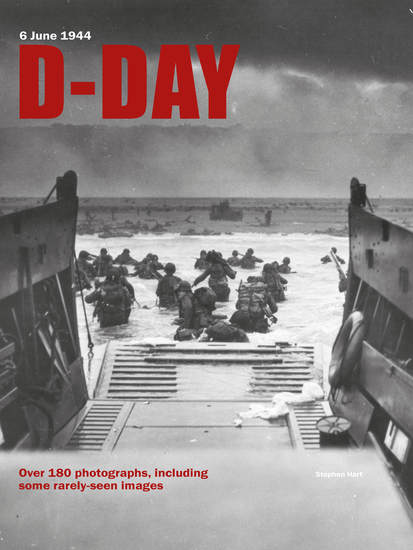
D-Day - 6 June 1944 - cover

D-Day - 6 June 1944

Stephen Hart

Editorial: Amber Books Ltd

  • 0
  • 0
  • 0

Sinopsis

“You are about to embark upon the Great Crusade, toward which we have striven these many months. The eyes of the world are upon you. The hope and prayers of liberty-loving people everywhere march with you.” – General Dwight D. Eisenhower, Order of the Day, June 6, 1944
 
By May 1944, more than 2.8 million Allied troops, with 4,000 American, British and Canadian ships, were amassed in southern England, waiting to cross the English Channel in the largest seaborne invasion of history. More that 1,200 planes stood ready to deliver specialist airborne troops behind enemy lines, to silence German ground resistance and destroy local infrastructure, and to dominate the skies of the battle theatre. D-Day provides a photographic exploration of this monumental military and political event that helped bring about the end of Nazi Germany’s four-year occupation of Europe. The book is divided into chapters covering the first days of the landings on the five beaches: Omaha, Utah, Gold, Juno and Sword; separate chapters cover the airborne landings of the famous American 82nd and 101st Airborne Divisions and the British 6th Airborne, as well as the crucial help of French Resistance fighters in providing intelligence and disrupting German communications and supply lines.
Disponible desde: 01/05/2024.
Longitud de impresión: 224 páginas.
Otros libros que te pueden interesar

  • Chemically Imbalanced - Everyday Suffering Medication and Our Troubled Quest for Self-Mastery - cover

    Chemically Imbalanced - Everyday...

    Joseph E. Davis

    • 0
    • 0
    • 0
    Everyday suffering—those conditions or feelings brought on by trying circumstances that arise in everyone’s lives—is something that humans have grappled with for millennia. But the last decades have seen a drastic change in the way we approach it. In the past, a person going through a time of difficulty might keep a journal or see a therapist, but now the psychological has been replaced by the biological: instead of treating the heart, soul, and mind, we take a pill to treat the brain. 
     
    Chemically Imbalanced is a field report on how ordinary people dealing with common problems explain their suffering, how they’re increasingly turning to the thin and mechanistic language of the “body/brain,” and what these encounters might tell us. Drawing on interviews with people dealing with struggles such as underperformance in school or work, grief after the end of a relationship, or disappointment with how their life is unfolding, Joseph E. Davis reveals the profound revolution in consciousness that is underway. We now see suffering as an imbalance in the brain that needs to be fixed, usually through chemical means. This has rippled into our social and cultural conversations, and it has affected how we, as a society, imagine ourselves and envision what constitutes a good life. Davis warns that what we envision as a neurological revolution, in which suffering is a mechanistic problem, has troubling and entrapping consequences. And he makes the case that by turning away from an interpretive, meaning-making view of ourselves, we thwart our chances to enrich our souls and learn important truths about ourselves and the social conditions under which we live.
    Ver libro
  • Rise and Fall of the Crusader States The: The History of the Outremer in the Holy Land - cover

    Rise and Fall of the Crusader...

    Charles River Editors

    • 0
    • 0
    • 0
    Of the many campaigns during the Middle Ages, few are as remarkable or seemingly impossible to win at the start as the First Crusade (1095-99), and the true crowning achievement of that crusade, which resulted in two centuries of Western European Christian states in the Middle East and the permanent firing of the European imagination, was the conquest of Jerusalem on July 15, 1099 after three weeks of siege. That victorious siege came four years after the call for a crusade first went out, and had the Crusaders not taken Jerusalem, the First Crusade would not likely have been followed by any more and the campaign might have been no more than an historical footnote of what could have been.  
    Despite the successful First Crusade, the Crusader States were relatively small and weak, and while they tried to be a bulwark of Christianity in the Holy Land, the Crusader States were reconquered centuries before modern European colonialism began. Nonetheless, the Crusades and the Crusader States galvanized the Christians of Western Europe to expand their world. While it remains unclear how much that world expanded in practical terms such as trade, or how it affected later attitudes during the expansion to the New World and other regions, it definitely engaged the European mind in both positive and negative ways. As such, the crusades soon achieved near-mythic status in the European literature and remain among the most important events of the Middle Ages. 
    At the same time, the Crusader States were not one homogenized region but actually several distinct territories that had their own unique histories and interests. In fact, many of them were founded a century apart, with the Kingdom of Antioch established in 1097 and the Duchy of Cyprus in 1191, and they stretched across the Near East and the Mediterranean. As such, each one had different political, religious, and economic characteristics.
    Ver libro
  • Solitude - The Science and Power of Being Alone - cover

    Solitude - The Science and Power...

    Thuy-vy T. Nguyen, Heather...

    • 0
    • 0
    • 0
    The average adult spends nearly one-third of their waking life alone. How do we overcome the stigma of solitude and find strength in going it alone? Whether we love it or try to avoid it, we can make better use of that time. The science of solitude shows that alone time can be a powerful space used to tap into countless benefits. Translating key research findings into actionable facts and advice, this book shows that alone time can boost well-being. From relaxation and recharging to problem solving and emotional regulation, solitude can benefit personal growth, contentment, creativity, and our relationships with ourselves and others. By learning what makes us better at spending time alone, you can use these principles to move toward your best possible self.
    Ver libro
  • Time Bomb - Irish Bombs English Justice and the Guildford Four - cover

    Time Bomb - Irish Bombs English...

    Ros Franey, Grant McKee

    • 0
    • 0
    • 0
    Fifty years after the Guildford bombings, the case remains profoundly relevant today.  This new  edition is completely updated and revised with startling new material.  The Guildford Four endured 15 years behind bars for a crime they did not commit. The only evidence against them was their confessions extracted through intimidation and violence. Three Surrey police officers were acquitted of wrongdoing in 1993, but as this new edition reveals, there is testimony, never published, that corroborates evidence of far wider police malpractice.  Time Bomb was central to the reopening of the case of the Guildford Four when it was published in 1988 – exposing this egregious miscarriage of justice, and telling the chilling parallel story of the men actually responsible for the bombings, the London Active Service Unit, whose 1974-75 IRA campaign terrorised Britain.  Profoundly relevant today, as Michael Mansfield identifies in his introduction, the case of the Guildford Four is essentially the prototype of the corruption and concealment scandals which have beset the UK, from the Stephen Lawrence case through to the Post Office scandal, and asks how we can galvanise reform.  'Every twist and turn needs to be lived by the reader… page after page of compelling and mesmerising fact.  As you proceed, the magnitude of these events strikes a sense of burning injustice.'  Michael Mansfield
    Ver libro
  • World War II in 1942: The History of the Year the Allies Turned the Tide Against the Axis - cover

    World War II in 1942: The...

    Editors Charles River

    • 0
    • 0
    • 0
    The United States began 1942 determined to avenge Pearl Harbor, but the Allies, now including the Soviet Union by necessity, did not agree on the war strategy. In 1941, both the Germans and British moved armies into North Africa, where Italy had already tried and failed to reach the Suez Canal. The British sought American help in North Africa, where British General Bernard Montgomery was fighting the legendary “Desert Fox,” General Erwin Rommel. At the same time, Stalin was desperate for Allied action on the European continent that could free up the pressure on the besieged Soviets. 
    President Roosevelt had a consequential decision to make, and he eventually decided to land American forces on North Africa to assist the British against Rommel, much to Stalin’s chagrin. While the Americans and British could merely harass the Germans with air power and naval forces in the Atlantic, Stalin’s Red Army had to take Hitler’s best shots in Russia throughout 1942. But the Red Army’s tenuous hold continued to cripple the Nazi war machine while buying the other Allies precious time. 
    Despite fighting in North Africa and the Atlantic, the United States still had the resources and manpower to fight the Japanese in the Pacific. Though the Japanese had crippled the American fleet at Pearl Harbor, its distance from Japan made an invasion of Pearl Harbor impossible, and Japan had not severely damaged important infrastructure. Thus, the United States was able to quickly rebuild a fleet, still stationed at Pearl Harbor right in the heart of the Pacific. This forward location allowed the United States to immediately push deeply into the Pacific theater. In fact, the turning point in the Pacific theater took place in 1942 near Midway Island. The Japanese had moved a sizable fleet intending to occupy Midway Island and draw the American navy near.
    Ver libro
  • Las cosas que van Things That Go - cover

    Las cosas que van Things That Go

    Kim Mitzo Thompson, Karen Mitzo...

    • 0
    • 0
    • 0
    A los niños les encantará esta divertida historia que los alentará a aprender los nombres de los vehículos de transporte y el importante trabajo que cada vehículo realiza para ayudar a nuestras comunidades. Disfrutarán escuchando esta adorable historia que presenta efectos de sonido y voces profesionales para ayudar a los niños a desarrollar vocabulario y mejorar sus habilidades auditivas. La historia se presenta primero en español y luego en inglés, lo que lo convierte en un recurso maravilloso para que los niños aprendan un idioma diferente. Las oraciones simples, la enunciación clara y las palabras repetitivas alentarán a los niños a enamorarse de contar historias y aprender un nuevo idioma. 
     
    Kids will love this playful story that will encourage children to learn transportation vehicle names and the important job each vehicle does to help our communities. They will enjoy listening to this adorable story that features sound effects and professional voices to help children develop vocabulary and improve listening skills.  The story is first presented in Spanish and then in English making this a wonderful resource for children learning a different language.  Simple sentences, clear enunciation, and repetitive words will encourage children to fall in love with storytelling and learning a new language.
    Ver libro