¡Acompáñanos a viajar por el mundo de los libros!
Añadir este libro a la estantería
Grey
Escribe un nuevo comentario Default profile 50px
Grey
Suscríbete para leer el libro completo o lee las primeras páginas gratis.
All characters reduced
The Red and the Black (World's Classics Series) - Enriched edition - cover

The Red and the Black (World's Classics Series) - Enriched edition

Stendhal

Traductor Horace B. Samuel

Editorial: DigiCat

  • 0
  • 0
  • 0

Sinopsis

Stendhal's "The Red and the Black," a seminal work in the realism movement, intricately weaves the life of Julien Sorel, a young man torn between ambition and societal constraints in post-Napoleonic France. The novel employs a rich tapestry of psychological insight and irony, showcasing Stendhal's acute observations of class dynamics, romantic aspirations, and the often-turbulent interplay between personal desires and social expectations. Characterized by its vivid realistic detail and exploration of themes such as ambition, love, and deception, the narrative serves as a profound critique of the era's rigid social hierarchies and moral ambiguities. Born as Henri Beyle in Grenoble, France, Stendhal's diverse experiences as a soldier, diplomat, and art critic significantly shaped his literary perspective. Drawing from his extensive travels and acute observations of human behavior, he imbued "The Red and the Black" with a keen understanding of psychological complexity and a critique of 19th-century French society, reflecting his own struggles against conformity and mediocrity. Readers seeking a transformative journey through the intricacies of ambition and social stratification will find "The Red and the Black" a compelling and enriching experience. Stendhal's masterful narrative invites readers to reflect upon their own moral dilemmas and aspirations, ensuring its relevance in today's literary landscape.

In this enriched edition, we have carefully created added value for your reading experience:
- A succinct Introduction situates the work's timeless appeal and themes.
- The Synopsis outlines the central plot, highlighting key developments without spoiling critical twists.
- A detailed Historical Context immerses you in the era's events and influences that shaped the writing.
- An Author Biography reveals milestones in the author's life, illuminating the personal insights behind the text.
- A thorough Analysis dissects symbols, motifs, and character arcs to unearth underlying meanings.
- Reflection questions prompt you to engage personally with the work's messages, connecting them to modern life.
- Hand‐picked Memorable Quotes shine a spotlight on moments of literary brilliance.
- Interactive footnotes clarify unusual references, historical allusions, and archaic phrases for an effortless, more informed read.
Disponible desde: 26/12/2023.
Longitud de impresión: 522 páginas.

Otros libros que te pueden interesar

  • The Star - cover

    The Star

    H. G. Wells

    • 0
    • 0
    • 0
    "The Star" is an 1897 apocalyptic short story by H. G. Wells.
    Here is an impressive story based on the inter-action of planetary bodies and of the sun upon them. A great star is seen approaching the earth. At first it is only an object of interest to the general public, but there is an astronomer on the earth, who is watching each phase and making mathematical calculations, for he knows the intimate relation of gravitation between bodies and the effect on rotating bodies of the same force from an outside source. He fears all sorts of wreckage on our earth. He warns the people, but they, as usual, discount all he says and label him mad. But he was not mad. H. G. Wells, in his own way, gives us a picturesque description of the approach of the new body through long days and nights—he tells how the earth and natural phenomena of the earth will react. Though this star never touches our sphere, the devastation and destruction wrought by it are complete and horrible. The story is correct in its astronomical aspects.
    Ver libro
  • The Miracle - From their pens to your ears genius in every story - cover

    The Miracle - From their pens to...

    John Davys Beresford

    • 0
    • 0
    • 0
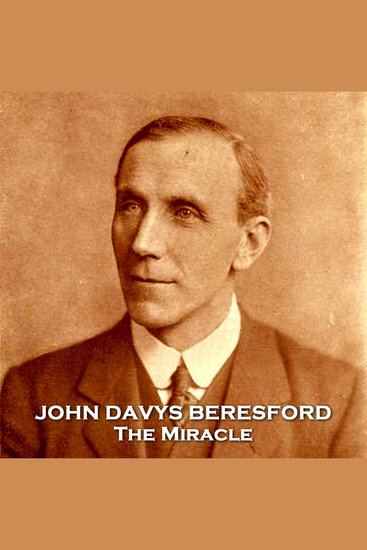
    John Davys Beresford was born on 17th March 1873.  His life was blighted by infantile paralysis which left him partially disabled. 
    After an education at Oundle school he trained to be an architect.  However, he quickly decided that his life was to be centred on a literary career.  His first offerings were in drama and as a journalist. 
    As well as being a book reviewer for the Manchester Guardian he contributed to New Statesman, The Spectator, Westminster Gazette, and the Theosophist magazine The Aryan Path.   
    His spiritual journey in early adulthood had claimed him as an agnostic, in defiance of his clergyman father.  This view he later abandoned in preference to describing himself as a Theosophist and a pacifist. 
    As well as many novels, many themed with spiritual and philosophical elements.  Beresford was also a gifted short story writer particularly across the science-fiction, horror and ghost genres. 
    All of these elements helped him to obtain a prominent place in Edwardian Literary London. 
    John Davys Beresford died on the 2nd February 1947. He was 73.
    Ver libro
  • The Child-Who-Was-Tired - cover

    The Child-Who-Was-Tired

    Katherine Mansfield

    • 0
    • 0
    • 0
    The Child-Who-Was-Tired is a short story by Katherine Mansfield: She was just beginning to walk along a little white road with tall black trees on either side, a little road that led to nowhere, and where nobody walked at all, when a hand gripped her shoulder, shook her, slapped her ear. - “Oh, oh, don’t stop me,” cried the Child-Who-Was-Tired. “Let me go.”
    Ver libro
  • The Story of Doctor Dolittle - cover

    The Story of Doctor Dolittle

    Hugh Lofting

    • 0
    • 0
    • 0
    "Why can't a man learn to speak the language of the beasts?"
    
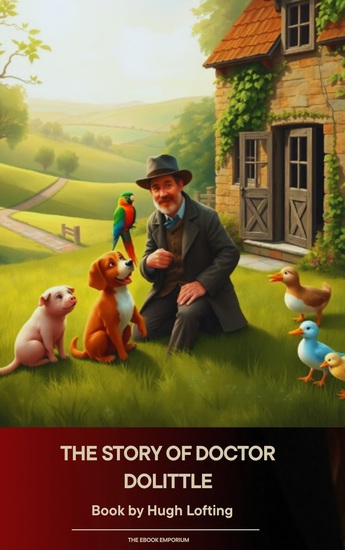
    John Dolittle, MD, is a respected physician in the quiet town of Puddleby-on-the-Marsh—until his growing collection of pets frightens away his human patients. Armed with the secret knowledge passed down by his wise parrot, Polynesia, the Doctor learns to speak the languages of the animal kingdom. From the smallest mouse to the largest elephant, Dolittle becomes the world's first "animal doctor." When a dire message arrives about an epidemic among the monkeys in Africa, the Doctor sets sail on a perilous journey that introduces him to the rarest creatures on Earth, including the two-headed Pushmi-pullyu.
    
    A Legacy of Compassion: Hugh Lofting famously began writing these stories in letters to his children from the trenches of World War I. Seeking an alternative to the violence he witnessed, he created a hero whose greatest weapons are empathy, linguistics, and a deep respect for all living things. The Doctor's house becomes a sanctuary where the "Animal Family"—including Jip the dog, Gub-Gub the pig, and Dab-Dab the duck—live in harmony.
    
    The Grand Adventure: The voyage to Africa is a masterclass in early 20th-century adventure. From escaping the King of the Jolliginki to crossing the "Precipice of the Barbary Coast," Lofting blends high-seas drama with the gentle humor of the Doctor's eccentric personality. It is a story that celebrates the idea that the "wild" world is not a place to be conquered, but a community to be understood.
    
    Discover the magic of communication. Purchase "The Story of Doctor Dolittle" today and start listening to the world around you.
    Ver libro
  • Bolognese Tears - From their pens to your ears genius in every story - cover

    Bolognese Tears - From their...

    Gustav Meyrink

    • 0
    • 0
    • 0
    Gustav Meyrink was born in Vienna on the 19th January, 1868. 
    As a young man he co-founded a bank in Prague, but a personal crisis and a suicide attempt turned his life away from commerce to a study of the occult and a career in literature. 
    His early short stories, supernatural, occult and weird, are full of promise, menace and the unusual. 
    In 1915 he published his landmark novel ‘Der Golem’ and followed these with others which, whilst noted, failed to achieve the extraordinary heights of the first.  Meyrink was also a prolific and gifted translator of the works of Dickens and others into German. 
    After studying Theosophy, Kabbala and other religions he made, in 1927, a late conversion to Buddhism. 
    Gustav Meyrink died in Starnberg, Germany on the 4th December 1932.  He was 64.
    Ver libro
  • At the Mountains of Madness - Part 3 of 12 - cover

    At the Mountains of Madness -...

    H.P. Lovecraft

    • 0
    • 0
    • 0
    More classic horror narrations on Jonathan's YouTube channel: https://www.youtube.com/@JonathanDunneHorrorAudiobooks 
    Title: At the Mountains of Madness — Part 3 of 12 
    Author: H. P. Lovecraft 
    Narrator: Jonathan Dunne 
    Original Publication: 1936 
    Public Domain: Yes 
    Series Placement: Timeless Terrors No. 84 — Part 3 of 12 
    Description: 
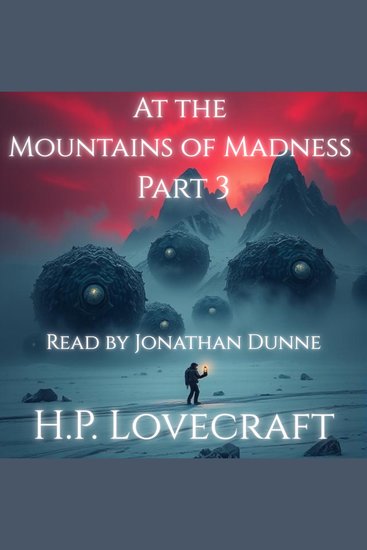
    In Part Three of At the Mountains of Madness, the Miskatonic University expedition presses deeper into its Antarctic investigations, yielding discoveries that challenge every known boundary of biology and history. The strange fossil specimens recovered from the ice reveal anatomies unlike any life forms previously catalogued—intricate, alien, and disturbingly advanced. 
    As the scientists analyze these findings, the narrative delves into detailed comparisons with known terrestrial life, uncovering evolutionary implications that stretch impossibly far into Earth’s prehistoric past. What should be a moment of academic triumph instead becomes a source of growing disquiet, as the evidence hints at an ancient dominance that predates humanity by unfathomable ages. 
    Lovecraft balances meticulous scientific exposition with a steadily tightening sense of dread, allowing the implications of the discoveries to resonate more strongly than any overt horror. The Antarctic setting remains stark and unforgiving, its frozen silence amplifying the unease that now shadows the expedition’s progress. 
    Narrated by Amazon-bestselling horror author Jonathan Dunne, this chapter deepens the mystery and reinforces the cosmic scale of Lovecraft’s vision, as knowledge itself begins to feel like a dangerous pursuit. 
    This is Part 3 of a 12-part complete audiobook series. The revelations grow darker—and the ice holds far more than fossils.
    Ver libro