¡Acompáñanos a viajar por el mundo de los libros!
Añadir este libro a la estantería
Grey
Escribe un nuevo comentario Default profile 50px
Grey
Suscríbete para leer el libro completo o lee las primeras páginas gratis.
All characters reduced
Monopoly Stifles Gains - cover

Monopoly Stifles Gains

Soren Earthwalker

Traductor A AI

Editorial: Publifye

  • 0
  • 0
  • 0

Sinopsis

Monopoly Stifles Gains examines the impact of market concentration on economic inequality, arguing that lax antitrust enforcement has allowed monopolies and oligopolies to flourish, hindering wealth distribution. The book connects Economics and Politics to analyze how failures in antitrust policy affect everyday citizens. It highlights how competitive markets foster innovation and equitable wealth distribution, while concentrated markets depress wages and exacerbate income inequality.

 
The book progresses through three parts, beginning with core concepts of market concentration and the history of antitrust laws. It then presents case studies of industries like technology and healthcare, demonstrating how dominant firms suppress competition and raise prices. Finally, it advocates for stronger antitrust enforcement and policy reforms to promote a more equitable distribution of wealth.

 
The book uniquely correlates industry concentration levels with indicators of income inequality, offering insights for policymakers, entrepreneurs, and consumers alike. The approach taken emphasizes the distributional consequences of unchecked market power, connecting the effects of monopolies to broader societal impacts. It dives into the argument about the role of antitrust laws in shaping economic outcomes, while addressing claims that monopolies are simply the result of superior efficiency or innovation. The book proposes specific policy recommendations, including stricter merger reviews and increased funding for antitrust agencies.
Disponible desde: 26/02/2025.
Longitud de impresión: 75 páginas.

Otros libros que te pueden interesar

  • HOW TO START A VENDING MACHINE BUSINESS - In These 7 Simple Steps You'll Discover How to Create a Monthly Full-Time Income Automatically with Little Budget and No Experience Required (Complete Beginners Guide) - cover

    HOW TO START A VENDING MACHINE...

    Jordan Mallin

    • 0
    • 0
    • 0
    Build a solid and secure business, protected from recession and crisis. 
    Don't miss out on the vending machine business and turn your life around! 
    A profitable and flexible self-employed business allows you to devote time to your family or hobbies. 
    If you are dreaming of something better for your and your family's future, it's time for a change: the vending machine business, a business without high start-up costs and with unbeatable profit margins! 
    Vending machines are everywhere and they work 24 hours a day! 
    Vending machines allow you to create a business even if you do not have a lot of money or perfect business or entrepreneurial knowledge. It only takes a few steps to pay attention to, after which the doors of success will open wide for you. 
    The vending machine market is a billion-dollar-a-year market, constantly growing and requiring minimal investment. An opportunity not to be missed! 
    By reading this guide, you'll understand: 
    - How to plan and prepare for the start of your vending machine business, so it will be successful from the very beginning 
     - What to sell: a detailed analysis of the products to choose from 
     - The right location: all the tricks to choose the best place to install the vending machine 
     - Budget and financing: business analysis, operating cost analysis for making more profit 
     & Much More! 
    You have the opportunity to build with your business a steady income that can easily replace - or even exceed - your salary. 
    Take charge of your life and become your own boss. 
    So... what are you waiting for?Take a step towards the future you deserve: Scroll up and click the "Add to cart" button now!
    Ver libro
  • Objective Secure - cover

    Objective Secure

    Nick Lavery

    • 0
    • 0
    • 0
    Nick Lavery is an active-duty Green Beret within the United States Army Special Forces. Although injuries sustained in combat resulted in the above-the-knee amputation of his leg - Nick not only remained in the Army, he returned to his Special Forces detachment and continues conducting combat operations to this day.Objective Secure is the methodology Nick employed to return to operational status. IT is also the methodology he uses today as he continues this unprecedented journey in service to his country. It is a battle-tested guide forged by fire - literally.Strap in for an impactful ride as Nick methodically explains the objective secure philosophy and system while also providing insight into the events surrounding its necessary creation and implementation. The intent is simple - provide readers the tools necessary to achieve any goal no matter how farfetched, unlikely, or impractical it may seem. Period.
    Ver libro
  • Seeds of Success: A Meditation for Patience in Business - cover

    Seeds of Success: A Meditation...

    Kameta Media

    • 0
    • 0
    • 0
    You can’t lose if you never quit. 
     
    Yet many people give up on their goals simply because of the time it takes to achieve them. But that time will pass either way. 
     
    Cultivating patience in business is an essential skill that will help you through tough times.  
     
    This meditation is designed to increase your patience so you can reach your goals without being impatient. 
     
    This meditation can help you: 
     
    ·      Cultivate patience in business and your career 
    ·      Leverage visualization to help you achieve optimal outcomes 
    ·      Become more patient 
    ·      Reduce stress and anxiety 
     
    Listen today to steer yourself in the right direction–with patience. 
     
    How to Use: 
     
    For some, guided meditation will work the first time.  
     
    For others, it can take multiple sessions.  
     
    You can do this meditation every day until you feel the effects.  
     
    The average time for listeners to feel the mental shift is three weeks of daily meditations.  
     
    Adjust these recommendations to your unique situation.  
     
    Listen when you will not be operating heavy machinery and will not be interrupted. 
     
    This audio is brought to you by Kameta Media, a brand committed to the idea that every person has the power and ability to evolve in ways they never thought possible.
    Ver libro
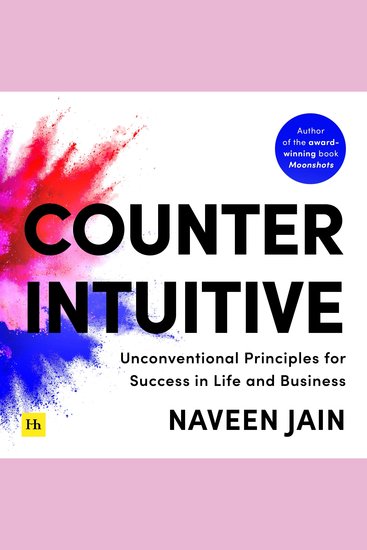
  • Counterintuitive - Unconventional Principles for Success in Life and Business - cover

    Counterintuitive -...

    Naveen Jain

    • 0
    • 0
    • 0
    'A masterclass in challenging assumptions and building ideas that create meaningful impact.'–Jay Shetty, #1 New York Times bestselling author and host of On Purpose podcastMost people spend their lives solving small problems—following rules they never question, chasing goals they didn’t choose, and accepting limits that don’t actually exist.If you’ve ever felt you were meant to play a bigger game, this book shows you how.In Counterintuitive, Naveen Jain—serial entrepreneur, philanthropist, and founder of multiple billion-dollar companies—reveals the way of thinking that allowed him to consistently do what others believed was impossible. Jain shares that his success did not come from being smarter, luckier, or more connected. Instead, it came from asking better questions and challenging the conventional.Breakthrough success doesn’t come from working harder within the system. It comes from stepping outside it entirely. It’s thinking so big that problems become simpler. It’s using imagination as a discipline, not a daydream. And it’s choosing bold optimism when the world insists on cautious realism.This is not a book of tactics. It’s a blueprint for a mindset shift.Inside, you’ll discover:Why thinking bigger is often easier than thinking small—and why the world’s most complex problems are the most solvableHow to unlearn the invisible rules that limit ambition, creativity, and impactHow to train your imagination to see opportunities where others see constraintsThe counterintuitive principles Jain used to build billion-dollar companies, shape industries, and tackle global challenges 
    Blending personal stories, hard-won lessons, and unconventional insights, Counterintuitive challenges you to stop settling for what you’re told is realistic and start reaching for what’s truly possible.
    Ver libro
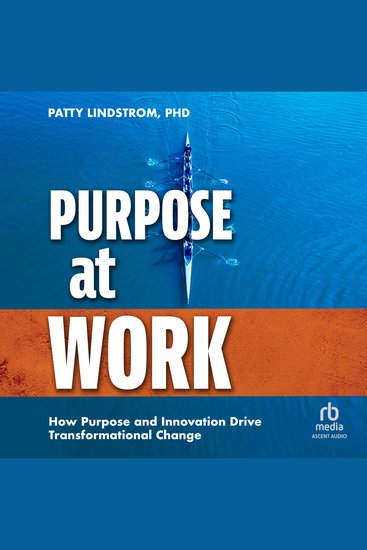
  • Purpose at Work - How Purpose and Innovation Drive Transformational Change - cover

    Purpose at Work - How Purpose...

    Patty Lindstrom

    • 0
    • 0
    • 0
    This book offers practical frameworks, models, and case studies that will help leaders inspire and lead change effectively, making it an essential resource. It belongs on the desks of founders, entrepreneurs, CEOs, leadership teams, HR professionals, managers, and consultants across industries, as well as business students. 
     
    Despite the recognition that innovation is key to growth, many companies struggle to implement it effectively. In this groundbreaking work, Patty Lindstrom introduces a three-dimensional framework for growing an organization's capacity to innovate, focusing on defining, communicating, activating, and embedding purpose. Purpose is not just a concept―it's the catalyst for scalable growth and lasting change. 
     
    Drawing on thirty years of real-world experience and insights from a comprehensive study, Lindstrom explores how purpose impacts individuals, teams, and organizations, driving clarity, confidence, and commitment. She reveals how purpose can enhance innovation capacity, transform organizational culture, and lead to tangible, positive change.
    Ver libro
  • Learn and Understand Economic History - cover

    Learn and Understand Economic...

    Introbooks Team

    • 0
    • 0
    • 0
    Economic compositions date from prior to Mesopotamian, Greek, and Roman, Indian subcontinent, Chinese, Persian, and Arab developments. Eminent authors from old times through the fourteenth century incorporate Aristotle, Xenophon, Chanakya (otherwise called Kautilya), Qin Shi Huang, Thomas Aquinas, and Ibn Khaldun. Joseph Schumpeter portrayed Aquinas as "coming closer than whatever another gathering to being the "organizers" of experimental economic matters" as to money linked, finest, and featured hypothesis inside of a characteristic law perspective. 
    Two gatherings, later on, called "mercantilists" and "physiocrats", more specifically affected the resulting improvement of the subject. Both gatherings were connected with the ascent of monetary patriotism and cutting edge private enterprise in Europe. Mercantilism was an economic precept that thrived from the sixteenth to the eighteenth century in productive leaflet writing, whether of traders or statesmen. It held that a country's riches relied on upon its amassing of gold and silver. Countries without access to mines could get gold and silver from exchange just by offering merchandise abroad and limiting imports other than of gold and silver. The tenet called for importing modest crude materials to be utilized as a part of assembling products, which could be traded, and for state regulation to force defensive levies on remotely fabricated merchandise and preclude fabricating in the colonies. 
    Physiocrats, a group of eighteenth-century French masterminds and authors, added to the economy as a roundabout stream of wage and yield. Physiocrats trusted that just horticultural creation produced an unmistakable surplus over cost, with the goal that farming was the premise of all riches. In this manner, they contradicted the mercantilist approach of advancing assembling and exchange to the detriment of agribusiness, including import taxes. Physiocrats supported supplanting authoritatively expensive assessment accumulations with a solitary duty on the pay of area proprietors. In response to abundant mercantilist exchange regulations, the physiocrats supported an approach of free enterprise, which called for insignificant government mediation in the economy. 
    Adam Smith (1723–1790) was an early economic theorist. Smith was brutally disapproving of the mercantilists yet portrayed the physiocratic scaffold "with every one of its blemishes" as "maybe the purest guess to the reality that has yet been distributed" on the matter. 
    This was the concise introduction to what this course contains. Read out the whole of it to learn all the details. 
    Ver libro