¡Acompáñanos a viajar por el mundo de los libros!
Añadir este libro a la estantería
Grey
Escribe un nuevo comentario Default profile 50px
Grey
Suscríbete para leer el libro completo o lee las primeras páginas gratis.
All characters reduced
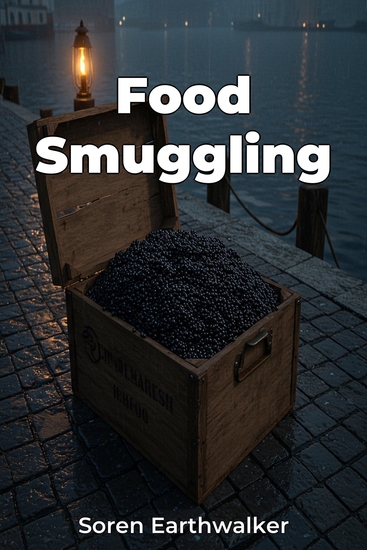
Food Smuggling - cover

Food Smuggling

Soren Earthwalker

Traductor A AI

Editorial: Publifye

  • 0
  • 0
  • 0

Sinopsis

"Food Smuggling" explores the hidden world of illegal food trade, revealing how ordinary items become contraband and fuel complex criminal networks. This true crime and history narrative uncovers the economic incentives, historical roots, and human impact of smuggling. For instance, trade restrictions and tariffs throughout history have driven individuals to risk illegal transportation, mirroring situations from the colonial sugar trade to modern embargoes. The book uniquely blends historical analysis with contemporary case studies. It examines specific smuggled goods—from European dairy products to luxury items like caviar—detailing smuggling routes, involved actors, and consequences for local economies and public health. Furthermore, it highlights how food smuggling, often an economic crime, is a symptom of systemic issues such as unequal resource access and flawed trade policies, reflecting the desperation of those seeking sustenance or profit. The book progresses by first defining food smuggling and differentiating it from legitimate trade. It then delves into case studies and concludes by assessing countermeasures employed by governments and international organizations. This approach offers readers a comprehensive understanding of the complex dynamics within global trade and cross-border law enforcement.
Disponible desde: 11/03/2025.
Longitud de impresión: 72 páginas.
Otros libros que te pueden interesar

  • A Journey of Little Profit - From their pens to your ears genius in every story - cover

    A Journey of Little Profit -...

    John Buchan

    • 0
    • 0
    • 0
    The Scottish novelist John Buchan enjoyed a remarkable career as politician, historian and Governor General. He was born John Buchan on 26th August 1875 and later added 1st Baron Tweedsmuir PC GCMG GCVO CH to his name.  
    Buchan studied at Hutchesons’ Grammar School, Glasgow and at seventeen won a scholarship to the University of Glasgow to study classics. There he began to write poetry. In 1895 he transferred to Oxford to continue his study of Classics and in 1896 ‘Sir Quixote of the Moors’ was published followed by the non-fiction ‘Scholar-Gipsies’. His prolific literary output now hardly faltered. 
    He graduated in 1900 and became the private secretary to Alfred Milner, the High Commissioner for Southern Africa and other colonies. Buchan found the same inspiration in the African landscape as he had in the Scottish Borders, and would later set many works here. Returning to London he became a partner in a publishing house, and garnered an editorial role at The Spectator. He also completed his law studies. He was called to the bar in 1901 but never practiced.  
    On 15th July 1907 Buchan married Susan Charlotte Grosvenor, the cousin of the Duke of Westminster. In 1910 he wrote ‘Prester John’, the first of a series set in South Africa.  
    In 1911 Buchan entered politics as a Unionist candidate in the Scottish Borders advocating the support of free trade, women’s suffrage, national insurance, and reducing the power of the House of Lords.  
    The Great War saw Buchan writing for the War Propaganda Bureau and as Times correspondent in France. In 1915, he published ‘The Thirty-Nine Steps’, his most famous book and a follow-up Richard Hannay novel, ‘Greenmantle’, in 1916.  
    In 1916 Buchan enlisted in the Intelligence Corps which included writing speeches for Sir Douglas Haig. By 1917 he was Director of Information under Lord Beaverbrook. Buchan called it “the toughest job he ever took on”. He somehow found time to assist in a history of the war magazine. This was later published in 24 volumes: Nelson’s History of the War. 
    After the war his writing focused on historical studies. In 1927 Buchan became the Unionist Party Member of Parliament for the Combined Scottish Universities. In a speech to Parliament he said “I believe every Scotsman should be a Scottish nationalist. If it could be proved that a Scottish parliament were desirable… Scotsmen should support it.”  
    Over the next decade he continued to distinguish himself politically and in literature.  On the 1st June 1935 he became 1st Baron Tweedsmuir of Elsfield in the County of Oxford.  
    He was now also given the position of Governor General in Canada and resolved to travel all over Canada to gain a better insight of the country. Having crossed both length and breadth he saw the cultural shift between areas and their common ground and helped bring about a clear national Canadian identity. 
    On the 6th February 1940 he collapsed from a stroke and sustained a very serious head injury in falling. Two rounds of surgery to stabilise his condition were unsuccessful and Buchan died on the 11th February. After a state funeral in Ottawa his ashes were returned to his estate in Oxfordshire.
    Ver libro
  • Nine Years Among the Indians: 1870-1879 - The Story of the Captivity and Life of a Texan Among the Indians - cover

    Nine Years Among the Indians:...

    Herman Lehmann

    • 0
    • 0
    • 0
    Nine Years Among the Indians is an autobiography of Herman Lehmann, who was an eleven-year-old boy when he was captured by a raiding party of eight to ten Apaches alongside his older brother Willie. The Apaches called Lehmann "En Da" (White Boy). He spent about six years with them and became assimilated into their culture, rising to the position of petty chief. As a young warrior, one of his most memorable battles was a running fight with the Texas Rangers on August 24, 1875, which took place near Fort Concho, about 65 miles west of the site of San Angelo, Texas.The phenomenon of a white child raised by Indians made Herman Lehmann a notable figure in the United States.
    Ver libro
  • Metamorphosis - An Anthology - cover

    Metamorphosis - An Anthology

    Joe Graves, Devon Ortega

    • 0
    • 0
    • 0
    "Change is natural—beautiful, cathartic, necessary. But change is also painful, ugly,vdestructive. It’s one of life’s only constants. You can either embrace it or struggle against it. But it’s unlikely you’ll ever stop it. This collection of 29 short stories, poems, and essays will take your breath away, break your heart, and even inspire transformation in your life. Because there’s no time like the present to break out of your shell, spread your wings, and embrace your own metamorphosis. Written by members of The Ohio Writers’ Association. This is their second audio book collaboration with members of the Ohio Audiobook Narrators. """"Wild Animals"""" by James Siegel, narrated by Gretchen LaBuhn """"Upon The Zinnia Petal"""" by Curtis Deeter, narrated by Gary Smith """"The Hidden"""" by Ellen Austin-Li, narrated by Angus Freathy """"The Sisters"""" by Jamie Galioto, narrated by Danielle Muething """"Chaoyangia"""" by Dong Isbister, narrated by Doug McDonald """"A Place For My Brother"""" by Susan Oelbracht, narrated by Doug McDonald """"Spring Forward"""" by Elizabeth Barrickman, narrated by Angus Freathy """"Experiments In Living Chemistry"""" by Kelly Ferguson, narrated by Gretchen LaBuhn """"I Am Gilgamesh"""" by John Graham, narrated by Rob Reider """"On Seeing My Great Granddaughter In The Womb"""" by Robin Mullet, narrated by Becky White """"Lump"""" by Devon Ortega, narrated by Danielle Muething """"Transparent"""" by Heidi Heiby, narrated by Danielle Muething """"Miracle Of The Mass"""" by Charlene Fix, narrated by Angus Freathy """"My Patient, My Aunt"""" by Nadia Ibrashi, narrated by Becky White """"Mystery School"""" by Nadia Ibrashi, narrated by Becky White """"Negala Clouds"""" by Felicia Cameron, narrated by Rob Reider """"The Blown Harp Lesson"""" by Pamela Spence, narrated by Angus Freathy """"The Rift by Timothy Doyle"""" narrated by Doug McDonald """"The Guts That Come With Love"""" by Schyler Butler, narrated by Angus Freathy """"The Sheriff"""" by George Pallas, narated by Doug McDonald Unbecoming"""" by Devon Ortega, narrated by Gretchen LaBuhn """"Red: A Fairy Tale"""" by Jim Hodnett, narrated by Danielle Muething """"The Last Susan"""" by Christina Moore, narrated by Angus Freathy """"Aubade"""" by Karen Schubert, narrated by Becky White """"Grandma Teague And Me"""" by Stella Ling, narrated by Gretchen LaBuhn """"At The Crossing"""" by Kathy Nicklaus, narrated by Doug McDonald """"Eight Billion Wolves"""" by Jeffrey Mckee, narrated by Doug McDonald """"Fair Flip"""" by Charles O'Donnell, narrated by Gary Smith """"On The Way To Proximata"""" by Joseph Graves, narrated by Becky White & Gary Smith "
    Ver libro
  • A Man with Two Lives - From their pens to your ears genius in every story - cover

    A Man with Two Lives - From...

    Ambrose Bierce

    • 0
    • 0
    • 0
    Ambrose Gwinnett Bierce was born on 24th June 1842 at Horse Cave Creek in Meigs County, Ohio. His parents were poor but they introduced him to literature at an early age, instilling in him a deep appreciation of books, the written word and the elegance of language.  
    Growing up in Koscuisko County, Indiana poverty and religion were defining features of his childhood, and he would later describe his parents as “unwashed savages” and fanatically religious, showing him little affection but always quick to punish. He came to resent religion, and his introduction to literature appears to be their only positive effect. 
    At age 15 Bierce left home to become a printer’s devil, mixing ink and fetching type at The Northern Indian, a small Ohio paper. Falsely accused of theft he returned to his farm and spent time sending out work in the hopes of being published. 
    His Uncle Lucius advised he be sent to the Kentucky Military Institute. A year later he was commissioned as an Officer.  As the Civil War started Bierce enlisted in the 9th Indiana Infantry Regiment.  
    In April 1862 Bierce fought at the Battle of Shiloh, an experience which, though terrifying, became the source of several short stories. Two years later he sustained a serious head wound and was off duty for several months. He was discharged in early 1865.  
    A later expedition to inspect military outposts across the Great Plains took him all the way to San Francisco. He remained there to become involved with publishing and editing and to marry, Mary Ellen on Christmas Day 1871.  They had a child, Day, the following year.  
    In 1872 the family moved to England for 3 years where he wrote for Fun magazine. His son, Leigh, was born, and first book, ‘The Fiend’s Delight’, was published.  
    They returned to San Francisco and to work for a number of papers where he gained admiration for his crime reporting. In 1887 he began a column at the William Randolph Hearst’s San Francisco Examiner.  
    Bierce’s marriage fell apart when he discovered compromising letters to his wife from a secret admirer. The following year, 1889 his son Day committed suicide, depressed by romantic rejection. 
    In 1891 Bierce wrote and published the collection of 26 short stories which included ‘An Occurrence at Owl Creek Bridge’.  Success and further works including poetry followed.  
    Bierce with Hearst’s resources helped uncover a financial plot by a railroad to turn 130 million dollars of loans into a handout. Confronted by the railroad and asked to name his price Bierce answered “my price is $130 million dollars. If, when you are ready to pay, I happen to be out of town, you may hand it over to my friend, the Treasurer of the United States”.  
    He now began his first foray as a fabulist, publishing ‘Fantastic Fables’ in 1899.  But tragedy again struck two years later when his second son Leigh died of pneumonia relating to his alcoholism.  
    He continued to write short stories and poetry and also published ‘The Devil’s Dictionary’.  
    At the age of 71, in 1913 Bierce departed from Washington, D.C., for a tour of the battlefields where he had fought during the civil war. At the city of Chihuahua he wrote his last known communication, a letter to a friend. It’s closing words were “as to me, I leave here tomorrow for an unknown destination,” Ambrose Bierce then vanished without trace.
    Ver libro
  • Russian Short Story The - Volume 1 - Alexander Pushkin to Nikolai Gogol - cover

    Russian Short Story The - Volume...

    Alexander Puskin, Nikolái Gógol

    • 0
    • 0
    • 0
    The Russian novel has a reputation that is immense, both in narrative and in length.  Unquestionably though the ideas, themes and characters make many novels rightly revered as world class, as icons of literature. 
     
    Perhaps an easier way to enjoy a wider selection of the Russian heritage, with its varied and glorious literary talents, is with the short story.  These gems sparkle and beguile the mind with their characters and narrative, exploring facets of society and the human condition that more Western authors somehow find more difficult to navigate, or to explore, explain and relate to.   
     
    The Russian short story is, in many respects, in a genre of its own.  It is at its captivating best whether it’s an exploration of real-life experiences, through fantasy and fables and on to total absurdity. 
     
    In a land so vast it is unsurprising that it is a world almost unto itself. Cultures and landscapes of differing hues are packed together bound only by the wilful bonds and force of Empire. 
     
    The stories in this collection traverse the decades where one might be a serf under an absolute monarch, and the reality of that was pretty near to slavery, into an emancipation of sorts in the fields, or towns under the despotic will of landowners and the rich into the upheavals of Empire and then the overthrow of the ruling class and its replacement by the communists, who promised equality for all and delivered a society where the down-trodden remained the lowest yet vital cog of the state machine and its will.  
     
    Whilst Tolstoy, Gogol, Dostoevsky, Pushkin and Chekhov are a given in any Russian collection we also explore and include Andreyev, Korolenko, Turgenev, Blavatsky and many others to create a world rich and dense across a sprawling landscape of diverse people, riddled with the class and unfairness in perhaps some of the most turbulent times that Russia has ever experienced. 
     
    01 - The Russian Short Story - Volume 1 - An Introduction 
    02 - The Queen of Spades by Alexander Pushkin 
    03 - The Stationmaster by Alexander Pushkin 
    04 - The Blizzard by Alexander Pushkin 
    05 - The Coffin Maker by Alexander Pushkin 
    06 - The Shot by Alexander Pushkin 
    07 - St Johns Eve by Nikolai Gogol 
    08 - The Cloak by Nikolai Gogol also known as 'The Overcoat' 
    09 - Old Fashioned Landowners by Nikolai Gogol 
    10 - The Nose by Nikolai Gogol
    Ver libro
  • 18 Long Lived Communities around the World - cover

    18 Long Lived Communities around...

    Martin K. Ettington

    • 0
    • 0
    • 0
    This book is about communities and cities around the world where people live to very old ages.It is divided into two groups. Those communities who have the longest lived peoples in the world. Lots of lifestyle and diet data is included for them.The second group are another set of communities which have high average ages which people live to but are not quite the outliers that the first group is.I’ve also tried to provide some general lifestyle and diet guidelines to give an idea of why these places are different for longevity purposes.The first four communities were also profiled in my book “Diets and Lifestyles of the World's Oldest Peoples & 32 Longevity Recipes” which goes into lot of details about these four locations including traditional recipes.Overall, I think you will get a better idea of what the reasons are why people live a long time in these locations around the world which may give you ideas about adapting your lifestyle and diets to have maximum longevity.
    Ver libro