Join us on a literary world trip!
Add this book to bookshelf
Grey
Write a new comment Default profile 50px
Grey
Subscribe to read the full book or read the first pages for free!
All characters reduced
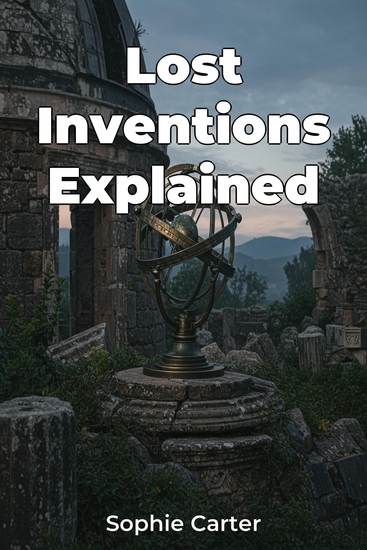
Lost Inventions Explained - cover

Lost Inventions Explained

Sophie Carter

Translator A AI

Publisher: Publifye

  • 0
  • 0
  • 0

Summary

"Lost Inventions Explained" explores the fascinating world of forgotten technologies, examining why some innovations thrived while others faded into obscurity. The book challenges the idea of linear technological progress by showcasing ingenious devices from ancient civilizations to abandoned prototypes, revealing that societal acceptance and resource availability often dictate an invention's fate, not just its inherent merit. For instance, advanced metallurgical techniques of the ancient world were lost, only to be rediscovered centuries later. 

 
The book adopts a multifaceted approach, drawing from archaeological findings, historical documents, and scientific analyses to reconstruct the stories behind these lost inventions. It presents case studies from various historical periods, including ancient marvels, Renaissance-era inventions, and 19th and 20th-century prototypes, to illustrate the complex interplay between technology, society, and economics. 

 
Each chapter builds upon the previous one, progressively revealing how understanding these "forgotten technology" examples can inspire new approaches to problem-solving and promote sustainable innovation today.
Available since: 03/31/2025.
Print length: 56 pages.

Other books that might interest you

  • Behind Academy Doors - Yuri Anime - cover

    Behind Academy Doors - Yuri Anime

    Rainbow Press

    • 0
    • 0
    • 0
    The things that go on behind closed doors… 
      
    Hanita and Oni — schoolmates, yes. But more?
    Show book
  • Liberal White Supremacy - How Progressives Silence Racial and Class Oppression - cover

    Liberal White Supremacy - How...

    Angie Beeman

    • 0
    • 0
    • 0
    In Liberal White Supremacy, Angie Beeman argues that white supremacy is maintained not only by right-wing conservatives or stereotypically uneducated working-class racial bigots but also by progressives who operate from a liberal ideology of color-blindness, racism-evasiveness, and class elitism. This distinction provides insight on divisions among progressives at the local level, in community organizations, and at the national level, in the Democratic Party. By distinguishing between liberal and radical approaches to racism, class oppression, capitalism, and social movement tactics, Beeman shows how progressives continue to be limited by liberal ideology and perpetuate rather than dismantle white supremacy, all while claiming to be antiracist. 


    She conceptualizes this self-serving process as "liberal white supremacy," the tendency for liberal European Americans to constantly place themselves in the superior moral position in a way that reinforces inequality. Beeman advances what she calls action-oriented and racism-centered intersectional approaches as alternatives to progressive organizational strategies that either downplay racism in favor of a class-centered approach or take a talk-centered approach to racism without developing explicit actions to challenge it.
    Show book
  • Kierkegaard - Existentialism and the Leap of Faith - cover

    Kierkegaard - Existentialism and...

    Hector Davidson

    • 0
    • 0
    • 0
    Søren Kierkegaard, often regarded as the father of existentialism, was born on May 5, 1813, in Copenhagen, Denmark. His early life was marked by tragedy, as his mother died when he was just a child, and his father, a deeply religious man, instilled in him a sense of guilt and the weight of existential questioning. Kierkegaard’s relationship with his father deeply influenced his philosophical development, particularly in his exploration of faith, despair, and the individual's relationship with God. 
    Kierkegaard’s intellectual journey began at the University of Copenhagen, where he studied theology and philosophy. He was deeply influenced by the works of philosophers such as Immanuel Kant and Friedrich Hegel, yet he sought to diverge from the systematic and rational approaches of these thinkers. Instead, he focused on the subjective aspects of human experience, emphasizing personal choice, individual responsibility, and the need for authentic existence. Kierkegaard believed that philosophy should not merely be an abstract pursuit but should directly address the real, lived experiences of individuals. 
    One of Kierkegaard's most significant contributions to philosophy was his critique of the established norms of society and religion. He believed that individuals often live in a state of "inauthenticity," blindly following social conventions and doctrines without truly reflecting on their own beliefs. For Kierkegaard, true existence could only be achieved through the individual’s leap of faith—an existential act that transcends reason and embraces the paradoxical nature of human life.
    Show book
  • Roman Innovations - Engineering Marvels of the Ancient World - cover

    Roman Innovations - Engineering...

    Rogan Fish

    • 0
    • 0
    • 0
    Roman engineering formed the bedrock upon which the Roman Empire’s power and prosperity were built. The Romans, known for their advanced construction techniques, utilized a deep understanding of engineering principles to create infrastructure that stood the test of time. The strategic use of roads, bridges, and construction materials allowed them to expand and maintain control over their vast empire. Roman innovations not only provided practical solutions to everyday challenges but also played a pivotal role in shaping the empire’s military, economic, and social systems. 
    The Romans’ extensive network of roads was one of the cornerstones of their engineering achievements. Roads connected distant regions of the empire, facilitating trade, communication, and the rapid movement of the Roman military. These roads were engineered with precision, employing layers of different materials to ensure durability and effectiveness in various terrains. The roads, often straight and well-maintained, allowed the Roman legions to travel efficiently and helped bind together the sprawling empire. 
    Roman construction materials were key to their engineering marvels. One of the most significant Roman innovations was the development of concrete, a material that enabled the Romans to build large, durable structures such as aqueducts, bridges, and amphitheaters. Roman concrete, made from a mixture of volcanic ash, lime, and seawater, was stronger and more water-resistant than earlier forms of concrete. This breakthrough allowed for the creation of monumental structures, such as the Colosseum and the Pantheon, that could withstand the test of time and the elements.
    Show book
  • Timeless Wisdom of Epictetus The: Philosophy for Modern Life [Illustrated and Annotated] - cover

    Timeless Wisdom of Epictetus...

    Andrew Weston, Epictetus

    • 0
    • 0
    • 0
    Get ready to immerse yourself in the enduring power of Epictetus’ Stoic philosophy, brought to life by the strong, masculine voice of a rugged outdoors philosopher, also known as "the rucking philosopher." This audiobook isn’t just a recitation—it’s a bold journey into the timeless lessons of resilience, inner strength, and true freedom. 
    Epictetus’ wisdom offers profound guidance for today’s turbulent world. This modernized version makes his teachings more accessible, while preserving the depth of his philosophy. As you listen, you’ll feel as though you’re trekking alongside a philosopher through life’s rocky and rough terrain—listening to the wisdom of the ancients. All the while rekindling your connection with your civilizational origins and gaining insight from the teachings of Epictetus on how to navigate life’s challenges with a steadfast mind. 
    This audiobook bridges ancient wisdom with modern struggles, guiding you through life’s complexities with clarity and conviction. Whether you’re dealing with personal loss, professional hurdles, or seeking purpose, Epictetus’ guidance becomes a practical toolkit for living well. 
    Let the commanding, grounded narration inspire you to find peace, power, and purpose—no matter what life throws your way.
    Show book
  • The Wounds Are the Witness - Black Faith Weaving Memory into Justice and Healing - cover

    The Wounds Are the Witness -...

    Yolanda Pierce

    • 0
    • 0
    • 0
    From celebrated scholar Dr. Yolanda Pierce comes this indelible meditation on Black faith, suffering, hope, and the healing possibilities of justice, written in the venerable tradition of James Cone and Kelly Brown Douglas. 
      
    What do we do with wounds—our own, others', and a nation's? We can turn away, avert our gaze. We can make a spectacle of suffering. Or like the doubting disciple who longed to touch Jesus's side, we can acquaint ourselves with the wounds: both the story they tell and the healing they prefigure. 
      
    In The Wounds Are the Witness, Yolanda Pierce, dean of Vanderbilt University Divinity School and author of In My Grandmother's House, weaves together her own memories, vignettes from Black life, and scenes from scripture, especially the passion of Christ. To work for liberation in a broken world, we cannot look away from crucified flesh. Bones from the Middle Passage, GI Bill benefits denied to Black veterans, women inmates shackled while giving birth: we must take all such wounds seriously. They testify to both the pain and the faith of a people. 
      
    With the lyrical eye of a poet and the moral precision of a preacher, Pierce casts readers into the astounding story of God's healing. From the curative powers of a spiderweb to the work of justice in history, politics, medicine, higher education, and the Black church, Pierce asks: Where are the remedies for the battered and broken? What does accountability look like? Is there any cure? 
      
    Healing takes time, Pierce writes, and even the wounds of the risen Christ do not immediately close. When the wounds become the witness, we find a faith reimagined and a hope transfigured. They tell the truth: about the extent of the injury and the extraordinary work of healing.
    Show book