Junte-se a nós em uma viagem ao mundo dos livros!
Adicionar este livro à prateleira
Grey
Deixe um novo comentário Default profile 50px
Grey
Assine para ler o livro completo ou leia as primeiras páginas de graça!
All characters reduced
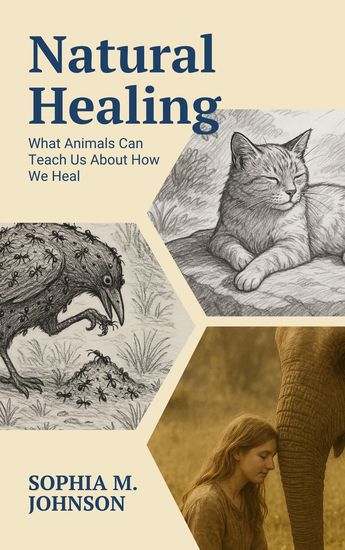
Natural Healing - What Animals Can Teach Us About How We Heal - cover
LER

Natural Healing - What Animals Can Teach Us About How We Heal

Sophia M. Johnson

Editora: Knowledge Lighthouse

  • 1
  • 0
  • 0

Sinopse

When pain enters our lives—whether physical, emotional, or spiritual—we search for solutions in pills, protocols, or progress. But in the quiet corners of nature, animals have been healing themselves long before humans built hospitals.
 
“Natural Healing” invites readers on a captivating journey into the instinctive recovery wisdom of the animal world. From the fevered stillness of a wounded deer to the sun-seeking stretches of a stray cat, and the grieving rituals of elephants, each species holds ancient lessons in how to restore balance, survive trauma, and reclaim vitality.
 
Blending behavioral science, evolutionary insight, and poetic observation, the Author explores how animals respond to wounds with patterns of stillness, warmth, fasting, touch, and care—patterns we’ve nearly forgotten. Each chapter draws parallels between animal instincts and modern healing choices, revealing a deeper rhythm of recovery that transcends species.
 
This is a book for anyone who senses that true healing isn’t a product—it’s a process rooted in nature, memory, and the shared biology of all living things.
Disponível desde: 09/08/2025.
Comprimento de impressão: 187 páginas.


Outros livros que poderiam interessá-lo

  • Doctor's In The: Treating America's Greatest Cyber Security Threat - cover

    Doctor's In The: Treating...

    Alan D. Weinberger, CJ Arlotta

    • 0
    • 0
    • 0
    About the Book 
    Many have compared the “Roaring Twenties” from the last century, to the 2020s of the 21st century. The new freedoms of this era (similar to 100 years ago) have caused disruptions, mainly as the Internet ‘flattens’ our world and accelerates outcomes that can be felt around the globe. One certainty, no matter how the new economic, political, and social structures will evolve, is the appearance of bad actors that will continue to use cyber warfare and cyber insecurity to their benefit. This book details in an easy-to-read format how we can best protect our “life, liberty and pursuit of happiness” in our new digital age.
    Ver livro
  • How to Lose the Hounds - Maroon Geographies and a World Beyond Policing - cover

    How to Lose the Hounds - Maroon...

    Celeste Winston

    • 0
    • 0
    • 0
    In How to Lose the Hounds Celeste Winston explores marronage—the practice of flight from and placemaking beyond slavery—as a guide to police abolition. She examines historically Black maroon communities in the Maryland suburbs of Washington, DC, that have been subjected to violent excesses of police power from slavery until the present day. Tracing the long and ongoing historical geography of Black freedom struggles in the face of anti-Black police violence in these communities, Winston shows how marronage provides critical lessons for reimagining public safety and community well-being. These freedom struggles take place in what Winston calls maroon geographies—sites of flight from slavery and the spaces of freedom produced in multigenerational Black communities. Maroon geographies constitute part of a Black placemaking tradition that asserts life-affirming forms of community. Winston contends that maroon geographies operate as a central method of Black flight, holding ground, and constructing places of freedom in ways that imagine and plan a world beyond policing.
    Ver livro
  • The Philosophy of Social Ecology - Essays on Dialectical Naturalism - cover

    The Philosophy of Social Ecology...

    Murray Bookchin, Todd McGowan

    • 0
    • 0
    • 0
    What is nature? What is humanity's place in nature? And what is the relationship of society to the natural world? In an era of ecological breakdown, answering these questions has become of momentous importance for our everyday lives and for the future that we and other life-forms face. In the essays of The Philosophy of Social Ecology, Murray Bookchin confronts these questions head on: invoking the ideas of mutualism, self-organization, and unity in diversity, in the service of ever expanding freedom. 


    Refreshingly polemical and deeply philosophical, these essays take issue with technocratic and mechanistic ways of understanding and relating to, and within, nature. More importantly, they develop a solid, historically and politically based ethical foundation for social ecology, the field that Bookchin himself created and that offers us hope in the midst of our climate catastrophe.
    Ver livro
  • Portrait to Landscape - A Landscape Strategy to Reframe Our Future - cover

    Portrait to Landscape - A...

    Alexandra Steed

    • 0
    • 0
    • 0
    Portrait to Landscape: A Landscape Strategy to Reframe Our Future is a ground-breaking book that calls for a transformative shift in our relationship with the natural world. Written by a renowned landscape architect, this book offers a new perspective on our place in the world and a compelling vision for a regenerative future. 
    In an era plagued by environmental disasters and global challenges, the book argues that our exploitative and fragmented relationship with nature is at the root of these issues. Drawing upon the metaphor of a self-focused portrait versus a wide-angle landscape view, the book illuminates the profound impact of our narrow perspective. It offers a roadmap for reconnecting with the larger community of life. 
    Through a captivating narrative, the author explores the interconnectedness of the living world and the urgent need to shift from a human-centric mindset to one that embraces the wisdom of nature. It demonstrates with inspiring examples from around the world how landscapes can become catalysts for healing and regeneration, leading to improved well-being and sustainability. 
    Portrait to Landscape presents a holistic approach to restoring the earth, addressing not only the symptoms but also the underlying causes of environmental degradation. The book outlines practical strategies for policymakers, activists, and individuals to protect and restore landscapes, emphasising collaboration and long-term stewardship. 
    With passion and expertise, the book calls on global citizens to take action and become active participants in the healing process. It offers a powerful message of hope and possibility. 
    This thought-provoking book will inspire readers to join the movement towards a more sustainable and regenerative future. It is a must-read for anyone seeking a deeper understanding of our place in the world and how we can inhabit it with integrity.
    Ver livro
  • Paleontology and Evolution - Tracing Ancient Life and Environments (3 in 1) - cover

    Paleontology and Evolution -...

    Mike Crawford

    • 0
    • 0
    • 0
    This book combo brings the prehistoric world to life through the study of ancient plants, animals, and climates. This compelling volume reveals how Earth’s long and complex history has shaped life as we know it—and how fossils, sediments, and ice cores serve as the time machines of science. 
    Begin with Paleobotany, the study of fossilized plants, and uncover how forests once grew where deserts now lie. Through preserved leaves, pollen, and wood, scientists reconstruct past ecosystems, trace plant evolution, and discover how vegetation adapted to shifting environments over millions of years. 
    Next, delve into Paleozoology, which focuses on the remains of ancient animals—from dinosaurs and mammoths to tiny marine creatures. Learn how skeletal remains, footprints, and fossilized behavior reveal evolutionary changes, predator-prey relationships, extinction events, and the rise of new species over geological time. 
    Finally, explore Paleoclimatology, the science of past climates. By analyzing tree rings, ice cores, and ocean sediments, researchers piece together Earth’s shifting temperatures, atmospheric conditions, and major climate events. This field is essential for understanding long-term climate cycles and their influence on both extinction and evolution. 
    Together, these disciplines create a vivid picture of Earth’s ancient biosphere, showing how life, land, and climate have evolved in tandem over hundreds of millions of years. Ideal for students, educators, and history-of-science enthusiasts, this volume opens a window into the deep past and its relevance to today’s environmental challenges.
    Ver livro
  • The Fifth History of Man - cover

    The Fifth History of Man

    MD John Bershof

    • 0
    • 0
    • 0
    In the spirit of medieval writer Chaucer, all human activity lies within the artist’s scope, the History of Man Series uses medicine as a jumping off point to explore precisely that, all history, all science, all human activity since the beginning of time. The jumping off style of writing takes the reader, the listener into worlds unknown, always returning to base, only to jump off again. History of Man are stories and tales of nearly everything. 
    The Fifth History of Man has a few parting shots at viruses but mostly continues with the world of parasites, from tick disease that tick us off, Old Lyme, Connecticut and Lyme disease, toxoplasmosis, Crazy Cat Lady and her clowder of cats, then on into a discussion of the avatar of parasites: malaria. Our travels will venture down into the valley: Valley Girls, Valspeak, Valley Fever, fungus and fungal infections. We’ll jump into the biology of evolution, Darwin, Huxley and the great debates, the geology of earthquakes, volcanos, the Ring of Fire, and Johnny Cash, and then through the homos: Homo habilis, Homo erectus, and Homo sapiens, and once the dust cleared how the opposable thumbs, walking erect, and bigger brains left one man standing, one woman, too. No discussion of human history can leave out the G.O.A.T. of French history, heck, of European history; the man, the legend, Napoleon Bonaparte, loved and admired by everyone, even his enemies. Our path will take us into war & military, World War I versus the 1918 Swine Flu, some Russian history and how Stalin got Lenin wrong.
    Ver livro