¡Acompáñanos a viajar por el mundo de los libros!
Añadir este libro a la estantería
Grey
Escribe un nuevo comentario Default profile 50px
Grey
Suscríbete para leer el libro completo o lee las primeras páginas gratis.
All characters reduced
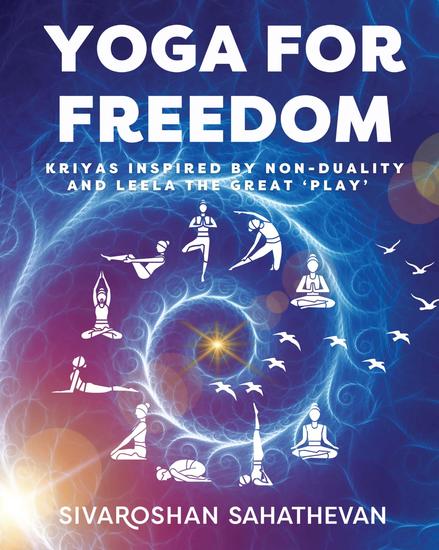
Yoga for Freedom - cover

Yoga for Freedom

Sivaroshan Sahathevan

Editorial: Grosvenor House Publishing

  • 0
  • 0
  • 0

Sinopsis

What does it mean to be Free?
To answer this question, it is useful to have a sense of what may contain us. At first we may attribute such to everyday issues: money, health, relationships etc. Yet, if we choose to see more deeply we understand that the origin is more subtle, emanating from the domain of 'Mind'. This book's foundational intention is to liberate ourselves from an unscrupulous mind and reveal our true essence.
Inspired by Advaita (non duality) and Leela (the great play) it uses the potency of Kriya (sequences of yoga postures, pranayama & mantra) to help us carve our path to freedom.
Disponible desde: 17/04/2025.
Longitud de impresión: 103 páginas.

Otros libros que te pueden interesar

  • Viracocha: The History and Legacy of the Inca’s Creator God - cover

    Viracocha: The History and...

    Editors Charles River

    • 0
    • 0
    • 0
    Although the Inca’s oral traditions suggested that the history of the region began with their empire, the various gods and the religious ceremonies of the peoples that inhabited the Inca’s lands before their arrival were assimilated into the Inca Empire and were incorporated into Inca religion. However, under Inca rule, all those gods were to be subordinate to those gods of the Incas themselves, so as to ensure that imperial authority was clear and without dispute among all quarters of the empire.  
    	Viracocha was the primary god in the Inca pantheon as the origin and creator of all things. His son, the god Inti, or the Sun, was married to Mama Quilla, the Moon, who was also created by Viracocha. According to one myth, Inti was the father of Manco Cápac, the founder of the Inca ruling dynasty, but it was believed by some that Viracocha himself fathered Manco Cápac. In practice, the Inca centered their religious worship on Inti, and this god's High Priest was the second most important person in Inca society. The god Inti was honored at an annual celebration held each June, and the Inti Raymi festival included sacrifices, feasts and sexual abstinence. This cosmology was imposed throughout the empire, and temples to the Sun were constructed and staffed by religious officials who were allotted farmland called “lands of the Sun.” Other local cults were provided with produce from these lands as well.  
    	The main temple of Inca religion was the Coricancha or Sun Temple in Cuzco, in which was kept the great golden disk of the Sun. The disk was appropriated by the Spanish in 1571 and sent off to the Pope. While it has disappeared, perhaps lost somewhere during the tortuous route to Spain, it remains alive in the fabulous world of adventure story writers, New Age mystics and manufacturers of souvenirs. It became a major element in the iconography of the 19th century independence movement in South America.
    Ver libro
  • Dangerous Theatre - The Federal Theatre Project as a Forum for New Plays - cover

    Dangerous Theatre - The Federal...

    George Kazacoff

    • 0
    • 0
    • 0
    Dangerous Theatre records the activities of the various organizations of the Federal Theatre Project involved with fostering the writing and production of new plays during the FTP's existence (1935-39). It presents a comprehensive and thorough picture of how playwrights actually worked and how their work was received by general audiences and critics. A critical perspective is established explaining how, why, and to what extent the aims of the FTP with regard to promoting new plays were, or were not achieved. "The Federal Theatre Project - one of the most ambitious and successful public enterprises in theatre (in America or anywhere) - is too often overlooked. FTP influenced theatre directing and staging, artists' approach to social issues, and playwriting for decades to come. It showed how public support for the performing arts can foster good art and lively debate while maintaining strong links to things that matter to masses of people: jobs, housing, peace, food, family relations. George Kazacoff's study of how the FTP provided places for new plays to be tested is an in1portant contribution not only to theatre scholarship but to An1erican history." -Richard Schechner New York University "Had it not been for the diligent investigations of George Kazacoff, it would still be a mystery. Now, however, it's finally possible to learn what Arthur Miller wrote for the Federal Theater's new plays project. In Dangerous Theatre, Kazacoff reveals who the subsidized playwrights were, what kind of plays they wrote-and how they related to the Depression Era, and, most important, how they were received by Federal Theatre readers and American audiences, when they were perfom1ed. While no great masterpieces emerged, the project was an important experiment in American Theatre. Kazacoff has now provided a missing chapter in our theatre history." - Glenn Loney The Graduate School and University Center of the City University of New York
    Ver libro
  • The Tragedy of White Injustice - (BCP Pamphlet) - cover

    The Tragedy of White Injustice -...

    Marcus Garvey

    • 0
    • 0
    • 0
    Marcus Garvey's The Tragedy of White Injustice is a powerful indictment of white racism and colonialism. Garvey argues that the white race has a long history of oppressing and exploiting non-white people all over the world, and that white racism is not simply a matter of individual prejudice, but rather a deeply ingrained system of oppression that is maintained by white institutions and social structures. Garvey also discusses the impact of white racism on Black people, arguing that it has caused them to suffer physical, psychological, and spiritual damage, and has prevented them from reaching their full potential. Garvey's book is a call to action for Black people to unite and resist oppression, and to build their own institutions and economies so that they can achieve self-determination.
    Ver libro
  • Clodia of Rome - Champion of the Republic - cover

    Clodia of Rome - Champion of the...

    Douglas Boin

    • 0
    • 0
    • 0
    One of Rome's most powerful women, Clodia has been maligned over two thousand years as a promiscuous, husband-murdering harlotthanks to her starring role in one of Cicero's most famous speeches in the Forum. But Cicero was lying, in defense of his own interests. Like so many women libeled or erased from history, Clodia had a life that was much more interesting, complex, and nuanced than the corrupted version passed down through generations. 


    Drawing on neglected sources and deep, empathetic study of Roman lives, classicist Douglas Boin reconstructs Clodia's eventful passage through her politically divided and tumultuous times, from her privileged childhood to her picking up a family baton of egalitarian activism. A widow and single mother, Clodia had a charisma and power that rivaled her male contemporaries and struck fear into the heart of Rome's political elite. That is, until a sensational murder trial, told here in riveting detail, brought about her fall from grace. 


    Freed from the caricature that Cicero painted of her, Clodia serves as a reminder of countless women whose stories have been erased from the historical record. In a Rome whose citizens were engaged in heated debates on imperialism, immigration, and enfranchisement, amidst rising anxieties about women's role in society, Clodia was an iconone worth remembering today.
    Ver libro
  • Radical Cartography - How Changing Our Maps Can Change Our World - cover

    Radical Cartography - How...

    William Rankin

    • 0
    • 0
    • 0
    A thought-provoking exploration of how maps shape our understanding of the world 
    Cartographer and historian William Rankin argues that it's time to reimagine what a map can be and how it can be used. Maps are not neutral visualizations of facts. They are innately political, defining how the world is divided, what becomes visible and what stays hidden, and whose voices are heard. What matters isn't just the topics or the data, but how maps make arguments about how the world works. And the consequences are enormous. A map's visual argument can change how cities are designed and how rivers flow, how wars are fought and how land claims are settled, how children learn about race and how colonialism becomes a habit of mind. Maps don't just show us information—they help construct our world.Brimming with vibrant maps, including many "radical" maps created by Rankin himself and by other cutting-edge mapmakers, Radical Cartography exposes the consequences of how maps represent boundaries, layers, people, projections, color, scale, and time. Challenging the map as a tool of the status quo, Rankin empowers listeners to embrace three unexpected values for the future of cartography: uncertainty, multiplicity, and subjectivity. Changing the tools—changing the maps—can change the questions we ask, the answers we accept, and the world we build.
    Ver libro
  • A Rare Recording of President Truman's 1945 Radio Address On The Potsdam Conference and Bombing of Hiroshima - cover

    A Rare Recording of President...

    President Harry S. Truman

    • 0
    • 0
    • 0
    Harry S. Truman (May 8, 1884 - December 26, 1972) was the 33rd president of the United States, serving from 1945 to 1953. A member of the Democratic Party, he previously served as vice president from January to April 1945 under FDR and as a US senator from Missouri from 1935 to January 1945. Assuming the presidency after FDR's death, Truman implemented the Marshall Plan to rebuild the economy of Western Europe and established both the Truman Doctrine and NATO to contain the expansion of Soviet communism. The following recording is an August 9th 1945 radio address President Harry S. Truman gave on the results of the Potsdam Conference and the dropping of the atomic bomb on Hiroshima, Japan.
    Ver libro