Join us on a literary world trip!
Add this book to bookshelf
Grey
Write a new comment Default profile 50px
Grey
Subscribe to read the full book or read the first pages for free!
All characters reduced
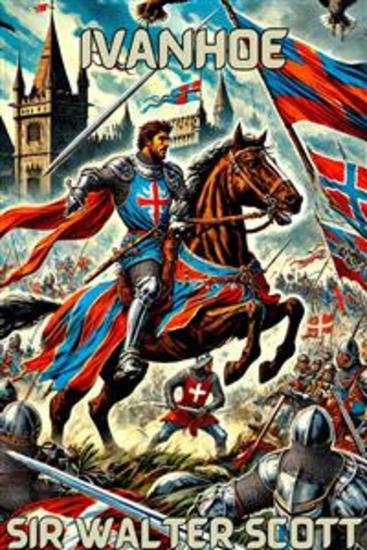
Ivanhoe A Romance(Illustrated) - cover

Ivanhoe A Romance(Illustrated)

Walter Scott

Publisher: Swish

  • 0
  • 0
  • 0

Summary

Illustrated Edition featuring 20 stunning illustrations
	Includes a comprehensive summary of the novel
	Contains a detailed characters list for easy reference

Features a thoughtful biography of the author, Sir Walter Scott
Ivanhoe: A Romance by Sir Walter Scott is a timeless tale of chivalry, honor, and adventure set in the tumultuous period of 12th-century England. The novel weaves a captivating story of Wilfred of Ivanhoe, a brave knight who finds himself caught in a struggle between Saxons and Normans, loyalty and betrayal, love and war.
Disinherited by his father, Ivanhoe embarks on a heroic journey to reclaim his place, win the heart of the beautiful Lady Rowena, and restore justice to a land torn apart by political intrigue. Along the way, he encounters iconic figures such as the noble King Richard the Lionheart, the villainous Templar Sir Brian de Bois-Guilbert, and the legendary outlaw Robin Hood. In a world filled with grand tournaments, daring rescues, and fierce rivalries, Ivanhoe must navigate treacherous enemies and find his path to victory.
This beautifully illustrated edition brings Scott's masterful narrative to life, enhancing the reader's experience with 20 intricate images that capture the essence of the story. With its thrilling plot and unforgettable characters, Ivanhoe remains a classic novel that explores themes of loyalty, courage, and the clash of cultures, making it a must-read for lovers of historical fiction.
 
Available since: 11/03/2024.

Other books that might interest you

  • Greats Abridged The: Oliver Twist - cover

    Greats Abridged The: Oliver Twist

    Charles Dickens

    • 0
    • 0
    • 0
    Step into the grim yet hopeful world of Oliver Twist, Charles Dickens' timeless tale of hardship, perseverance, and the quest for belonging—now thoughtfully abridged for modern listeners. Follow young Oliver, an orphan born into poverty and misfortune, as he escapes the harsh workhouse system only to be swept into the dark underworld of London crime led by the cunning Fagin and his band of pickpockets. Along the way, Oliver’s journey brings him face to face with both the cruelest and kindest sides of Victorian society.  
    This abridged version retains all the heart, tension, and social commentary of the original while offering a streamlined narrative ideal for students, families, and first-time Dickens readers. Narrated with warmth and clarity by Mary Ellin Kurtz, The Greats Abridged: Oliver Twist brings new life to a classic for all ages.
    Show book
  • A Christmas Tree - cover

    A Christmas Tree

    Charles Dickens

    • 0
    • 0
    • 0
    Charles John Huffam Dickens (7 February 1812 – 9 June 1870) was an English writer and social critic. He created some of the world's best-known fictional characters and is regarded as the greatest novelist of the Victorian era. His works enjoyed unprecedented popularity during his lifetime, and by the twentieth century critics and scholars had recognised him as a literary genius. His novels and short stories enjoy lasting popularity.
    I have been looking on, this evening, at a merry company of children assembled round that pretty German toy, a Christmas Tree. The tree was planted in the middle of a great round table, and towered high above their heads. It was brilliantly lighted by a multitude of little tapers; and everywhere sparkled and glittered with bright objects. There were rosy–cheeked dolls, hiding behind the green leaves; and there were real watches (with movable hands, at least, and an endless capacity of being wound up) dangling from innumerable twigs; there were French–polished tables, chairs, bedsteads, wardrobes, eight–day clocks, and various other articles of domestic furniture (wonderfully made, in tin, at Wolverhampton), perched among the boughs, as if in preparation for some fairy housekeeping; there were jolly, broad–faced little men, much more agreeable in appearance than many real men—and no wonder, for their heads took off, and showed them to be full of sugar–plums; there were fiddles and drums; there were tambourines, books, work–boxes, paint–boxes, sweetmeat–boxes, peep–show boxes, and all kinds of boxes; there were trinkets for the elder girls, far brighter than any grown–up gold and jewels; there were baskets and pincushions in all devices; there were guns, swords, and banners; there were witches standing in enchanted rings of pasteboard, to tell fortunes; there were teetotums, humming–tops, needle–cases, pen–wipers, smelling–bottles, conversation–cards, bouquet–holders; real fruit, made artificially dazzling with gold leaf; imitation apples, pears, and walnuts, crammed with surprises; in short, as a pretty child, before me, delightedly whispered to another pretty child, her bosom friend, “There was everything, and more.”
    Show book
  • Romeo And Juliet - Full Cast Drama - cover

    Romeo And Juliet - Full Cast Drama

    William Shakespeare

    • 0
    • 0
    • 0
    The characters of Romeo and Juliet have been depicted in literature, music, dance, and theatre. The appeal of the young hero and heroine—whose families, the Montagues and the Capulets, respectively, are implacable enemies—is such that they have become, in the popular imagination, the representative type of star-crossed lovers. Shakespeare sets the scene in Verona, Italy. Juliet and Romeo meet and fall instantly in love at a masked ball of the Capulets, and they profess their love when Romeo, unwilling to leave, climbs the wall into the orchard garden of her family’s house and finds her alone at her window. Because their well-to-do families are enemies, the two are married secretly by Friar Laurence. When Tybalt, a Capulet, seeks out Romeo in revenge for the insult of Romeo’s having dared to shower his attention on Juliet, an ensuing scuffle ends in the death of Romeo’s dearest friend, Mercutio. Impelled by a code of honor among men, Romeo kills Tybalt and is banished to Mantua by the Prince of Verona, who has been insistent that the family feuding cease. When Juliet’s father, unaware that Juliet is already secretly married, arranges a marriage with the eminently eligible Count Paris, the young bride seeks out Friar Laurence for assistance in her desperate situation. He gives her a potion that will make her appear to be dead and proposes that she take it and that Romeo rescue her. She complies. Romeo, however, unaware of the friar’s scheme because a letter has failed to reach him, returns to Verona on hearing of Juliet’s apparent death. He encounters a grieving Paris at Juliet’s tomb, reluctantly kills him when Paris attempts to prevent Romeo from entering the tomb, and finds Juliet in the burial vault. There he gives her a last kiss and kills himself with poison. Juliet awakens, sees the dead Romeo, and kills herself. The families learn what has happened and end their feud. 
     
    Show book
  • Labour Unrest The (Unabridged) - cover

    Labour Unrest The (Unabridged)

    H. G. Wells

    • 0
    • 0
    • 0
    Herbert George Wells (21 September 1866 - 13 August 1946) was an English writer. Prolific in many genres, he wrote dozens of novels, short stories, and works of social commentary, history, satire, biography and autobiography. His work also included two books on recreational war games. Wells is now best remembered for his science fiction novels and is often called the "father of science fiction", along with Jules Verne and the publisher Hugo Gernsback.
    THE LABOUR UNREST: Our country is, I think, in a dangerous state of social disturbance. The discontent of the labouring mass of the community is deep and increasing. It may be that we are in the opening phase of a real and irreparable class war.
    Show book
  • Mansfield Park - cover

    Mansfield Park

    Jane Austen

    • 0
    • 0
    • 0
    Mansfield Park is the third published novel by Jane Austen, first published in 1814 by Thomas Egerton. A second edition was published in 1816 by John Murray, still within Austen's lifetime. The novel did not receive any public reviews until 1821.
    The novel tells the story of Fanny Price, starting when her overburdened family sends her at age ten to live in the household of her wealthy aunt and uncle and following her development into early adulthood. From early on critical interpretation has been diverse, differing particularly over the character of the heroine, Austen's views about theatrical performance and the centrality or otherwise of ordination and religion, and on the question of slavery. Some of these problems have been highlighted in the several later adaptations of the story for stage and screen.
    Show book
  • Anne of Avonlea - cover

    Anne of Avonlea

    Lucy Montgomery

    • 0
    • 0
    • 0
    "Anne of Avonlea" by Lucy Maud Montgomery continues the charming tale of Anne Shirley as she steps into her new role as a schoolteacher in the quaint village of Avonlea. Now 16, Anne navigates the challenges and joys of guiding young minds while maintaining her vivid imagination and boundless enthusiasm. Alongside beloved characters and new friends, Anne engages in community projects, faces heartwarming adventures, and learns invaluable life lessons, enriching the tapestry of her cherished Avonlea.
    Show book