¡Acompáñanos a viajar por el mundo de los libros!
Añadir este libro a la estantería
Grey
Escribe un nuevo comentario Default profile 50px
Grey
Suscríbete para leer el libro completo o lee las primeras páginas gratis.
All characters reduced
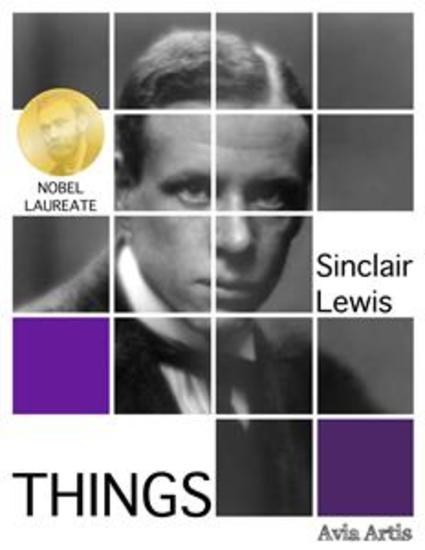
Things - cover

Things

Sinclair Lewis

Editorial: Avia Artis

  • 0
  • 0
  • 0

Sinopsis

“Things” is a book by Sinclair Lewis an American writer. In 1930, he became the first writer from the United States to receive the Nobel Prize in Literature.
“Things” is a short story by Sinclair Lewis.
“This is not the story of Theodora Duke and Stacy Lindstrom, but of a traveling bag with silver fittings, a collection of cloisonné, a pile of ratty school-books, and a fireless cooker that did not cook.
Long before these things were acquired, when Theo was a girl and her father, Lyman Duke, was a so-so dealer in cut-over lands, there was a feeling of adventure in the family. They lived in a small brown house which predicated children and rabbits in the back yard, and a father invariably home for supper. But Mr. Duke was always catching trains to look at pine tracts in northern Minnesota. Often his wife went along and, in the wilds, way and beyond Grand Marais and the steely shore of Lake Superior, she heard wolves howl and was unafraid.”
Preview.
 
Disponible desde: 22/03/2022.
Otros libros que te pueden interesar

  • The Lost Manuscript The Wind in the Willows - cover

    The Lost Manuscript The Wind in...

    Kenneth Grahame

    • 0
    • 0
    • 0
    This much-loved story follows a group of animal friends in the English countryside as they pursue adventure ... and as adventure pursues them! The chief characters - Mole, Rat, and Toad - generally lead upbeat and happy lives, but their tales are leavened with moments of terror, homesickness, awe, madcap antics, and derring-do. 
     
    Although classed as children's literature, The Wind in the Willows holds a gentle fascination for adults too. The vocabulary is decidedly not "Dick and Jane", and a reader with a love of words will find new ones to treasure, even if well-equipped for the journey. Parents will appreciate the themes of loyalty, manners, self-restraint, and comradeship which are evident throughout the book. When the characters err, they are prompt to acknowledge it, and so a reading of this book can model good behavior to children, who will otherwise be enchanted with the many ways in which the lives of these bucolic characters differ from modern life. 
     
    This book was so successful that it enabled the author to retire from banking and take up a country life somewhat like that of his creations. It has been adapted for screen, stage, and even a ride at the original Disneyland.
    Ver libro
  • Case of Charles Dexter Ward The (Ungekürzt) - cover

    Case of Charles Dexter Ward The...

    H. P. Lovecraft

    • 0
    • 0
    • 0
    Charles Dexter Ward is a young man from a prominent Rhode Island family who has disappeared from a mental asylum. He had been incarcerated during a prolonged period of insanity, during which he exhibited minor and inexplicable physiological changes. His empty cell is found to be very dusty. The bulk of the story concerns the investigation conducted by the Wards' family doctor, Marinus Bicknell Willett, in an attempt to discover the reason for Ward's madness and physiological changes. Willett learns that Ward had spent the past several years attempting to discover the grave of his ill-reputed ancestor, Joseph Curwen. The doctor slowly begins to reveal the truth behind the legends surrounding Curwen, an eighteenth-century shipping entrepreneur and alleged alchemist, who was in reality a necromancer and mass murderer. A raid on Curwen's farm was remarkable for the shouted incantations, lights, explosions, and some not-quite-human figures shot down by the raiders. The raiders swore any witnesses to strict secrecy about what they saw and heard. As Willett's investigations proceed, he finds that Charles had recovered Curwen's ashes, and through the use of magical formulae contained in documents found hidden in Curwen's home in Providence, was able to call forth Curwen from his "essential saltes" and resurrect him. Willett also finds that Curwen, who resembles Charles enough to pass for him, murdered and replaced his modern descendant and resumed his evil activities. Although Curwen convinces onlookers that he is Charles, his anachronistic mindset and behavior lead authorities to certify him insane and imprison him in an asylum.
    
    While Curwen is locked up, Willett's investigation leads him to a bungalow in Pawtuxet Village, which Ward had purchased while under the influence of Curwen. The house is on the site of the old farm which was Curwen's headquarters for his nefarious doings; beneath is a vast catacomb that the wizard had built as a lair during his previous lifetime. During a horrific journey through this labyrinth, in which Willett sees a deformed monster in a pit, he discovers the truth about Curwen's crimes and also the means of returning him to the grave. It is also revealed that Curwen has been engaged in a long-term conspiracy with certain other necromancers, associates from his previous life who have somehow escaped death, to resurrect and torture the world's wisest people to gain knowledge that will make them powerful and threaten the future of mankind. While in Curwen's laboratory, Willett accidentally summons an ancient entity who is an enemy of Curwen and his fellow necromancers. The doctor faints, awakening much later in the bungalow. The entrance to the vaults has been sealed as if it had never existed, but Willett finds a note from the being written in Latin instructing him to kill Curwen and destroy his body. Willett confronts Curwen at the asylum and succeeds in reversing the resurrection spell, returning the sorcerer to dust. News reports reveal that Curwen's prime co-conspirators and their households have met brutal deaths, and their lairs have been destroyed.
    Ver libro
  • Uncle's Dream - cover

    Uncle's Dream

    Fyodor Dostoyevsky

    • 0
    • 0
    • 0
    "Uncle's Dream" explores themes of ambition, deception, and the consequences of manipulating others for personal gain. Dostoyevsky skilfully weaves a tale that showcases the complexities of human nature and the unpredictability of life's outcomes. Through Mariya and Zinaida's experiences, the novella delves into the desires, dreams, and sacrifices people make in their pursuit of a better future. Read in English, unabridged.
    Ver libro
  • Billy Budd - cover

    Billy Budd

    Herman Melville

    • 0
    • 0
    • 0
    "Billy Budd" is a novella written by Herman Melville, completed shortly before his death in 1891. It tells the story of Billy Budd, a handsome and popular sailor who becomes embroiled in a conflict with his ship's master-at-arms, John Claggart, on board a British naval vessel during the late 18th century. The novella explores themes of innocence, morality, justice, and the inherent conflict between good and evil. 
     
    The narrative centers around the character of Billy Budd, a young and virtuous sailor admired by his peers for his exceptional charm and simplicity. However, his life takes a dramatic turn when he is falsely accused of inciting mutiny by Claggart, a malevolent and envious officer. The novella delves into the psychological dynamics between the two characters and the moral dilemmas faced by the ship's captain, Captain Vere, as he grapples with the decision of how to handle the situation. 
     
    "Billy Budd" explores the clash between absolute goodness and institutional authority, with Melville examining the complexities and ambiguities of human nature. The novella raises profound questions about the nature of justice, the corrupting influence of power, and the struggle to maintain one's moral integrity in a society driven by hierarchy and oppression. 
     
    Melville's writing in "Billy Budd" is characterized by his rich prose, nuanced characterization, and philosophical inquiries. The novella incorporates nautical terminology and imagery, drawing on Melville's own experiences as a sailor, and employs a multi-layered narrative that invites readers to contemplate deeper moral and existential questions.
    Ver libro
  • The House Of The Arrow - cover

    The House Of The Arrow

    A. E. W. Mason

    • 0
    • 0
    • 0
    A young English girl is accused in Dijon of murdering her French aunt. Hanaud to the rescue! Inspector Hanaud is a member of the French Sûreté. He is said to have been the model for Agatha Christie’s Hercule Poirot, as well as the opposite of Conan Doyle’s Sherlock Holmes. In 1910, Mason undertook to create a fictional detective as different as possible from Sherlock Holmes, who had recently been resuscitated after his supposed death by Arthur Conan Doyle in 1903. Inspector Gabriel Hanaud was stout, not gaunt like Holmes; a professional policeman, not a gentleman amateur; from the French Sûreté, not Victorian England; and relying on psychological insights rather than physical evidence. His "Watson" is a retired London banker named Mr. Julius Ricardo, though he appears only briefly in this novel.
    Ver libro
  • Pride and Prejudice - cover

    Pride and Prejudice

    Jane Austen

    • 0
    • 0
    • 0
    Jane Austen's classic tale of love overcoming preconceptions centers on the two eldest daughters of the Bennet family: Jane and Elizabeth. Elizabeth has to fend off an unwelcome offer of marriage from the Rev. Collins, while mistakenly falling for the charms of the dashing Mr Wickham, before realizing that appearances are deceptive and that her prejudice against Mr Darcy has blinded her to his real character. Witty, humorous and ultimately satisfying, this masterpiece of classic fiction has endured for more than two hundred years.
    Ver libro