Join us on a literary world trip!
Add this book to bookshelf
Grey
Write a new comment Default profile 50px
Grey
Subscribe to read the full book or read the first pages for free!
All characters reduced
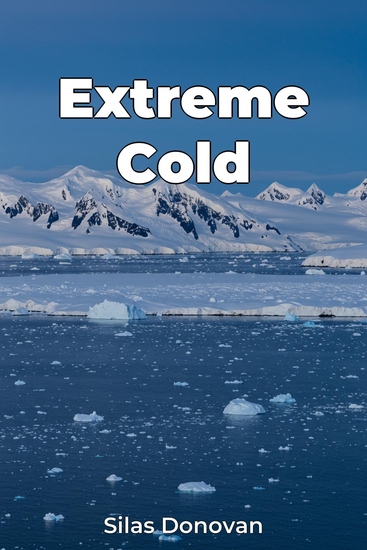
Extreme Cold - cover

Extreme Cold

Silas Donovan

Translator A AI

Publisher: Publifye

  • 0
  • 0
  • 0

Summary

Extreme Cold explores the science behind life in Earth's coldest regions, focusing on the interplay between Biology, Earth Sciences, and Geography. It highlights how organisms, from microbes to mammals, have evolved remarkable biological adaptations to thrive in subzero environments, such as antifreeze proteins in fish that prevent their blood from freezing. Within the context of climate change, the book emphasizes the importance of understanding these extreme environments and the unique challenges they pose to human survival.

 
The book examines the physiological impacts of extreme cold, detailing how hypothermia and frostbite affect the human body. It also delves into the atmospheric and geographic conditions that create polar regions, differentiating between the Arctic and Antarctic.

 
Progressing from the physical properties of cold environments to the human element and then to the exploration of biological adaptations, Extreme Cold provides a comprehensive look at how life endures and even flourishes in these harsh climates.
Available since: 03/20/2025.
Print length: 82 pages.

Other books that might interest you

  • Going for Gold - cover

    Going for Gold

    Roger Trow

    • 0
    • 0
    • 0
    The Stewart family clashes with the shady Weiss family at a local rugby match. However, matters get out of hand and Jim Stewart’s police complaint is mysteriously dismissed through high level influencers. This prompts Jim to investigate the background of the Weiss family and he discovers that Johannes Weiss and his shady partner,  Dr Elise Murthen operate a Swiss clinic where 25 rich patients died under suspicious circumstances. Dr Murthen has 2 sons of exceptional athletic ability and it is suspected that they have been genetically modified. The British and Russian governments compete for the technology and the bidding is intense. But who will be the first to produce a super soldier?
    Show book
  • The Unity of Science - Exploring Our Universe from the Big Bang to the Twenty-First Century - cover

    The Unity of Science - Exploring...

    Irwin Shapiro

    • 0
    • 0
    • 0
    A journey guided by science that explores the universe, the earth, and the story of life 


    For Irwin Shapiro, science starts with questions. This book provides a broad and entertaining survey of major scientific discoveries that have changed our views of nature and, in turn, spawned further questions. 


    Shapiro, an award-winning scientist and beloved teacher, separates his inquiry into three parts: looking up at the universe; looking down at the earth and its fossils; and looking in at the story of life. His framework encourages listeners to view science as a detective story—to observe and question nature and natural phenomena, and to base all conclusions on scientific evidence. 


    With his knowledgeable yet conversational approach, Shapiro offers an enjoyable way for the curious to learn about the foundations of a range of scientific topics: the motions of bodies in the cosmos, the history and structure of the earth, the evolution of organisms, and the search for extraterrestrial life and intelligence.
    Show book
  • Data-ism - The Revolution Transforming Decision Making Consumer Behavior and Almost Everything Else - cover

    Data-ism - The Revolution...

    Steve Lohr

    • 0
    • 0
    • 0
    Steve Lohr, a technology reporter for the New York Times, chronicles the rise of Big Data, addressing cutting-edge business strategies and examining the dark side of a data-driven world. 
    Coal, iron ore, and oil were the key productive assets that fueled the Industrial Revolution. Today, Data is the vital raw material of the information economy. The explosive abundance of this digital asset, more than doubling every two years, is creating a new world of opportunity and challenge. 
    Data-ism is about this next phase, in which vast, Internet-scale data sets are used for discovery and prediction in virtually every field. It is a journey across this emerging world with people, illuminating narrative examples, and insights. It shows that, if exploited, this new revolution will change the way decisions are made—relying more on data and analysis, and less on intuition and experience—and transform the nature of leadership and management. 
    Lohr explains how individuals and institutions will need to exploit, protect, and manage their data to stay competitive in the coming years. Filled with rich examples and anecdotes of the various ways in which the rise of Big Data is affecting everyday life it raises provocative questions about policy and practice that have wide implications for all of our lives.
    Show book
  • Perfect - Feeling Judged on Social Media - cover

    Perfect - Feeling Judged on...

    Rosalind Gill

    • 0
    • 0
    • 0
    Social media is replete with images of 'perfection'. But many are unrealistic and contribute to a pervasive sense of never being good enough: not thin enough; not pretty enough; not cool enough. Try too hard and you risk being condemned for being ‘attention-seeking’, don't try hard enough and you're slacking. 
     
    Rosalind Gill challenges polarized perspectives that see young women as either passive victims of social media or as savvy digital natives. She argues the real picture is far more ambivalent. Getting likes and followers and feeling connected to friends feels fantastic, but posting material and worrying about 'haters' causes significant anxieties. 
     
    Gill uses young women's own words to show how they feel watched all the time; worry about getting things wrong; and struggle to live up to an ideal of being 'perfect' yet at the same time ‘real’. It's the wake-up call we all need.
    Show book
  • Futurecide - cover

    Futurecide

    W. Douglas Smith

    • 0
    • 0
    • 0
    Every civilization in history has faced moments of overwhelming existential crises, and they all eventually collapsed. Was this failure inherent in the evolution of civilization, something within the human species, or a combination of both? More importantly, was it predictable and 
    unavoidable? Most civilizations believed they had a special relationship with the divine and were beyond the laws of nature. Our current economic civilization is now global and interdependent. Today’s economy is responsible for the most rapid mass extinction in Earth’s history. We face imminent catastrophic climate change and environmental disruption, yet the same sense of exceptionalism and hubris clouds humanity’s judgement and ability to act rationally.
     
    Environmental disruption is making the planet uninhabitable. No economy can consume its way out of scarcity. This law of nature conflicts with many longstanding economic theories. Sheltered and self-absorbed elitists promote lies and prey on humanity’s most vulnerable instincts of pecking order, conformity, and obedience to authority. These primal instincts may be maladapted to civilization in its current form. Today’s elitists are choosing mass extinction in a false belief in their own invincibility. To survive, humanity can no longer follow delusional 
    leaders to self-destruction.
     
    In non-technical language, the author explores common phases in the development of past civilizations, and the critical junctures and decisions that made collapse inevitable. He investigates the linkages and contradictions between human social behavior, the economy, and the environment. In the closing pages, he identifies a clear path to redemption.
    Show book
  • Mastering Bipolar Disorder - Your Stress-Free Roadmap to Understanding Coping and Achieving Mental Stability - cover

    Mastering Bipolar Disorder -...

    Jason L Brown

    • 0
    • 0
    • 0
    A diagnosis of bipolar disorder can be scary... but it also opens up an opportunity for growth and stability. Ready to find the answers? 
    Around one in every 100 people is diagnosed with bipolar disorder at some point in their lives… but if you’re one of them, it probably feels more isolating than that. 
    Despite the rising awareness of mental health challenges, it’s a condition still shrouded in misunderstanding, and while you’re caught up in the extreme highs and lows it presents, it’s difficult to understand it yourself, let alone help anyone else to understand it. 
    A diagnosis can bring a sense of relief—an explanation to help you finally make sense of what’s been happening with you… but it can also be scary. 
    Mariah Carey, who’s spoken outwardly about her experience with bipolar disorder, said that she “didn’t want to believe” it when she was given her diagnosis… and perhaps that’s a feeling you can relate to. 
    It can make you feel terribly alone, especially when you don’t understand all the nuances of bipolar disorder or how to manage it well… But this is where your diagnosis is a blessing. 
    Now that you know you have it, you can dive beneath the hood and implement techniques that you didn’t know to try before now. 
    But when there’s so much to know, where do you start? 
    Right here. 
    Written by an author whose diagnosis marked a positive turning point, this empathetic and holistic approach to understanding and managing bipolar disorder will show you exactly what you need to know. 
    Whether you’re living with the condition yourself or you’re caring for someone who is, your journey toward understanding starts here. 
    You might think a diagnosis is the end of your journey… It all makes sense now, after all. 
    But this is just the start of your path—because with a deeper understanding and a wealth of strategies you can turn to at any time, you can completely transform your daily experience.
    Show book