¡Acompáñanos a viajar por el mundo de los libros!
Añadir este libro a la estantería
Grey
Escribe un nuevo comentario Default profile 50px
Grey
Suscríbete para leer el libro completo o lee las primeras páginas gratis.
All characters reduced
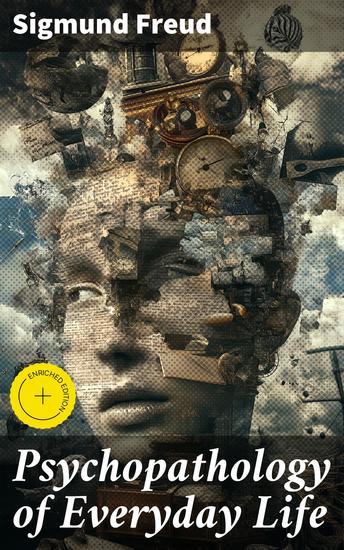
Psychopathology of Everyday Life - Enriched edition Revealing the Unconscious: Freudian Psychology in Daily Life - cover

Psychopathology of Everyday Life - Enriched edition Revealing the Unconscious: Freudian Psychology in Daily Life

Sigmund Freud

Traductor A. A. Brill

Editorial: Good Press

  • 0
  • 0
  • 0

Sinopsis

In "Psychopathology of Everyday Life," Sigmund Freud meticulously explores the interplay between the unconscious mind and everyday behaviors, presenting a groundbreaking analysis of slips of the tongue, forgotten names, and mundane actions. Employing a blend of clinical case studies, introspective analysis, and theoretical discourse, Freud elucidates how these seemingly trivial incidents reveal deeper psychological conflicts and desires. Written in a clear yet incisive literary style, the text serves as a cornerstone for psychoanalytic theory, positioning personal experiences within a broader context of human psychology, all while challenging the conventional understanding of sanity and expression in turn-of-the-century Vienna. Sigmund Freud, the father of psychoanalysis, derived insights for this seminal work from his extensive clinical practice and familiarity with contemporary psychological discussions. Born in 1856 in Austria, Freud's revolutionary ideas emerged from an era that grappled with the complexities of the human psyche. His innovative theories were influenced by his studies in neurology, the prevailing philosophical currents of his time, and a profound interest in the unconscious, which shaped his lifelong dedication to uncovering the hidden motivations behind human behavior. "Psychopathology of Everyday Life" is indispensable for anyone seeking to comprehend the intricate links between everyday occurrences and our internal psyches. Freud's groundbreaking examination remains relevant, offering profound insights for psychology students, literary scholars, and general readers alike. Engaging with this work provides a meaningful exploration into the depths of human behavior, inviting readers to reflect on their own unconscious processes.

In this enriched edition, we have carefully created added value for your reading experience:
- A succinct Introduction situates the work's timeless appeal and themes.
- The Synopsis outlines the central plot, highlighting key developments without spoiling critical twists.
- A detailed Historical Context immerses you in the era's events and influences that shaped the writing.
- An Author Biography reveals milestones in the author's life, illuminating the personal insights behind the text.
- A thorough Analysis dissects symbols, motifs, and character arcs to unearth underlying meanings.
- Reflection questions prompt you to engage personally with the work's messages, connecting them to modern life.
- Hand‐picked Memorable Quotes shine a spotlight on moments of literary brilliance.
- Interactive footnotes clarify unusual references, historical allusions, and archaic phrases for an effortless, more informed read.
Disponible desde: 21/08/2022.
Longitud de impresión: 184 páginas.


Otros libros que te pueden interesar

  • A Master Class In Krsna Bhakti - The Yoga Of Devotion - cover

    A Master Class In Krsna Bhakti -...

    Prana Govinda Das Spiritual...

    • 0
    • 0
    • 0
    "If you sell diamonds, you cannot expect to have many customers. But a diamond is a diamond even if there are no customers." A. C. Bhaktivedanta Swami Prabhupada 
     
    IF YOU ARE LOOKING FOR A DIAMOND - YOU HAVE COME TO THE RIGHT PLACE! Noted internationally known Self-help advocate and teacher of devotional yoga Prana Govinda Das was born in Liverpool, England in 1968 admittedly a pretty good year for all things bright and beautiful. He says, 'From as early as I can remember I had an unquenchable thirst for knowledge, and a desire to understand the true nature of man and this world we live in. I was also always seeking out people who could answer all the questions I had about life, the universe, and everything.' After studying film production in the early nineties Prana was able to fulfill his lifelong desire to travel to India. admittedly his first trip changed his life completely and forever. 'At that point,' He recalls, 'my thirst for material knowledge turned to a desire to understand the spiritual side of life. For the next six years, I returned frequently, where I studied many different paths of Hinduism, Buddhism, and other forms of yoga and meditation. However, even after learning and experiencing so much I was still left incomplete.' in 2001 during the young man's sixth trip to India, he traveled to Vrindavan, a holy town associated with Lord Krishna south of Delhi. It was there he met his spiritual guide, and mentor Srila Bhaktivedanta Narayana Goswami. Some twenty years on, Prana has been resident in his teacher's temples all over the world, particularly in India, Australia, America, and Europe. A wonderful audio adventure for everyone to enjoy!
    Ver libro
  • Twelve Conversations David Bohm - Brockwood Park UK and Gstaad Switzerland 1975 - cover

    Twelve Conversations David Bohm...

    J. Krishnamurti

    • 0
    • 0
    • 0
    1. What is truth and what is reality - 18 May 1975 Duration: 70 minutes• What is truth and what is reality?• Anything that thought thinks about or reflects upon or projects, that is reality.And that reality has nothing to do with truth.• The art of seeing is to place reality where it is, and not move that in order to gettruth. You can't get truth.• How am I to empty that consciousness and yet retain knowledge – otherwise Icouldn't function – and reach a state which will comprehend reality?2. Seeing 'what is' is action - 24 May 1975 Duration: 122 minutes• If truth is something totally different from reality then what place has action indaily life, in relation to truth and reality?• Seeing 'what is' is action.• What place has love in truth?Code: BRGSCB1-12-A-ENGCopyright © 1975, Krishnamurti Foundation Trust Ltd. www.jkrishnamurti.orgJ. KRISHNAMURTI• When I separate you, in that separation love cannot exist.• How are you to convey the sense of truth to a student?• As long as I live in the field of reality, which has its own energy, that energy willnot free me.• When the mind is empty, when the mind is nothing, not a thing, in that there isperception.3. Thought cannot bring about an insight - 31 May 1975 Duration: 81 minutes• Is there a thinking without the word?• The action brought about by thought into the investigation of an analysis isalways incomplete.• Insight is complete. It is not fragmented as thought is. So thought cannot bringabout an insight.• I must have an insight into conditioning otherwise I can't dissolve it.• What takes place when I have an insight that the observer is the observed?• In nothingness there is complete security and stability.4. The intelligence of love - 14 June 1975 Duration: 87 minutes• Why has desire become such an extraordinarily important thing in life?• How does desire arise from perception?• Can I desire truth?• Is the energy of nothingness different from the energy of things?• Is that nothingness a hypothesis, a theory, a verbal structure, or truth? • In dying to the reality only then there is nothingness.5. Attention implies that there is no centre - 22 June 1975Duration: 126 minutes• Consciousness, because it is in constant movement, has never found an energywhich is not contradictory, which is not produced by desire and thought.• Can thought ever see its own movement and the futility of its own movement? • Attention implies that there is no centre.• Is there a perception, a seeing outside the space which is part of consciousness? • Therearetwohumanbeings,onegetsconditionedandtheotherdoesn't.Why?How has it happened the other doesn't get conditioned?• How does this perception which is beyond attention, beyond awareness,beyond concentration come about?• Thought is rather superficial, it's merely a very small part of the operation of thebrain.• Can consciousness be completely empty of its content? • Order and disorder6. Perceiving without the perceiver - 28 June 1975 Duration: 139 minutes• Can thought naturally cease?• Perceiving without the perceiver• Facing the truth of death• Krishnamurti's 'process' and early years.• Kundalini• If you can understand suffering, face it and not escape from it, that has quite adifferent energy.• Truth is a pathless land.• There is something really tremendously mysterious.• Knowledge is becoming the curse.• When the mind, with all the confusion, is nothing, not a thing, then perhapsthere is the other.
    Ver libro
  • Artist's Way The: Book summary & analysis - cover

    Artist's Way The: Book summary &...

    Briefly Summaries

    • 0
    • 0
    • 0
    This is a concise summary and analysis of The Artist's Way, by Julia Cameron.
     
    It is not the original book and is not affiliated with or endorsed by Julia Cameron.
     
    Ideal those seeking a quick and insightful overview


    "The Artist's Way" is a transformative guidebook for nurturing creativity and overcoming artistic blocks. It offers a structured approach to discovering and recovering one's creative self. Through a series of exercises and reflections, the book guides readers on a spiritual path to higher creativity, emphasizing the importance of self-discovery, resilience, and inspiration. The author advocates for a daily practice of writing morning pages and weekly artist dates to cultivate creativity and break through creative barriers. Ultimately, "The Artist's Way" encourages readers to embrace their artistic talents and live more creatively, fostering personal growth and fulfillment.
    Ver libro
  • Wake Up America - Black Women on the Future of Democracy - cover

    Wake Up America - Black Women on...

    Keisha N. Blain

    • 0
    • 0
    • 0
    In 1968, civil rights activist Fannie Lou Hamer called for Americans to "wake up" if they wanted to "make democracy a reality." Today, as Black communities continue to face challenges built on centuries of discrimination, her plea is increasingly urgent. In this exhilarating anthology of original essays, Keisha N. Blain brings together the voices of major progressive Black women politicians, grassroots activists, and intellectuals to offer critical insights on how we can create a more equitable political future. 


    These women draw on their diverse experiences and expertise to speak to three core themes: claiming civil and human rights, building political and economic power, and combating all forms of hate. We hear from Black Lives Matter cofounder Alicia Garza, who argues that Black communities must organize to wield increased political power; EMILYs List president Laphonza Butler, who spells out ways to fight for women's reproductive rights; and Congresswoman Sheila Jackson Lee, who delineates practical, thorough steps toward tangible reparations. Additional incisive essays include those by former Ohio State Senator Nina Turner; prison abolitionist Mariame Kaba; disability rights activist Andraéa LaVant; Boston's first woman and first Black mayor, Kim Michelle Janey; and others at the forefront of the ongoing fight for social justice.
    Ver libro
  • The Birth of the Republic 1763-89 - Fourth Edition - cover

    The Birth of the Republic...

    Edmund S. Morgan, Joseph J....

    • 0
    • 0
    • 0
    In The Birth of the Republic, 1763–89, Edmund S. Morgan shows how the challenge of British taxation started Americans on a search for constitutional principles to protect their freedom, and eventually led to the Revolution. By demonstrating that the founding fathers' political philosophy was not grounded in theory, but rather grew out of their own immediate needs, Morgan paints a vivid portrait of how the founders' own experiences shaped their passionate convictions, and these in turn were incorporated into the Constitution and other governmental documents. The Birth of the Republic is the classic account of the beginnings of the American government, and in this fourth edition the original text is supplemented with a new foreword by Joseph J. Ellis and a historiographic essay by Rosemarie Zagarri.
    Ver libro
  • Benjamin Franklin - The Great Founding Father of the United States - cover

    Benjamin Franklin - The Great...

    Kelly Mass

    • 0
    • 0
    • 0
    Benjamin Franklin was an author, physicist, innovator, statesman, diplomat, printer, publisher, and political thinker who resided in America. Franklin was just one of the Founding Fathers of the United States, a drafter and signer of the US Declaration, and the first postmaster general of the United States. For his discoveries and views about electrical energy, he was an essential player in the American Knowledge and the history of physics as a researcher. He is most prominent for his developments like as the lightning arrester, bifocals, and the Franklin hotplate. 
    Many Americans know Benjamin Franklin to be an important political figure. Let’s explore more about his life and mission. Let’s see what his legacy is.
    Ver libro