¡Acompáñanos a viajar por el mundo de los libros!
Añadir este libro a la estantería
Grey
Escribe un nuevo comentario Default profile 50px
Grey
Suscríbete para leer el libro completo o lee las primeras páginas gratis.
All characters reduced
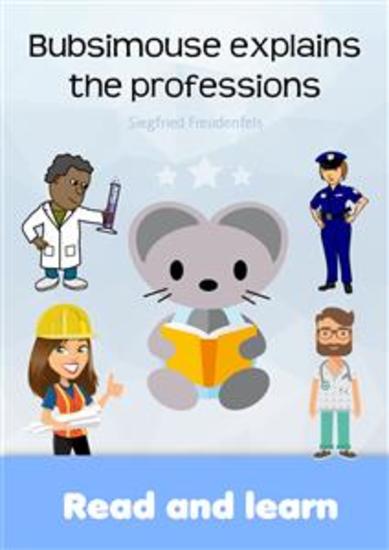
Bubsimouse explains the professions - Learn to read books - cover

Bubsimouse explains the professions - Learn to read books

Siegfried Freudenfels

Editorial: BookRix

  • 0
  • 0
  • 0

Sinopsis

"Bubsimouse explains the professions" is a lovingly designed children's book for children aged between 3 and 6 years. The book presents many interesting professions with illustrations and breathtaking pictures.Each page has a simple and child-friendly explanation. Learn to read is very simple with this book. 24 exciting professions are presented in this book. 
 
This book gives more learning material for beginning readers to confidently build their reading skill. Vocabulary development combined with entertaining illustations keep children engaged and excited about their reading accomplishments. This book is the perfect continuation of your child's reading journey.Vibrant images and short sentences with captivating characters help young readers want to read again and again. 
 
You are looking for learn to read books for kids, ebooks or non-fiction books for kids? Perfect!+ The Flovely children's story "Flovely in the camp" 
 
These Jobs are presented in the book: 
TeacherPolice OfficerEngineerTrain driverPainterGardenerBankerWaiterJoinerCaregiverJudgeDoctorTruck driverSellerConstruction workerBakerChemistPilotComputer scientistCookHairdresserFloristryFarmerRanger
Disponible desde: 20/12/2023.
Longitud de impresión: 16 páginas.

Otros libros que te pueden interesar

  • Founding Fathers The: Biographies of George Washington Alexander Hamilton Thomas Jefferson and Benjamin Franklin - cover

    Founding Fathers The:...

    Shane Costello

    • 0
    • 0
    • 0
    This audiobook includes biographies on the following men: George Washington, Alexander Hamilton, Thomas Jefferson, and Benjamin Franklin. 
    The Founding Fathers of the United States led the American Revolution against the Kingdom of Great Britain. Most were descendants of colonists settled in the Thirteen Colonies in North America. 
    Historian Richard B. Morris in 1973 identified the following seven figures as the key Founding Fathers: John Adams, Benjamin Franklin, Alexander Hamilton, John Jay, Thomas Jefferson, James Madison, and George Washington. Adams, Jefferson, and Franklin were members of the Committee of Five that drafted the Declaration of Independence. Hamilton, Madison, and Jay were authors of The Federalist Papers, advocating ratification of the Constitution. The constitutions drafted by Jay and Adams for their respective states of New York (1777) and Massachusetts (1780) were heavily relied upon when creating language for the US Constitution. Jay, Adams and Franklin negotiated the Treaty of Paris (1783) that would end the American Revolutionary War. Washington was Commander-in-Chief of the Continental Army and was President of the Constitutional Convention. All held additional important roles in the early government of the United States, with Washington, Adams, Jefferson, and Madison serving as President. Jay was the nation's first Chief Justice, Hamilton was the first Secretary of the Treasury, and Franklin was America's most senior diplomat, and later the governmental leader of Pennsylvania. 
    The term Founding Fathers is sometimes used to refer to the Signers of the embossed version of the Declaration of Independence in 1776. Signers should not be confused with the term Framers; the Framers are defined by the National Archives as those 55 individuals who were appointed to be delegates to the 1787 Constitutional Convention and took part in drafting the proposed Constitution of the United States.
    Ver libro
  • How We Got Our Antiracist Constitution - Canonizing Brown v Board of Education in Courts and Minds - cover

    How We Got Our Antiracist...

    Jesse Merriam

    • 0
    • 0
    • 0
    Over the past decade, several American cities have been rocked by race riots. With each passing year, a new racial agenda emerges—from police defunding to education reform to reparations—inciting more and more division and radicalization along racial lines. What started all of this? The roots of this pathology run much deeper than the recent symptoms suggest. The civil rights revolution unleashed an assault on the US Constitution, and the sacralization of that revolution, marked by the canonization of Brown v. Board of Education (1954), has transformed our constitutional order. A system once rooted in local self-governance and natural rights now operates along new moral axes, entirely foreign to the American way of life. The choice is increasingly obvious: Either the traditional American order or the new civil rights regime will prevail.
    Ver libro
  • Breathmaker: The History and Legacy of the Seminole’s Creator God - cover

    Breathmaker: The History and...

    Editors Charles River

    • 0
    • 0
    • 0
    The Seminole tribe is one of the best known Native American tribes, and one of the most feared among 19th century Americans and Spaniards. In fact, the origin of the term Seminole comes from a Spanish description of them as “wild”, which belies the fact that the Seminole had friendly relations with the British and Spanish during the colonial era.  
    	To appreciate Seminole Native American mythology, their history and origins must be understood. Their forebears, the Muscogee, first migrated into what is now the Southeastern United States from various points in the north and west, which they accomplished by overpowering the indigenous inhabitants. The region was already occupied by several groups, including the Yuchi and Hitchiti, tribes that were likely descendants of the Moundbuilders. These tribes were subdued and then integrated into the Muscogee system. Thus, the traditions, beliefs, rituals, and mythologies of these various groups became the communal belief system of the Muscogee collective.  	 
    	According to the Muscogee, humans emerged “somewhere in the west,” a location described as the “foundation of all things” or the “backbone” of the Earth. Most scholars associate this location with the Rocky Mountains, and they credit the Four Corners area of the United States as being the location for the creation myths of Native American groups like the Pueblo. Though still not commonly understood, Breathmaker became the creator god of the Seminole peoples (the name is also written as Breath Maker and Maker of Breath), and he became the center of a cycle of creation stories. 
    Ver libro
  • The American Operations in WW2: Northern Solomons - cover

    The American Operations in WW2:...

    U.S. Army Center of Military...

    • 0
    • 0
    • 0
    World War II was the largest and most violent armed conflict in the history of mankind. Highly relevant today, World War II has much to teach us, not only about the profession of arms, but also about military preparedness, global strategy, and combined operations in the coalition war against fascism. This book follows military operations of the US Army in the Pacific from 22 February 1943 to 21 November 1944. 
    From the Allied vantage point early in the spring of 1943, progress clearly had been made in the wars against Germany and Italy in Europe and the Mediterranean and Japan in the Pacific. During the winter an entire German army had been killed or captured deep within the Soviet Union at Stalingrad. In Africa, once-invincible Axis forces were in full-scale retreat, eventually to surrender in mid-May. The specter of continued Axis expansion in Europe was no longer the threat it had been a year before.
    Halfway around the world, the Japanese offensive in the Pacific also had crested. The May 1942 Battle of the Coral Sea, followed quickly by the great American victory at Midway, had cost Japan the strategic initiative. By February 1943 American and Australian troops had thwarted a Japanese pincer movement in Papua New Guinea, defeating an overland drive on Port Moresby, evicting the Japanese from Buna, and beating back an attack against Wau. That same month, hundreds of miles to the east in the Solomon Islands, American troops had wrested Guadalcanal from the Japanese. Victory required seven months of torturous fighting, but it secured the Allied line of communications to Australia. The Allied High Command now could take advantage of its improved strategic position...
    Ver libro
  • Cosmic Habits - Psychology and Philosophy of Life - cover

    Cosmic Habits - Psychology and...

    MAHAVIR SINGH

    • 0
    • 0
    • 0
    In today's fast-paced world, where people are overwhelmed by desires, high expectations, and the constant chase for material possessions, luxury, and power, I find myself turning back to the Bhagavad Gita again and again for guidance and clarity.Its timeless teaching on the way of living is as relevant today as they were thousands of years ago. No matter what challenges we face in life, it offers guidance for everything. Krishna comes to us from a different time, but His teachings are timeless.This book is a perfect blend of science, philosophy, and spirituality. It reveals the practical aspects of Vedic knowledge and their relevance to contemporary life.Psychology and Philosophy are two inseparable dimensions of human life. Psychology helps us understand our thoughts, emotions, behaviors, and mindset, while Philosophy provides the foundation for understanding the deeper meaning, purpose, and principles that guide our existence.Build habits that align with cosmic principles and harmonize with your circadian rhythm (your biological clock).In a world that never stops rushing, it will help you to slow down, reconnect, and realign with what truly matters. It offers inspiration for children, guidance for managers, wisdom for leaders, and imagination for creators.
    Ver libro
  • The Turnaround Leader - Rebuilding Great Organizations in the Face of Adversity - cover

    The Turnaround Leader -...

    Wes Wheeler

    • 0
    • 0
    • 0
    From Ashes to OpportunityI see that my purpose—my love—is fixing things. Families, after my dad left. Businesses, struggling to survive. Boats, deserving of glory instead of ashes. —Wes WheelerWes Wheeler has spent his life fixing things. From a young age, the New York native witnessed the decline of his family’s multi-generational boat business, watching it, quite literally, burn to the ground. While sorting through the ashes of the once successfully run company alongside his father, Wheeler’s future was decided for him. Instead of succumbing to the idea that businesses disintegrate and leave behind hordes of unemployed workers, their mission buried beneath burned bridges and abandoned dreams, Wheeler opted to arm himself with a work ethic built on faith, drive, and dogged determination.In The Turnaround Leader, Wheeler recounts his decades of managing projects for rising and falling companies, reshaping organizations, and restructuring business models to stand the test of time. Wheeler’s lifetime of ambition was launched during his humble beginnings as a paper delivery boy, where he discovered the little shifts that make a big difference, from the way he angled the papers he threw, to how he engaged with customers and mapped out his routes. These tiny lessons compounded over time and bolstered him while he faced difficult economic headwinds and ill-suited business leaders that preceded him, his most rewarding challenge being his leadership role during the COVID-19 pandemic. In a world where business models are rapidly changing and employment is never promised, Wheeler’s ability to adapt is both inspiring and achievable.
    Ver libro