Junte-se a nós em uma viagem ao mundo dos livros!
Adicionar este livro à prateleira
Grey
Deixe um novo comentário Default profile 50px
Grey
Assine para ler o livro completo ou leia as primeiras páginas de graça!
All characters reduced
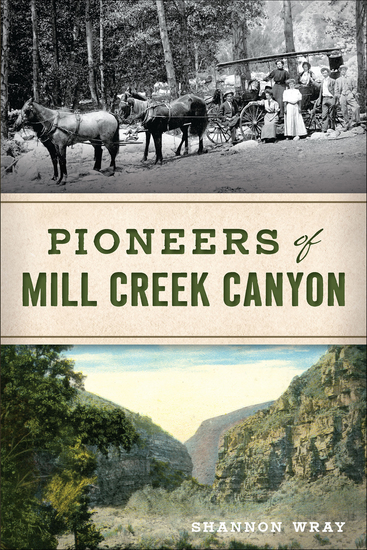
Pioneers of Mill Creek Canyon - cover
LER

Pioneers of Mill Creek Canyon

Shannon Wray

Editora: The History Press

  • 0
  • 0
  • 0

Sinopse

The pioneers of Mill Creek Canyon in the San Bernardino Mountains were visionaries, eccentrics and adventurers. Daniel Sexton married a Native American wife hoping to gain the secret to a mine, while Peter Forsee, a world-weary sheriff, married a widow who was sheltering two outlaw sons. Sylvanus Thurman's burros carried travelers into the wild and sometimes took them for a wild ride. George Burris didn't find gold, but his marble discovery built mansions. D. Rhea Igo created roadside attractions, and Louie Torrey left the city to farm the forest, creating a paradise for his family and others. Join author Shannon Wray as she explores the colorful lives of those who left an indelible mark on Mill Creek Canyon.
Disponível desde: 31/08/2020.
Comprimento de impressão: 179 páginas.

Outros livros que poderiam interessá-lo

  • The Bhagavad Gita - Hindi Presentation - cover

    The Bhagavad Gita - Hindi...

    Vyasa

    • 0
    • 0
    • 0
    The original "Yoga Secrets of Patanjali" are in themselves exceedingly brief, less than 10 pages in the original ancient texts. Yet, as they are based upon the great, timeless Bhagavad Gita, they contain the essence of all practical wisdom, set forth in admirable order and great detail. This timeless theme brings forth a palpable spiritual regeneration, the rebirth of the spiritual from the psychical: the same sacred theme that the realized yogis of India so wisely and eloquently set forth over 5,000 years ago. 
     
    Vyasa is the legendary Indian sage who is credited with compiling the Mahabharata, a collection of legendary and didactic poetry worked around a central heroic narrative. In India his birthday is celebrated as Guru Purnima, on Shukla Purnima day in the month of Ashadha (June–July). 
    Vyasa was the son of the ascetic Parashara and the dasyu (aboriginal) princess Satyavati and grew up in forests, living with hermits who taught him the Vedas. Thereafter he lived in the forests near the banks of the river Sarasvati, becoming a teacher and a priest, fathering a son and disciple, Shuka, and gathering a large group of disciples. Late in life, living in caves in the Himalayas, he is said to have divided the Vedas into the four traditional collections, composed Puranas, and, in a period of two and a half years, composed his great poetic work, the Mahabharata, supposedly dictating it to his scribe, Ganesha, the elephant god. 
     
    Perfect for all students of the eight-fold yoga path, curious commuters, and all library and school collections. A once-in-a-lifetime audio experience event. Perfect for universities and digital educational media.
    Ver livro
  • How to Save a Constitutional Democracy - cover

    How to Save a Constitutional...

    Tom Ginsburg, Aziz Z. Huq

    • 0
    • 0
    • 0
    Democracies are in danger. Around the world, a rising wave of populist leaders threatens to erode the core structures of democratic self-rule. In the United States, the tenure of Donald Trump has seemed decisive turning point for many. What kind of president intimidates jurors, calls the news media the “enemy of the American people,” and seeks foreign assistance investigating domestic political rivals? Whatever one thinks of President Trump, many think the Constitution will safeguard us from lasting damage. But is that assumption justified?How to Save a Constitutional Democracy mounts an urgent argument that we can no longer afford to be complacent. Drawing on a rich array of other countries’ experiences with democratic backsliding, Tom Ginsburg and Aziz Z. Huq show how constitutional rules can both hinder and hasten the decline of democratic institutions. The checks and balances of the federal government, a robust civil society and media, and individual rights—such as those enshrined in the First Amendment—often fail as bulwarks against democratic decline. The sobering reality for the United States, Ginsburg and Huq contend, is that the Constitution’s design makes democratic erosion more, not less, likely. Its structural rigidity has had unforeseen consequence—leaving the presidency weakly regulated and empowering the Supreme Court conjure up doctrines that ultimately facilitate rather than inhibit rights violations. Even the bright spots in the Constitution—the First Amendment, for example—may have perverse consequences in the hands of a deft communicator who can degrade the public sphere by wielding hateful language banned in many other democracies. We—and the rest of the world—can do better. The authors conclude by laying out practical steps for how laws and constitutional design can play a more positive role in managing the risk of democratic decline.
    Ver livro
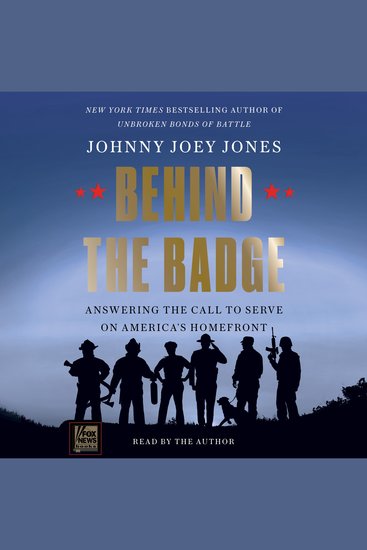
  • Behind the Badge - cover

    Behind the Badge

    Johnny Joey Jones

    • 0
    • 0
    • 0
    First responders run toward things the rest of us run away from. 
    What makes a person want to become a first responder? Who would become a cop after her brother died in the line of duty? What guy rejects joining a lucrative family business to become a local firefighter instead? Why would a Mexican American combat veteran choose to work as a medic for the Border Patrol, knowing the stigma he’d face?  
    One thing all these people have in common is that none of them wants to be called a hero.  
    First responders keep going to work every day, even though that means confronting the worst situ­ations imaginable. Their inspiring and unique stories are almost always overlooked when it comes to patri­otic recognition of service and sacrifice.  
    As in his New York Times bestselling book Unbroken Bonds of Battle, retired Marine Johnny Joey Jones didn’t have to look further than his closest family and friends to find frontline defenders—some he’s known since childhood, some he served with, and others have become friends and mentors. With vivid storytelling, Jones brings to life dramatic res­cues, heart-wrenching losses, and awe-inspiring acts of courage. He delves deep into what drives these brave men and women, offering an intimate look at their personal and professional lives.  
    Behind the Badge will leave you moved, inspired, and reminded of the true meaning of heroism—because these first responders are home­town heroes at heart. 
    Ver livro
  • How to Build Spaces That Think for You - cover

    How to Build Spaces That Think...

    Marcus Reed

    • 0
    • 0
    • 0
    Your environment is not neutral — it’s shaping your focus, creativity, and mood every second. How to Build Spaces That Think for You explores the psychology of design and how small, deliberate changes in light, sound, temperature, and layout can reprogram the way you think. This isn’t interior decoration; it’s cognitive architecture. Drawing from environmental psychology and neuroscience, it reveals how rooms can either drain your attention or amplify it — and how to make focus the default state. 
    From designing workspaces that sustain deep concentration to creating restorative zones that encourage recovery, this book offers a blueprint for aligning space with intention. The goal isn’t aesthetic perfection — it’s behavioral precision. Because when your environment supports your mind, discipline feels effortless and creativity becomes instinctive. You don’t just live in a space — you collaborate with it.
    Ver livro
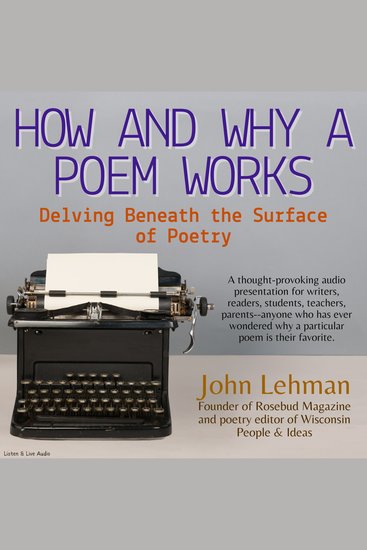
  • How and Why a Poem Works - Delving Beneath the Surface of Poetry - cover

    How and Why a Poem Works -...

    John Lehman

    • 0
    • 0
    • 0
    Here is a thought-provoking 51- minute audio presentation for writers, readers, students, teachers, parents...anyone who has ever wondered why a particular poem is their favorite. It includes the poem Stopping by the Woods, by Robert Frost. 
    Delving beneath the surface of Robert Frost's poetry, John Lehman is a nationally published writer and poet with 20 years experience as a professional speaker and 15 years as a creative director and senior copy writer for advertising agencies. He is a graduate of the Great Books program at Notre Dame University and has a master's degree in curriculum development from the University of Michigan. 
    John has presented seminars throughout the country. He is a book reviewer, business columnist, poet, and freelance feature writer for magazines and newspapers. His articles have appeared in The Christian Science Monitor, Popular Science, Omni, and in more than 50 other trade or consumer publications. He is also the founder of Rosebud magazine, managing partner of Zelda Wilde Publishing and the poetry editor of Wisconsin People and Ideas. 
    ©2009 John Lehman; (P)2009 John Lehman
    Ver livro
  • Cleopatra - Her History Her Myth - cover

    Cleopatra - Her History Her Myth

    Francine Prose

    • 0
    • 0
    • 0
    A feminist reinterpretation of the myths surrounding Cleopatra casts new light on the Egyptian queen and her legacy 
     
    The siren passionately in love with Mark Antony, the seductress who allegedly rolled out of a carpet she had herself smuggled in to see Caesar, Cleopatra is a figure shrouded in myth. Beyond the legends immortalized by Plutarch, Shakespeare, George Bernard Shaw, and others, there are no journals or letters written by Cleopatra herself. All we have to tell her story are words written by others. 
     
    What has it meant for our understanding of Cleopatra to have had her story told by writers who had a political agenda, authors who distrusted her motives, and historians who believed she was a liar? Francine Prose delves into ancient Greek and Roman literary sources, as well as modern representations of Cleopatra in art, theater, and film. She challenges the common narratives driven by orientalism and misogyny and offers a new interpretation of Cleopatra’s history from the lens of our own era.
    Ver livro