Begleiten Sie uns auf eine literarische Weltreise!
Buch zum Bücherregal hinzufügen
Grey
Einen neuen Kommentar schreiben Default profile 50px
Grey
Jetzt das ganze Buch im Abo oder die ersten Seiten gratis lesen!
All characters reduced
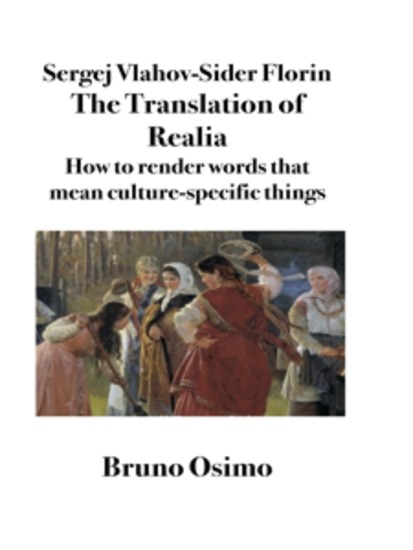
The Translation of Realia - How to render words that mean culture-specific things - cover

The Translation of Realia - How to render words that mean culture-specific things

Sergej Vlahov, Sider Florin

Verlag: Bruno Osimo

  • 0
  • 2
  • 0

Beschreibung

The concept of 'translation of realia' is doubly conventional: realia are normally untranslatable (from a dictionary perspective) and, again, are normally not rendered (in context) by means of translation.With respect to dictionary translation, however, "there are no words that could not be translated into another language, at least descriptively, i.e. by means of a widespread combination of words of the given language", and "what is not possible with respect to a single element, is possible with respect to a complex whole", i.e. with respect to a contextual translation.
Verfügbar seit: 23.03.2023.
Drucklänge: 94 Seiten.

Weitere Bücher, die Sie mögen werden

  • Wired for Love Second Edition - How Understanding Your Partner's Brain and Attachment Style Can Help You Defuse Conflict and Build a Secure Relationship - cover

    Wired for Love Second Edition -...

    PsyD Stan Tatkin, PhD Harville...

    • 0
    • 0
    • 0
    Every person is wired for love differently—with different habits, needs, and reactions to conflict. The good news is that most people's minds work in predictable ways and respond well to security, attachment, and routines, making it possible to neurologically prime the brain for greater love and connection and fewer conflicts. This go-to guide will show you how. 


    Drawn from neuroscience, attachment theory, and emotion regulation, this highly anticipated second edition of Wired for Love presents cutting-edge research on how and why love lasts, and offers ten guiding principles that can improve any relationship. This fully revised edition also includes new guidance on how to manage disagreements, as well as new exercises to help you create a sense of safety and security, establish healthy conflict ground rules, and deal with the threat of the third—any outside source which threatens the harmony in your relationship, including in-laws, alcohol, children, and affairs. 


    By using simple gestures and words, you'll learn to put out emotional fires and help your partner feel appreciated and loved. You'll also discover how to move past a "warring brain" mentality and toward a more cooperative "loving brain." Most importantly, you'll gain a better understanding of the complex dynamics at work behind love and trust in intimate relationships.
    Zum Buch
  • The Poverty of Philosophy - cover

    The Poverty of Philosophy

    Karl Marx

    • 0
    • 0
    • 0
    Marx started work on this book in January 1847, as can be judged from Engel's letter to Marx on January 15, 1847. By the beginning of April 1847, Marx's work was completed in the main and had gone to the press. On June 15, 1847, he wrote a short foreword. 
     
    Published in Paris and Brussels in 1847, the book was not republished in full during Marx's lifetime. Excerpts from section five of Chapter Two appeared in different years, mostly between 1872 - 1875 in papers such as La Emancipacion, Der Volksstaat, Social-Demokrat, and others. In 1880 Marx attempted to publish the Poverty of Philosophy in the French socialist newspaper L'Égalité, the organ of the French Workers' Party, but only the foreword and section one of Chapter One were published. 
     
    This translation is from the original 1847 French edition. It has been updated to also include the changes/corrections Marx made in the copy of the book he presented to N. Utina in 1876, as well as the corrections made by Frederick Engels in the second French edition and the German editions of 1885 and 1892. The first English edition of this work was published in 1900 by Twentieth Century Press. 
    Zum Buch
  • The Reconquista - Christian Spain's Crusade - cover

    The Reconquista - Christian...

    Harris Ropes

    • 0
    • 0
    • 0
    The Reconquista, meaning "reconquest" in Spanish, refers to the centuries-long struggle by Christian kingdoms to reclaim the Iberian Peninsula from Muslim rule. Its origins trace back to the early 8th century, when the Islamic Umayyad forces crossed the Strait of Gibraltar in 711 and swiftly conquered much of what is now Spain and Portugal. The defeat of the Visigothic King Roderic at the Battle of Guadalete marked the beginning of Muslim dominance in Iberia. Within a few years, nearly the entire peninsula had fallen under Muslim control, becoming part of the vast Umayyad Caliphate. This rapid conquest, however, did not erase the memory of Christian rule, especially in the remote and mountainous regions of the north. 
    In these isolated territories, remnants of the Visigothic nobility and clergy began to organize resistance. The Kingdom of Asturias, founded by Pelayo, a nobleman of likely Visigothic heritage, emerged as the first bastion of Christian defiance. According to tradition, Pelayo’s victory at the Battle of Covadonga in 722 symbolized divine favor and the beginning of a sacred mission to restore Christian rule. Though modest in scope, this victory held immense symbolic weight and inspired future generations to continue the struggle. Over time, Asturias would expand and give rise to other Christian polities such as León and Castile, each taking up the cause of the Reconquista in their own right. 
    The idea of reconquest was not purely political; it was deeply tied to religious identity. The fall of the Visigothic kingdom was viewed by many Christians as a divine punishment for past sins, but it also fostered a sense of purpose and redemption. Reclaiming lost territories became not just a matter of sovereignty but a spiritual imperative. The Christian leaders and their subjects saw themselves as the defenders of the true faith, fighting to restore a sacred order.
    Zum Buch
  • The Grunts of Wrath - A Memoir - cover

    The Grunts of Wrath - A Memoir

    Ronny Bruce

    • 0
    • 0
    • 0
    Combat diaries from elite operators and commanding officers dominate the space. But what happens when regulars face the fire? 


    Ronny Bruce is a renaissance man: philosopher, drifter, Gen X rock 'n' roller, and gentleman. At thirty-two, divorced and burnt-out with the burbs, Ronny bails on his teaching career and seeks army infantry. It's no joke when boot camp is mandatory since his marine corps' service ended ten years beforehand. Assigned to Charlie Company, 3rd Battalion, 509th Parachute Infantry Regiment, Ronny's platoon hunts an Afghan foe who's never surrendered. Half collapse from wounds. 


    Ronny's decade-long postwar journey examines victory and failure. Six men expire before thirty-five as a result of four suicides, one unexplained death, and murder. Labels for the living include felon, vagrant, drunk, addict, depressed, and suicidal. Ronny checks some boxes. Graduate, businessman, engineer, teacher, accountant, and rich describes other paths. Ronny checks some of those too. 


    War through the eyes of this offbeat ATLien provides explosive payoffs that get smothered by each page—answering an age-old question: what drives warriors over the edge?
    Zum Buch
  • Power and Innocence - A Search for the Sources of Violence - cover

    Power and Innocence - A Search...

    Rollo May

    • 0
    • 0
    • 0
    Stressing the positive, creative aspects of power and innocence, Rollo May offers a way of thinking about the problems of contemporary society. 


    Rollo May defines power as the ability to cause or prevent change; innocence, on the other hand, is the conscious divesting of one's power to make it seem a virtue, a form of powerlessness that Dr. May sees as particularly American in nature. From these basic concepts he suggests a new ethic that sees power as the basis for both human goodness and evil. 


    Dr. May discusses five levels of power's potential in each of us: the infant's power to be; self-affirmation, the ability to survive with self-esteem; self-assertion, which develops when self-affirmation is blocked; aggression, a reaction to thwarted assertion; and, finally, violence, when reason and persuasion are ineffective.
    Zum Buch
  • Loving Someone with Suicidal Thoughts - What Family Friends and Partners Can Say and Do - cover

    Loving Someone with Suicidal...

    PhD Stacey Freedenthal, PhD...

    • 0
    • 0
    • 0
    If you love someone who has suicidal thoughts, you may struggle with profound fear of saying or doing the wrong thing. You desperately want to help, but you're unsure of where to start. This book can guide you as you support your loved one—without sacrificing your own needs and well-being. You'll find the answers to some of your most urgent questions, including: what are signs and clues of suicide risk; how do I talk with my loved one about their suicidal thoughts; when should I call the police; what do I say and do after a suicide attempt; what treatments for suicidality are available; how can I help the person I care about stay safe; what can I do to help them feel better, too; what can I do to cope better; and what does recovery look like after a suicidal crisis? 


    Written by a psychotherapist with decades of clinical experience in suicidology, this compassionate guide offers essential communication techniques you can use to help your loved one, as well as strategies for navigating your own stress, worry, fear, and anxiety. Drawn from cognitive behavioral therapy (CBT), acceptance and commitment therapy (ACT), and mindful self-compassion, the tools in this book will help you recognize warning signs, improve communication, create a safety plan, know when to seek professional help, and support a loved one in crisis.
    Zum Buch