Join us on a literary world trip!
Add this book to bookshelf
Grey
Write a new comment Default profile 50px
Grey
Subscribe to read the full book or read the first pages for free!
All characters reduced
Oddly Specific Rules - cover

Oddly Specific Rules

Sebastian Farnham

Translator A AI

Publisher: Publifye

  • 0
  • 0
  • 0

Summary

Oddly Specific Rules explores the curious origins of seemingly bizarre regulations found in various facets of life, from workplaces to legal systems. These rules, often appearing nonsensical at first glance, frequently stem from specific historical incidents and the desire to prevent their recurrence. For instance, the book reveals how a particular event might lead to a formal workplace policy or even a state law, highlighting the evolution of social norms into codified rules.

 
The book approaches presenting information in a narrative non-fiction style, making the content accessible and engaging. The book delves into the unintended consequences of rule-making and the delicate balance between freedom and control. It examines the historical context, legislative processes, and even the psychological factors involved in creating these regulations. Did you know that some laws prohibiting certain actions with animals originated from very specific, often humorous, past incidents?

 
The book's structure progresses from an introduction to the concept to focusing on specific environments like schools, and legal systems, before culminating in an analysis of the broader implications of these rules on behavior and social norms. By analyzing these Oddly Specific Rules, readers gain a deeper understanding of the social, historical, and political forces shaping our world.

 
The book emphasizes critical thinking about the regulations governing our lives, offering insights valuable to students of social science, politics, and history, as well as anyone curious about the hidden logic behind everyday rules and policies.
Available since: 03/29/2025.
Print length: 69 pages.

Other books that might interest you

  • Hypnosis for Procrastination - Learn How To Stop Being Lazy How To Be More Productive And Get Things Done With Hypnosis - cover

    Hypnosis for Procrastination -...

    James Mesmer

    • 0
    • 0
    • 0
    Human nature is the minimum level of Procrastination. However, others struggle to find ways to help his mind get rid of Procrastination. It steadily but slowly evolves into a mental disorder. A simple postponement characterizes this condition due to a starting problem or uncertainty as to how to finish it. 
    Time to STOP Procrastination! 
    Would you like the POWER to inspire you? 
    Doing all the stuff you think you're going to do? 
    You should, of course! 
    Why wouldn't do that? 
    Let's face it... even the most popular people in the world are procrastinating. So, what do they do differently from me and you? 
    Okay, to be honest, not a lot! 
    They're procrastinating about unimportant stuff, though. That is the difference! We average men, without hard-core self-discipline. We prefer to place things that are important to us. 
    And because of that, we're still in a constant war with ourselves. Never step forward in your career. Or at least not as fast as we should. 
    What You Will Learn In This Audiobook Hypnosis For ProcrastinationUses Of HypnosisProcrastination— Your Enemy In Life10 Good And Bad Things About ProcrastinationHow To Become OrganizedA Simple Self-Hypnosis Strategy For Procrastination 
    And Many More!
    Show book
  • Archaic Humans: The History of the Different Prehistoric Species in the Genus Homo - cover

    Archaic Humans: The History of...

    Editors Charles River

    • 0
    • 0
    • 0
    The evolutionary path from the original primates to modern man is a long one and has taken many twists and turns, but naturally, as the fossil record grows, scientists gain a more complete understanding of our own mental and physical history in terms of genetics and anatomy. However, the correct order and relationships of the various specimen types are difficult to pin down. Many representative samples have been found in such minute amounts as to not preclude anomalies. They have been discovered in various stages of wear. Modern features did not occur simultaneously or uniformly, taking millions of years to become manifest in later types. Up to the present day’s Homo sapiens, examples of the main types have been hybrids of older and more modern features. 
    	One of the earliest species of the genus Homo to be discovered is Homo habilis, which basically means “handy man.” The name comes from the belief at the time of its discovery that this species was the first to start using stone tools. The first fossils to be uncovered in Olduvai Gorge were from the same stratigraphic layer as simple stone tools. Fossils of the crania and postcranial skeleton for this species have been found in both eastern and southern Africa and date to around 2.5–1.6 million years ago.  
    	Features of Homo erectus suggest an evolution toward modern humans, and the features which separate Homo erectus from the other Homo species are found in the skull. The size of the brain was approximately 900 cc, making it larger than the brain size of Homo habilis. Homo erectus would not have the largest brain capacity of the Homo genus during its existence, with the emergence of Homo heidelbergensis approximately 800,000 years ago. The larger brain size may not matter much when the size of the brain is considered with the size of the body, which also increased. 
    Show book
  • Foster Parent Collaboration - A Guidebook for Social Workers and Other Professionals - cover

    Foster Parent Collaboration - A...

    Amanda Preston, Lisa Schelbe

    • 0
    • 0
    • 0
    Foster Parent Collaboration: A Guide for Social Workers and Other Professionals argues that the foster care system is in crisis and one strategy for meaningful change is for social workers and other professionals to collaborate with foster parents. The collaboration will assist with increasing foster parent retention and the quality of care they can provide to children in their homes. The book provides practical suggestions supported by current research for how this can be done. The book provides information about the foster care system, children in foster care, and foster parents' vital roles. It couples the first-hand experience of a foster parent and social worker with current research. This combined lens provides a critical examination of the current realities of foster parents and social workers in foster care. 


    Derived from both practice knowledge and empirical evidence, the book provides guidance to social workers and other professionals about how to effectively work with foster parents. The goal is to promote change in the foster care system and improve the outcomes for children and families. It serves as a tool to help social workers and other professionals currently working in the foster care system improve their skills and better collaborate with foster parents. Foster Parent Collaboration contains numerous practice examples drawn from actual cases that offer insights into what social workers and foster parents navigate and how social workers best can work with foster parents. Each chapter includes a real-life challenge from a foster parent's perspective.
    Show book
  • Indonesian Made Easy - Beginner - Volume 2 of 3 - cover

    Indonesian Made Easy - Beginner...

    Lingo Wave

    • 0
    • 0
    • 0
    We broke our new series on learning Indonesian down into different learning stages. Start with the "Lower Beginner" books followed by the "Beginner" and "Upper Beginner" books. Next, progress to the "Intermediate" series, then test and reinforce your knowledge with the "Conversations" series. 
    This audiobook is divided into units.While it provides different learning patterns and accommodates various needs, this audiobook focuses on helping you improve your ability to understand, speak, and memorise Indonesian.  
    In Unit 1 you will hear Indonesian decoded with each syllable spoken very slowly and clearly with repetition. Immediately before each sentence is spoken, you will hear the translation, so you will always understand what is being said. 
    Unit 2 focuses solely on increasing your listening ability, which will improve your abilities to engage in dialogue with a native Indonesian speaker. This chapter requires you to listen very carefully to nuances in the language. 
    By Unit 3 you will already notice progress in your abilities to speak and understand Indonesian. The spoken translation is followed by two repetitions in Indonesian at a completely natural speed. While you are learning to process naturally spoken Indonesian, Units 3 and 4 will help you memorise new vocabulary and full sentences. 
    In Unit 5 you can test yourself on how much you have learned. If you are having difficulties, we suggest you revisit the listening, speaking, or memorisation section of Units 1, 2 3 or 4, according to what you need more help with. 
    Topics covered in this book: 
    1. Asking about family 
    2. Asking about relationship status 
    3. Expressing frequency 
    4. Talking about spare time activities and hobbies 
    5. Using quantifiers/determiners 
    6. Talking about preference 
    7. Talking about abilities 
    8. Talking about location of places 
    9. Describing appearance 
    10. Talking about personality 
    ...
    Show book
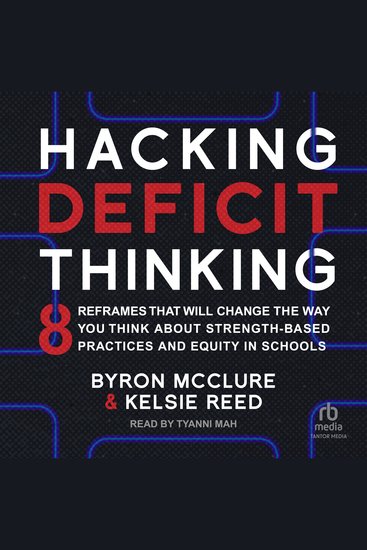
  • Hacking Deficit Thinking - 8 Reframes That Will Change The Way You Think About Strength-Based Practices and Equity in Schools - cover

    Hacking Deficit Thinking - 8...

    Kelsie Reed, Byron McClure

    • 0
    • 0
    • 0
    Are you focused on what's wrong with your students? Now you can transform learning by reframing your view from what's wrong to what's strong. 


    "At risk." "Low." "Title I kids." If you've worked with students, you've probably heard or said these coded labels that reflect deficit thinking. This focus on weakness is a pervasive, powerful judgment that continues to harm students long after they leave school. It's time for educators to hack deficit thinking, think about SEL and about strength-based teaching, and reframe teaching and learning. 


    Nationally certified school psychologists McClure and Reed show teachers, administrators, and support staff how to unlearn student blame and reframe thinking to focus on students' strengths. When we acknowledge the impact of teaching practices and the broader structural inequities, we can help everyone reach their highest potential. 


    In Hacking Deficit Thinking, you'll learn how to: build on student strengths; think about student empathy; humanize your data; recognize the value of differences; think about teacher empathy; talk about equity in schools; tap into school-wide strengths; flourish as an educator.
    Show book
  • AI for Educators - Ethical Practical Fun and Timesaving Strategies to Personalize Learning Foster Critical Thinking and Prepare Your Students for a Rapidly Changing Future - cover

    AI for Educators - Ethical...

    Pascal Claeys

    • 0
    • 0
    • 0
    You're not just a teacher – you're a guide, a mentor, and a beacon of hope in a rapidly changing world. 
    "AI for Educators" will empower you to: 
    1) Navigate the ethical maze of AI with confidence and grace 
    2) Prepare your students for jobs that don't even exist yet 
    3) Become the cool teacher who "gets it" in the eyes of your tech-savvy students
    Show book