Join us on a literary world trip!
Add this book to bookshelf
Grey
Write a new comment Default profile 50px
Grey
Subscribe to read the full book or read the first pages for free!
All characters reduced
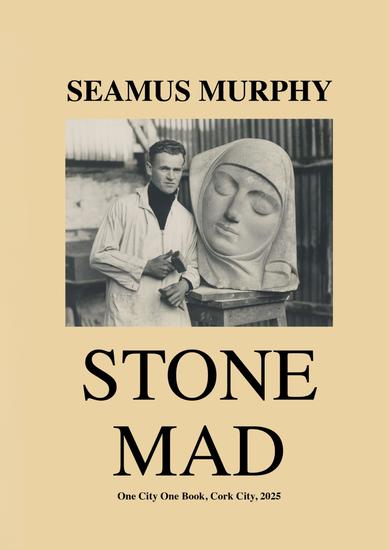
Stone Mad - cover

Stone Mad

Seamus Murphy

Publisher: Mercier Press

  • 0
  • 0
  • 0

Summary

50th Anniversary Edition. Paperback.
'In the sharply formal conversations of the stonemen, the bittersweet flavour of provincial Ireland is presented with neither sentiment nor adornment.' —William Trevor, The Guardian
'The men who have gone before us have left us a heritage to be proud of; and we feel our own contribution has been for the good.' —Seamus Murphy, from the preface to Stone Mad.
In 'Stone Mad' Seamus Murphy tells the story of his seven years spent as an apprentice to the stone carving trade, the growing knowledge of the challenges and joys of stone – and of the men who worked it. His artistic feeling for the quality responded to his workmates' reverence for 'the well made thing'. The result is a book of surpassing beauty, full of warmth, humour and profound perception.
Available since: 04/17/2025.
Print length: 240 pages.

Other books that might interest you

  • Fagan of Hoboken & the Horseshoe - In a gilded manly age of disorderly industrial Armageddon and progressive urban reform - cover

    Fagan of Hoboken & the Horseshoe...

    Nicholas Fagan Dealy

    • 0
    • 0
    • 0
    Declaring that you would rather cut your own throat than meet with the Democratic machine boss to talk out your differences was not the usual way to become Mayor of Hoboken in New Jersey’s Hudson County of the 1890s. But that’s exactly what Lawrence Fagan did, prior to winning the job for the first time in 1893. 
    A Democrat but independent in actions and views, Fagan served four consecutive terms during the city’s period of peak immigration and population growth. Efforts toward reforming a loosely run police force and officiating the fighting forces of temperance and a swelling saloon industry occupied much of his time in office, a tenure also shaped by an apocalyptic harbor and steamship fire in 1900. 
    In addition to being a politician, Fagan was an ironmaster. He ran an ironworks in the rugged Horseshoe section of neighboring Jersey City, where he took a very hands-on approach to business. On one occasion, Fagan determined that a labor union representative had called on his foundry for purposes of extortion. Fagan made his view on this matter clear and responded with his fists. When summoned by a court of law to answer for the assault, Fagan’s testimony was frank and explicit. He freely acknowledged punching the plaintiff. “Had I been excessively angry at the time,” explained Fagan, “the punishment would have been more severe.” 
    Fagan was also an owner of a newspaper, The Observer, which had grown to become New Jersey’s most influential Democratic publication by 1910. The apogee of Fagan’s interest in the newspaper business coincided with the launch of Woodrow Wilson’s career in politics. As Wilson campaigned to be Governor of New Jersey, he encountered a peculiar truth: The road to the governor’s mansion in Trenton went through Hudson County’s “Elysian Fields of politics,” and therefore through Lawrence Fagan.
    Show book
  • General Custer - cover

    General Custer

    Geoffrey Giuliano

    • 0
    • 0
    • 0
    General George Armstrong Custer was one of the most famous and controversial military figures of nineteenth-century America. Celebrated as a daring Civil War cavalry commander and remembered for his dramatic final battle on the Great Plains, he became a symbol of both heroism and tragedy during a period of rapid national expansion and conflict. 
     
    Born in Ohio in 1839, Custer graduated from West Point just as the American Civil War began. His aggressive leadership and willingness to take risks quickly earned him promotion and national attention. By his mid-twenties, he had become one of the youngest generals in the Union Army, participating in many of the war's most significant campaigns. After the Civil War, Custer served with the Seventh Cavalry on the western frontier. His career became closely tied to the conflicts between the United States and Native American nations. 
     
    This biography traces Custer's life, military career, achievements, controversies, and lasting legacy. Drawing upon letters, military records, memoirs, and historical accounts, it examines a complex figure whose story remains central to understanding the American frontier and the nation's westward expansion.
    Show book
  • Mephobia - The Fear of Becoming so Awesome that the Human Race can't Handle it and Everybody Dies: An Autobiography - cover

    Mephobia - The Fear of Becoming...

    Hayden Pearton

    • 0
    • 0
    • 0
    Do you like autobiographies filled with life-changing events, death-defying tales and powerful personal achievements? No? Well then Mephobia is just what you need! 
    Chronicling the first 30 years of Hayden Pearton's love, loss and Labradors! So if you want to read 30 brand new poems written by a South African independent author, poet and physiotherapist, check this out!
    Show book
  • The Student - From their pens to your ears genius in every story - cover

    The Student - From their pens to...

    Anton Chekhov

    • 0
    • 0
    • 0
    Anton Pavlovich Chekhov was born on 29th January 1860 in Taganrog, on the south coast of Russia.  
    His family life was difficult; his father was strict and over-bearing but his mother was a passionate story-teller, a subject Chekhov warmed to. As he later said; ‘our talents we got from our father, but our soul from our mother’.  
    At school Chekhov was distinctly average. At 16 his father mis-managed his finances and was declared bankrupt. His family fled to Moscow. Chekhov remained and eked out a living by various means, including writing and selling short sketches to newspapers, to finish his schooling. That completed and with a scholarship to Moscow University obtained he rejoined his family. 
    He was able to help support them by selling satirical sketches and vignettes of Russian lifestyles and gradually obtained further commissions. In 1884, he qualified as a physician and, although it earned him little, he often treated the poor for free, he was fond of saying ‘Medicine is my lawful wife, and literature is my mistress.’ 
    His own health was now an issue as he began to cough up blood, a symptom of tuberculosis.  Despite this his writing success enabled him to move the family into more comfortable accommodation.  
    Chekhov wrote over 500 short stories which included many, many classics including ‘The Kiss’ and ‘The Lady with a Dog’.  His collection ‘At Dusk’ won him the coveted Pushkin Prize when was only 26.  
    He was also a major playwright beginning with the huge success of ‘Ivanov’ in 1887.   
    In 1892 Chekhov bought a country estate north of Moscow. Here his medical skills and money helped the peasants tackle outbreaks of cholera and bouts of famine. He also built three schools, a fire station and a clinic.  It left him with less time for writing but the interactions with real people gained him detailed knowledge about the peasantry and their living conditions for his stories.  
    His most famous work, ‘The Seagull’ was received disastrously at its premiere in St Petersburg. It was later restaged in Moscow to highlight its psychological aspects and was a huge success. It led to ‘Uncle Vanya’, ‘The Three Sisters’ and ‘The Cherry Orchard’.  
    Chekhov suffered a major lung hemorrhage in 1897 while visiting Moscow. A formal diagnosis confirmed tuberculosis and the doctors ordered changes to his lifestyle.  
    Despite a dread of weddings the elusive literary bachelor quietly married the actress Olga Knipper, whom he had met at rehearsals for ‘The Seagull’, on 25th May 1901. 
    By May 1904 with his tuberculosis worsening and death imminent he set off for the German town of Badenweiler writing cheerful, witty letters to his family and assuring them his health was improving.  
    On 15th July 1904 Anton Chekhov died at Badenweiler.  He was 44.
    Show book
  • Mouse Tracks - The Story of Walt Disney Records - cover

    Mouse Tracks - The Story of Walt...

    Greg Ehrbar, Tim Hollis, Leonard...

    • 0
    • 0
    • 0
    Mouse Tracks: The Story of Walt Disney Records chronicles for the first time the fifty-year history of the Disney recording companies launched by Walt Disney and Roy Disney in the mid-1950s, when Disneyland Park, Davy Crockett, and the Mickey Mouse Club were taking the world by storm. The book provides a perspective on all-time Disney favorites and features anecdotes, reminiscences, and biographies of the artists who brought Disney magic to audio. 


    Authors Tim Hollis and Greg Ehrbar go behind the scenes at the Walt Disney Studios and discover that in the early days Walt Disney and Roy Disney resisted going into the record business before the success of "The Ballad of Davy Crockett" ignited the in-house label. Along the way, the book traces the recording adventures of such Disney favorites as Mickey Mouse, Donald Duck, Cinderella, Bambi, Jiminy Cricket, Winnie the Pooh, and even Walt Disney himself. Mouse Tracks reveals the struggles, major successes, and occasional misfires. Included are impressions and details of teen-pop princesses Annette Funicello and Hayley Mills, the Mary Poppins phenomenon, a Disney-style "British Invasion," and a low period when sagging sales forced Walt Disney to suggest closing the division down. 


    Mouse Tracks is a collector's bonanza of information on this little-analyzed side of the Disney empire.
    Show book
  • Six Miles to Charleston - The True Story of John and Lavinia Fisher - cover

    Six Miles to Charleston - The...

    Bruce Orr, John LaVerne

    • 0
    • 0
    • 0
    Explore the grizzly tale of Charleston's most infamous serial killers from the beginning of their reign of horror till their eventual incarceration and execution. 


    In 1819, a young man outwitted death at the hands of John and Lavinia Fisher and sparked the hunt for Charleston's most notorious serial killers. Former homicide investigator Bruce Orr follows the story of the Fishers, from the initial police raid on their Six Mile Inn with its reportedly grisly cellar to the murderous couple's incarceration and execution at the squalid Old City Jail. Yet there still may be more sinister deeds left unpunished, an overzealous sheriff, corrupt officials, and documents only recently discovered all suggest that there is more to the tale. Orr uncovers the mysteries and debunks the myths behind the infamous legend of the nation's first convicted female serial killer.
    Show book