Join us on a literary world trip!
Add this book to bookshelf
Grey
Write a new comment Default profile 50px
Grey
Subscribe to read the full book or read the first pages for free!
All characters reduced
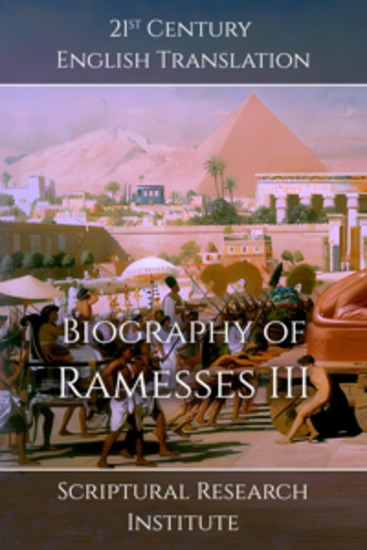
Biography of Ramesses III - cover

Biography of Ramesses III

Scriptural Research Institute

Publisher: Digital Ink Productions

  • 0
  • 0
  • 0

Summary

Ramesses III was the king of Egypt between circa 1186 and 1155 BCE, after inheriting the throne from his father Setnakhte, the founder of the 20th Dynasty. Setnakhte had seized power after the previous Pharaoh Queen Twosret died at the end of the 19th dynasty. It is unclear if he was descended from the royal family, however, he refused to recognize the kingship of either Twosret or her predecessor Siptah, implying he was a descendant of Seti II, the last Pharaoh whose rule he recognized. Seti II had only reigned for about 6 years when he died, while Siptah and Twosret only ruled for a total of 8 years. Before their rule, Egypt had been ripped apart by the civil war between Seti II and Amenmesse, which brought chaos to the land that had not been resolved until Setnakhte's short, three-year reign. The Biography of Ramesses III reports that a Syrian named Arsu seized control of the land, which would have happened sometime during the reigns of Siptah or Twosret, between 1197 and 1189 BCE. This Syrian invasion happened shortly after the previous uprising across Canaan in 1206 BC, suggesting that the Egyptians never really managed to regain control over the area.According to the Biography of Ramesses III, Setnakhte reunited the land of Egypt, and then Ramesses III restored the earlier prestige of Egypt, conquering all Egypt's enemies, and reopening trade with Punt. While Setnakhte is considered the founder of the 20th dynasty, Ramesses III is considered the founder of the Ramesside Period, the last great era of Egyptian history, in which the restored Egyptian Empire of Ramesses III slowly lost power over the final century of the New Kingdom era, and finally collapsed. The Biography of Ramesses III claims that he defeated the Palestinians and Tjeker of southern Canaan, Libyans of the Saharan Oases, and the Sardinians and Greeks in their isles. While there is no evidence of the Egyptians invading Greece or Sardinia, Sardinian artifacts including weapons have been found in Crete, the Greek mainland, Cyprus, and Sicily, supporting the reports in the Egyptian records that they were in an alliance at the time. Pylos, in southwestern Peloponnese, was destroyed by someone circa 1180 BCE after the land was suddenly attacked by a major force. The records found at the site mention defenses being quickly erected that clearly weren't strong enough to defend the city. In the mid-1100s, many sites across Greece were destroyed, and much of the population of Boeotia, Argolis, and Messenia disappeared, supporting the claims that the Egyptians took many of them as captives after the battles.The Biography of Ramesses III is preserved in the longest known papyrus scroll to survive to the present, the 41 meter-long (134.5 foot-long) Papyrus British Museum EA 9999 scroll. The scroll includes 1500 lines of text, mostly lists of gifts that Ramesses III made to the various temples, however, the so-called 'Historical Section' at the end, includes his biography, which is not of the longer and more elaborate biographies from any dynasty to survive to the present. The biography was written at the beginning of Ramesses IV's rule after Ramesses III died, as reported at the end of the biography.
Available since: 02/15/2025.
Print length: 32 pages.

Other books that might interest you

  • Hidden Histories - 100 Wild Stories You Never Learned in History Class - cover

    Hidden Histories - 100 Wild...

    Tim Rayborn

    • 0
    • 0
    • 0
    Discover the little known facts about some of the world’s greatest historical icons. 
    We all know what was written in the history books. There are some stories we’ve heard a hundred times—but often our understanding of these events and people is narrow. Have you ever wondered about the lesser known details that influenced major events and figures behind-the-scenes? This hilarious compendium of fascinating facts and dizzying what-ifs will delight and shock history buffs and trivia lovers alike. From Abraham Lincoln’s wrestling champ background to the day Napoleon was attacked by a horde of hungry rabbits, this book will give you a new perspective. Including:Walt Disney gave his housekeeper Disney stock every year on her birthday and Christmas. By the time she retired, she was a multi-millionaire.Charlie Chaplin entered a lookalike contest as a joke…and got 20th place.Henry Ford, the founder of Ford Motor Company, convinced Thomas Edison’s son to collect Edison’s last breath in a test tube. It is on display at The Henry Ford Museum in Detroit.Before Galileo Galilei was buried, three of his fingers and a tooth were removed from his body by his admirers. The body parts are on display at the Museo Galileo in Florence, Italy. 
      
    From ancient civilization to modern times, history is full of mysterious and downright bizarre circumstances. With these crazy and compelling facts, Hidden Histories will change your view of history
    Show book
  • The World Minute at Waterloo - cover

    The World Minute at Waterloo

    Stefan Zweig

    • 0
    • 0
    • 0
    The Battle of Waterloo on June 18, 1815 was Napoleon Bonaparte's last battle. It took place around 15 km south of Brussels near the village of Waterloo, then part of the Kingdom of the United Netherlands and now in Belgium. The defeat of the French led by Napoleon against the Allied troops under the English General Wellington and the Prussian Field Marshal Blücher ended Napoleon's rule of the Hundred Days and led to the end of the French Empire with his final abdication on June 22, 1815. After this second total military defeat in a short period of time, tightened peace terms were imposed on France in the Second Peace of Paris. Napoleon himself was taken as a prisoner of war by the British to the Atlantic island of St. Helena, where he died in exile on May 5, 1821. The idiom "to experience one's Waterloo" as a synonym for a total defeat has its origin in this battle.
    Show book
  • Imperial China - Foundations of a Great Civilization (3 in 1) - cover

    Imperial China - Foundations of...

    Jun Liu

    • 0
    • 0
    • 0
    This book offers an in-depth exploration of three of the most influential dynasties in Chinese history: the Han, Qin, and Tang Dynasties. This book delves into the powerful legacies of these dynasties, each of which shaped China’s cultural, political, and social development in profound ways. The Qin Dynasty, under the leadership of Emperor Qin Shi Huang, is known for unifying China and initiating monumental infrastructure projects such as the Great Wall and the Terracotta Army. The Han Dynasty, a golden age in Chinese history, expanded China’s borders, solidified Confucian ideals, and fostered the flourishing of trade along the Silk Road. Finally, the Tang Dynasty, often regarded as the most prosperous period in China’s imperial history, saw significant advancements in arts, culture, and governance. 
    In the Qin Dynasty, China was unified for the first time under a single ruler, marking the beginning of imperial rule. Emperor Qin’s centralization of power, creation of a standardized legal system, and the construction of defensive walls set the stage for the future of Chinese civilization. Although short-lived, the Qin Dynasty’s impact on Chinese governance and infrastructure would echo through the centuries.  
    Meanwhile, the Han Dynasty succeeded the Qin, ushering in an era of stability, economic prosperity, and cultural development. The Han established a strong bureaucracy and military, advanced in science and technology, and integrated Confucianism as the official philosophy, influencing Chinese society for over two millennia. 
    The Tang Dynasty, which followed the collapse of the Sui Dynasty, is celebrated for its cultural achievements, including the flourishing of poetry, painting, and literature. The Tang Empire expanded China's territory to its greatest extent, and its cosmopolitan capital, Chang'an, became a vibrant hub for international trade and cultural exchange.
    Show book
  • History of New Zealand: A Captivating Guide to the History of the Land of the Long White Cloud from the Polynesians Through the Māori Musket Wars to the Present - cover

    History of New Zealand: A...

    Captivating History

    • 0
    • 0
    • 0
    Did you know New Zealand was the first country to offer universal suffrage? 
    Many people today only started dreaming of visiting New Zealand after discovering it was the beautiful filming place of the Lord of the Rings series. However, ignoring the two islands in the Pacific Ocean is not a modern thing. The remote lands of New Zealand were the last large, livable lands to be discovered, inhabited, and colonized. 
    Since the Polynesians (the first humans in New Zealand who would become known as the Māori) were the most modern humans to settle in an uninhabited land, it is no surprise New Zealand has always been ahead of its time. Despite its late settlement, New Zealand has been one of the most rapidly modernizing nations in the world. New Zealand was the first country to introduce full democracy, women’s suffrage, state pensions, and state housing. New Zealand has a history unlike any other nation, from its late inhabitation to its unusually respectful colonization, involving hundreds of Māori chiefs signing an agreement to allow European settlement. 
    Although New Zealand was the last inhabited country and one of the most isolated developed regions in the world, it has been significantly involved in historical events, adding even more interest to its complex and rich history. 
    Intrigued? Pick up this audiobook to learn more about the following:Extinct animals that used to call New Zealand home;The arrival of the Polynesians and what that meant for the region;The early European explorations and who is credited with discovering the island nation;Colonization efforts and their impact on the Māori;How New Zealand was run under European control;The progressive changes that took place;And so much more! 
    Scroll up and click the “add to cart” button to begin learning about New Zealand!
    Show book
  • How to Influence People Without Them Knowing - cover

    How to Influence People Without...

    Clifford Page

    • 0
    • 0
    • 0
    Do you ever wish to evoke exactly what you want with a simple gesture or tone of voice? Can you imagine how it would be to command more respect from the people around you? Then you need to keep reading...In this book, you'll discover:- How to start developing strong emotional intelligence NOW with nine methods. (Become psychologically untouchable with these expert-tested tips so that you can control your emotions!)- How to put into practice reverse psychology with a step-by-step guide and how to obtain what you want from other people.- The most effective way to manipulate your boss and negotiate with success.- Little-known secrets to decipher facial expressions, hidden messages or other types of behavior.- How to transform your worst enemy into a person that feels admiration for you, so that refers to YOU for leadership. (Hint: aggression is not required!)- How to use a dangerously powerful tool to seduce anyone you desire.- How to affirm you're the one in control and how to show dominance with subtle body language. (Feel confident about yourself and make everyone follow YOUR rules with specific strategies!)And much, much more...Even if you've always been a total nobody who is often ignored or you've never been the dominant personality of the group, this guide will help you have control of your emotions, master the art of using a specific behavior, and how to use strategic actions to manipulate others for your own advantage.With the expert tools in this guide, you'll immediately start acting as if you've always had a dominant behavior and you'll develop the power of getting exactly what you want and when you want.If you want to access these advanced techniques and transition from "played" to "major player," then you need to start this book today!
    Show book
  • William Lloyd Garrison for Little Listeners - cover

    William Lloyd Garrison for...

    Little Listener

    • 0
    • 0
    • 0
    Discover the inspiring story of William Lloyd Garrison, a young boy who grew up to become a powerful voice against slavery in America. This engaging biography for young children introduces Garrison's life, his newspaper 'The Liberator,' and his courageous fight for freedom and equality for all. Learn how one person's belief in what's right can make a big difference in the world.
    Show book