¡Acompáñanos a viajar por el mundo de los libros!
Añadir este libro a la estantería
Grey
Escribe un nuevo comentario Default profile 50px
Grey
Suscríbete para leer el libro completo o lee las primeras páginas gratis.
All characters reduced
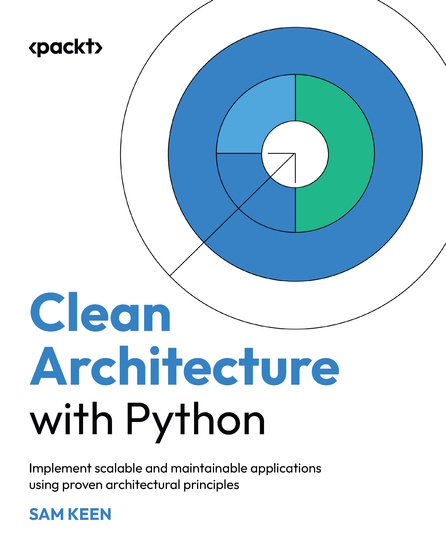
Clean Architecture with Python - Implement scalable and maintainable applications using proven architectural principles - cover

Clean Architecture with Python - Implement scalable and maintainable applications using proven architectural principles

Sam Keen

Editorial: Packt Publishing

  • 0
  • 0
  • 0

Sinopsis

In the rapidly evolving tech industry, software applications struggle to keep pace with changing business needs, leaving developers grappling with complex codebases that resist change, ultimately reducing productivity and increasing technical debt. Clean Architecture with Python offers a powerful approach to address these challenges. Drawing from his extensive experience architecting cloud-native systems, Sam Keen helps you transform complex architectural challenges into digestible, implementable solutions.This book teaches essential principles for effective development, emphasizing the Pythonic implementation of Clean Architecture. Through practical examples, you'll learn how to create modular, loosely coupled systems that are easy to understand, modify, and extend. The book covers key concepts such as the Dependency Rule, separation of concerns, and domain modeling, all tailored for Python development.By the end of this book, you'll be able to apply Clean Architecture principles effectively in your Python projects. Whether you're building new systems or managing existing ones, you'll have the skills to create more maintainable and adaptable applications. This approach will enhance your ability to respond to changing requirements, setting you up for long-term success in your development career.
Disponible desde: 20/06/2025.
Longitud de impresión: 362 páginas.


Otros libros que te pueden interesar

  • Watershed - Herman Murrah and the Pascagoula River Swamp - cover

    Watershed - Herman Murrah and...

    Davy Murrah

    • 0
    • 0
    • 0
    The Pasagoula River is the largest unobstructed river in the continuous United States. Because of this lack of restraint, the river has been left to rise and fall naturally with the seasons, overflowing annually into the adjoining bottomland surrounded by some of the most ecologically diverse woodlands, in North America. 


    Herman Murrah (1935-2022) lived his entire life on the banks and in the swamp surrounding this river in southeast Mississippi. In this book, Herman's eldest son, Davy, details the adventures that continue to inspire young conservationists in the fight to protect our remaining natural ecosystems. 


    As a young adult, Herman worked as a game warden in the Pascagoula River Swamp. When the Pascagoula Hardwood Company, then owners of the swamp, decided to sell the vast tract of forest for clearcutting, Herman was incensed. Determined to protect this natural wonder, Herman teamed up with other visionaries to persuade the State of Mississippi to purchase the land and preserve it in perpetuity. Herman was appointed area manager for the upper portion of the newly designated Pascagoula River Wildlife Management Area. He dedicated the remainder of his life to preserving, protecting, and improving the swamp for the good of south Mississippi.
    Ver libro
  • Sex Drugs and Sea Slime - The Oceans' Oddest Creatures and Why They Matter - cover

    Sex Drugs and Sea Slime - The...

    Ellen Prager

    • 0
    • 0
    • 0
    When viewed from a quiet beach, the ocean, with its rolling waves and vast expanse, can seem calm, even serene. But hidden beneath the sea’s waves are a staggering abundance and variety of active creatures, engaged in the never-ending struggles of life—to reproduce, to eat, and to avoid being eaten. With Sex, Drugs, and Sea Slime, marine scientist Ellen Prager takes us deep into the sea to introduce an astonishing cast of fascinating and bizarre creatures that make the salty depths their home. From the tiny but voracious arrow worms whose rapacious ways may lead to death by overeating, to the lobsters that battle rivals or seduce mates with their urine, to the sea’s masters of disguise, the octopuses, Prager not only brings to life the ocean’s strange creatures, but also reveals the ways they interact as predators, prey, or potential mates. And while these animals make for some jaw-dropping stories—witness the sea cucumber, which ejects its own intestines to confuse predators, or the hagfish that ties itself into a knot to keep from suffocating in its own slime—there’s far more to Prager’s account than her ever-entertaining anecdotes: again and again, she illustrates the crucial connections between life in the ocean and humankind, in everything from our food supply to our economy, and in drug discovery, biomedical research, and popular culture. Written with a diver’s love of the ocean, a novelist’s skill at storytelling, and a scientist’s deep knowledge, Sex, Drugs, and Sea Slime enchants as it educates, enthralling us with the wealth of life in the sea—and reminding us of the need to protect it.
    Ver libro
  • Space's Hidden Forces - How Dark Matter Holds Galaxies Together - cover

    Space's Hidden Forces - How Dark...

    Dirk Fallon

    • 0
    • 0
    • 0
    For centuries, humans have gazed up at the night sky in awe, wondering what lies beyond the stars. With the invention of powerful telescopes, astronomers began mapping galaxies, studying their motion, and uncovering patterns in how they moved through space. But something strange started to appear in the data. Galaxies were spinning in ways that defied the known laws of gravity. Based on what could be seen—the stars, dust, and gas—the galaxies should have been flying apart. The visible mass simply wasn’t enough to account for the gravitational pull holding everything together. This marked the beginning of a great cosmic mystery. 
    In the 1930s, Swiss-American astronomer Fritz Zwicky made one of the first observations that hinted at this invisible force. He studied a cluster of galaxies and noticed that they were moving too fast to be held together by the visible matter alone. He proposed the existence of “dunkle Materie,” or dark matter—an unknown substance that made up the missing mass. At the time, his ideas were largely ignored or dismissed as speculative. But in the decades that followed, more evidence began to emerge, and dark matter slowly gained credibility within the scientific community. 
    Fast forward to the 1970s, astronomer Vera Rubin provided some of the most convincing evidence that dark matter was real. By analyzing the rotation curves of spiral galaxies, she showed that stars far from the center of galaxies were moving just as quickly as those near the core. According to Newtonian physics, the stars on the edges should move slower, as the gravitational pull should weaken with distance from the center. But that wasn’t happening. Something unseen was holding these stars in orbit, acting like a glue that bound the galaxies together. This unseen substance, which does not emit, absorb, or reflect light, became known as dark matter.
    Ver libro
  • Fermi Remembered - cover

    Fermi Remembered

    James W. Cronin

    • 0
    • 0
    • 0
    Nobel laureate and scientific luminary Enrico Fermi (1901-54) was a pioneering nuclear physicist whose contributions to the field were numerous, profound, and lasting. Best known for his involvement with the Manhattan Project and his work at Los Alamos that led to the first self-sustained nuclear reaction and ultimately to the production of electric power and plutonium for atomic weapons, Fermi's legacy continues to color the character of the sciences at the University of Chicago. During his tenure as professor of physics at the Institute for Nuclear Studies, Fermi attracted an extraordinary scientific faculty and many talented students—ten Nobel Prizes were awarded to faculty or students under his tutelage. Born out of a symposium held to commemorate the hundredth anniversary of Fermi's birth, Fermi Remembered combines essays and newly commissioned reminiscences with private material from Fermi's research notebooks, correspondence, speech outlines, and teaching to document the profound and enduring significance of Fermi's life and labors. The volume also features extensives archival material—including correspondence between Fermi and biophysicist Leo Szilard and a letter from Harry Truman—with new introductions that provide context for both the history of physics and the academic tradition at the University of Chicago. Edited by James W. Cronin, a University of Chicago physicist and Nobel laureate himself, Fermi Remembered is a tender tribute to one of the greatest scientists of the twentieth century. Contributors: Harold Agnew Nina Byers Owen Chamberlain Geoffrey F. Chew James W. Cronin George W. Farwell Jerome I. Friedman Richard L. Garwin Murray Gell-Mann Maurice Glicksman Marvin L. Goldberger Uri Haber-Schaim Roger Hildebrand Tsung Dao Lee Darragh Nagle Jay Orear Marshall N. Rosenbluth Arthur Rosenfeld Robert Schluter Jack Steinberger Valentine Telegdi Al Wattenberg Frank Wilczek Lincoln Wolfenstein Courtenay Wright Chen Ning Yang Gaurang Yodh
    Ver libro
  • Simulation Games Techniques - cover

    Simulation Games Techniques

    Jo Lambert

    • 0
    • 0
    • 0
    Simulation Games Techniques: The Essential Guide on How to Excel and Play Simulation Games Like a GodSimulation games attempt to imitate multiple activities from real life in a form of a game for several purposes. The typical examples of these are analysis, prediction, and training. These games can be defined as any video game that tries to replicate real life. Say, for instance, players may be piloting a plane that often has all of the real control systems.These games invite players to improve decision-making competencies while striving for established goals. Simulation games are produced by commercial businesses but can be created by the trainer. The trainer devises objectives and rules for the game and offers roles for multiple learners.In this audiobook, you will learn The Essential Guide on How to Excel and Play Simulation Games Like a God! So what are you waiting for, download a copy of Simulation Games Techniques today!
    Ver libro
  • The Postgenomic Condition - Ethics Justice & Knowledge after the Genome - cover

    The Postgenomic Condition -...

    Jenny Reardon

    • 0
    • 0
    • 0
    Now that we have sequenced the human genome, what does it mean? In The Postgenomic Condition, Jenny Reardon critically examines the decade after the Human Genome Project, and the fundamental questions about meaning, value and justice this landmark achievement left in its wake. Drawing on more than a decade of research—in molecular biology labs, commercial startups, governmental agencies, and civic spaces—Reardon demonstrates how the extensive efforts to transform genomics from high tech informatics practiced by a few to meaningful knowledge beneficial to all exposed the limits of long-cherished liberal modes of knowing and governing life. Those in the American South challenged the value of being included in genomics when no hospital served their community.  Ethicists and lawyers charged with overseeing Scottish DNA and data questioned how to develop a system of ownership for these resources when their capacity to create things of value—new personalized treatments—remained largely unrealized. Molecular biologists who pioneered genomics asked whether their practices of thinking could survive the deluge of data produced by the growing power of sequencing machines. While the media is filled with grand visions of precision medicine, The Postgenomic Condition shares these actual challenges of the scientists, entrepreneurs, policy makers, bioethicists, lawyers, and patient advocates who sought to leverage liberal democratic practices to render genomic data a new source of meaning and value for interpreting and caring for life. It brings into rich empirical focus the resulting hard on-the-ground questions about how to know and live on a depleted but data-rich, interconnected yet fractured planet, where technoscience garners significant resources, but deeper questions of knowledge and justice urgently demand attention.
    Ver libro