¡Acompáñanos a viajar por el mundo de los libros!
Añadir este libro a la estantería
Grey
Escribe un nuevo comentario Default profile 50px
Grey
Suscríbete para leer el libro completo o lee las primeras páginas gratis.
All characters reduced
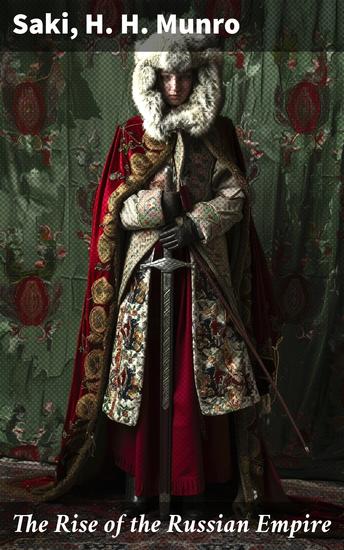
The Rise of the Russian Empire - From the Foundation of Kievian Russia to the Rise of the Romanov Dynasty - cover

The Rise of the Russian Empire - From the Foundation of Kievian Russia to the Rise of the Romanov Dynasty

Saki Saki, H. H. Munro

Editorial: Good Press

  • 0
  • 0
  • 0

Sinopsis

In 'The Rise of the Russian Empire,' readers are treated to a multifaceted exploration of one of Europe's most enigmatic realms, conveyed through the incisive prose of Saki, H. H. Munro. This anthology deftly weaves together themes of power, identity, and historical transformation, capturing the essence of an empire at the crossroads between tradition and modernity. The collection's diverse range of literary styles, from biting satire to poignant narrative, challenges conventional interpretations of imperial Russia, offering fresh insights into its expansive history. Each piece stands alone yet connects to the others, creating a rich tapestry that invites readers to delve into the complexities of Russian imperialism. The anthology's contributors bring together a wealth of backgrounds and perspectives, with the eloquent Saki, H. H. Munro at the helm as a unifying editor. His celebrated wit and keen eye for detail guide the reader through the multifaceted narratives, aligning with broader historical and cultural movements of the early 20th century. Through their unique voices, the authors collectively underscore the tensions and adaptions within the Russian Empire, celebrating its cultural diversity and historical significance, thus illuminating our understanding of its evolution and influence. Esteemed scholars and literary enthusiasts will find 'The Rise of the Russian Empire' an invaluable addition to their libraries. This anthology offers a unique opportunity to explore an array of perspectives and narrative styles, encouraging a deeper appreciation of its themes. The volume serves not only as a reflective mirror on the past but also as a bridge inviting dialogue between past and present, fostering an enriched understanding of empire and identity in an ever-changing world. Embark on a journey through history with this collection, where educational value meets compelling storytelling.
Disponible desde: 17/11/2023.
Longitud de impresión: 299 páginas.
Otros libros que te pueden interesar

  • How to Talk About Love - An Ancient Guide for Modern Lovers - cover

    How to Talk About Love - An...

    Plato

    • 0
    • 0
    • 0
    What is love? In poetry, songs, fiction, movies, psychology, and philosophy, love has been described, admired, lamented, and dissected in endless ways. Is love based on physical attraction? Does it bring out our better selves? How does it relate to sex? Is love divine? Plato's Symposium is one of the oldest, most influential, and most profound explorations of such questions—it is even the source of the idea of "Platonic love." How to Talk about Love introduces and presents the key passages and central ideas of Plato's philosophical dialogue in a lively new translation. 


    The Symposium is set at a fictional drinking party during which prominent Athenians engage in a friendly competition by delivering improvised speeches in praise of Eros, the Greek god of love and sex. The aristocrat Phaedrus, the legal expert Pausanias, the physician Eryximachus, the comic playwright Aristophanes, and the tragic poet Agathon—each by turn celebrates different aspects of love before Socrates proposes not to praise love but to tell the truth about it. In the final speech, the politician and libertine Alcibiades argues that Socrates himself is the epitome of love. 


    Deftly capturing the essence and spirit of Plato's masterpiece, How to Talk about Love makes the Symposium more accessible and enjoyable than ever before.
    Ver libro
  • The Social Superpower - The Big Truth About Little Lies - cover

    The Social Superpower - The Big...

    Kathleen Watt

    • 0
    • 0
    • 0
    "This might sound like a back-handed compliment, but it is not meant to be: I cannot think of a better, more elegant or more articulate guide to mistruth than Kathleen." – Sathnam Sanghera, author of Empireland: How Imperialism Has Shaped Modern Britain
    ***
    "There are a few secrets," he tells me. "A few discoveries that I've never published. Some of the most powerful ones. I wouldn't betray them under torture."
    In a time of deep fakes, alternative truths and leaked secrets, it would be easy to think that we are surrounded by lies. While most people are shaking their heads and muttering dark things about the new levels of deceit, former Times journalist Kathleen Wyatt is busy marvelling at how society manages it.
    How do we do this extraordinary thing, often under the most ordinary of circumstances? When do we first do it, why do we do it and do we really tell more lies today? Wyatt goes deep into disinformation to find out – but given her own lies, can she even be trusted on this subject?
    In this brilliant, wide-ranging study of lies and lying, Wyatt introduces us to a cast of professionals and professional liars – from scientists to investigators, from double agents to toddler specialists, from a fallen titan of industry to a Nobel Peace Prize-winning journalist. Together, they all help her prove a remarkable thesis: lies hold us together as much as they push us apart and they play a vital role in a healthy society.
    Ver libro
  • The End of Antiquity - cover

    The End of Antiquity

    Nick Holmes

    • 0
    • 0
    • 0
    How did a remote desert people change the course of world history? 
     
    In the seventh century AD, the Eastern Roman Empire collapsed—defeated by the rising power of Arabia. How did this happen? And why then? 
    In this gripping new history, Nick Holmes offers a fresh view of the end of the Ancient World and the rise of Islam—it wasn't just religion and war that shaped history, but a hidden force also played a vital role—climate change. A mysterious climatic shift—the Late Antique Little Ice Age—devastated the Roman and Persian empires while Arabia thrived. 
    The End of Antiquity brings together history, science, and religion to uncover the truth behind one of the most enigmatic centuries in history. It's the fifth book in Holmes' acclaimed series on the fall of the Roman Empire—and the most surprising yet.
    Ver libro
  • Our Common Cause - Establishing the Political Power We Lack - cover

    Our Common Cause - Establishing...

    Étienne Chouard

    • 0
    • 0
    • 0
    I want to talk to you about democracy. The real one. The one that does not exist, and the one we really need today. My research method is that of Hippocrates, who said, look for the cause of causes. In other words, to cure a disease, to solve a problem, it is useless to attack the consequences, it is useless to attack the different causes. There is always a determining cause (the one that determines all the others)—and that is our common cause.
    The first decisive battle is to push the important words "right side up":
    First. I am not a "citizen" (a citizen is autonomous; he votes himself his laws). I am only a "voter;" that is to say, a political child—because I am subject to the law voted into existence by someone other than me.
    Second. My "parents" in politics, the elected officials, do not want me to emancipate myself from them—they do not allow me to vote for or against the laws to which I have to submit myself.
    We are "the incompetents." They treat us like children. But it is our fault, because children also believe in "Santa Claus," and so voters believe in "universal suffrage," which we accept to call "democracy" (demos kratos, power belongs to the people). The so-called modern "democracy".
    Ver libro
  • A Fragile Life - Accepting Our Vulnerability - cover

    A Fragile Life - Accepting Our...

    Todd May

    • 0
    • 0
    • 0
    It is perhaps our noblest cause, and certainly one of our oldest: to end suffering. Think of the Buddha, Chuang Tzu, or Marcus Aurelius: stoically composed figures impervious to the torments of the wider world, living their lives in complete serenity—and teaching us how to do the same. After all, isn’t a life free from suffering the ideal? Absolutely not, argues Todd May in this provocative but compassionate book. In a moving examination of life and the trials that beset it, he shows that our fragility is actually one of the most important aspects of our humanity. 
     
    May starts with a simple but hard truth: suffering is inevitable. At the most basic level, we suffer physically—a sprained ankle or a bad back. But we also suffer insults and indifference. We suffer from overburdened schedules and unforeseen circumstances, from moral dilemmas and emotional heartaches. Even just thinking about our own mortality—the fact that we only live one life—can lead us to tremendous suffering. No wonder philosophies such as Buddhism, Taosim, Stoicism, and even Epicureanism—all of which counsel us to rise above these plights—have had appeal over the centuries. May highlights the tremendous value of these philosophies and the ways they can guide us toward better lives, but he also exposes a major drawback to their tenets: such invulnerability is too emotionally disengaged from the world, leading us to place too great a distance between ourselves and our experience. Rather than seeking absolute immunity, he argues most of us just want to hurt less and learn how to embrace and accept what suffering we do endure in a meaningful way. 
     
    Offering a guide on how to positively engage suffering, May ultimately lays out a new way of thinking about how we exist in the world, one that reassures us that our suffering, rather than a failure of physical or psychological resilience, is a powerful and essential part of life itself.
    Ver libro
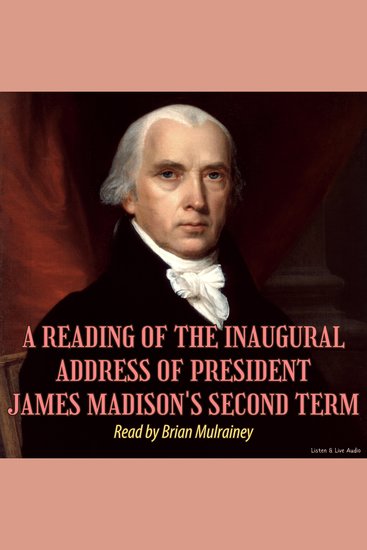
  • A Reading of the Inaugural Address of President James Madison's Second Term - cover

    A Reading of the Inaugural...

    President James Madison

    • 0
    • 0
    • 0
    James Madison (March 16, 1751 - June 28, 1836) was an American statesman, diplomat, and Founding Father who served as the fourth president of the United States from 1809 to 1817. Madison was popularly acclaimed the "Father of the Constitution" for his pivotal role in drafting and promoting the Constitution of the United States and the Bill of Rights. The following is a reading of President Madison's second-term inaugural address on March 4, 1809.
    Ver libro