Join us on a literary world trip!
Add this book to bookshelf
Grey
Write a new comment Default profile 50px
Grey
Subscribe to read the full book or read the first pages for free!
All characters reduced
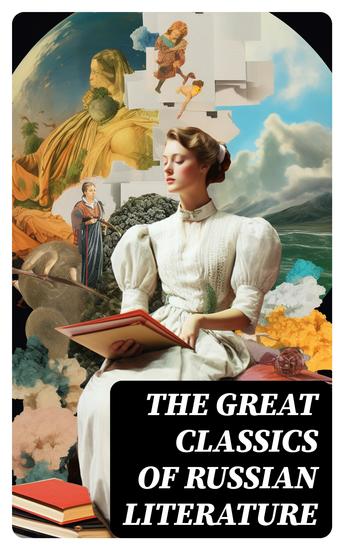
The Great Classics of Russian Literature - 110+ Titles in One Volume: Crime and Punishment War and Peace Mother Uncle Vanya Inspector General Crocodile and more - cover

The Great Classics of Russian Literature - 110+ Titles in One Volume: Crime and Punishment War and Peace Mother Uncle Vanya Inspector General Crocodile and more

Leonid Andreyev, Saki Saki, Herman Bernstein, Maxim Gorky, Iván Turguénev, Anton Chekhov, Leo Tolstoy, Fyodor Dostoevsky, Alexander Puschkin, Nikolai Gogol, M.Y. Saltykov, V.G. Korolenko, V.N. Garshin, K. Sologub, I.N. Potapenko, S.T. Semyonov, M.P. Artzybashev, A.I. Kuprin, H. H. Munro, Ivan Goncharov

Translator Aylmer Maude, Constance Garnett, Louise Maude, Thomas Seltzer, C.J. Hogarth, Julius West, Claud Field

Publisher: DigiCat

  • 0
  • 0
  • 0

Summary

The anthology "The Great Classics of Russian Literature" offers a rich tapestry of narratives and styles, weaving together the groundbreaking works of Russian literary giants with insightful contributions from select Western authors. This collection delves into themes of existential inquiry, social justice, and the human condition, presenting stories marked by a profound engagement with the tumultuous spirit of their time. Readers will find tales imbued with the dark humor of Saki, the psychological depth reminiscent of Dostoevsky, and the sweeping moral landscapes that echo Tolstoy's influence, making this anthology an indispensable exploration of literary brilliance across borders. The featured authors, including titans such as Pushkin, Gogol, and Gorky, represent a diverse array of voices who have collectively defined and redefined Russian literature. Their works are pivotal to understanding not only the evolution of Russian storytelling but also the broader cultural and historical frameworks they embody. These narratives are situated against the backdrop of the Russian Empire's dynamic socio-political changes, including serfdom, reform, and revolution, complemented by cross-cultural dialogues fostered by international contributors like Herman Bernstein and H.H. Munro, offering a nuanced portrayal of the era's literary richness. This collection presents a cherished opportunity for readers to immerse themselves in an intellectually stimulating journey through varied perspectives and styles. Whether one seeks to understand the socio-political climates from which these narratives arose or simply wishes to appreciate the literary craftsmanship, "The Great Classics of Russian Literature" promises educational enrichment and thought-provoking engagement. As readers traverse these pages, they are invited into a dialogue between cultural epochs and literary traditions, uncovering truths about the shared human experience through the lens of unparalleled classic storytelling.
Available since: 11/08/2023.
Print length: 8725 pages.

Other books that might interest you

  • A Son At The Front - cover

    A Son At The Front

    Edith Wharton

    • 0
    • 0
    • 0
    In the realm of classic literature, there exists a treasure trove of stories that capture the essence of human emotions and experiences during times of conflict. One such masterpiece is "A Son at the Front," a novel written by Edith Wharton and published in 1923. This poignant work of fiction delves into the lives of its characters against the backdrop of World War I, weaving a narrative that explores themes of love, sacrifice, and the unrelenting toll of war. 
     
    The story primarily revolves around the protagonist, John Campton, an American painter residing in Paris. John is a devoted father, and his world revolves around his beloved son, George. The novel traces John's inner turmoil as he wrestles with his desire to protect his son from the horrors of war while also coming to terms with his own artistic ambitions. 
     
    As the novel unfolds, we witness the complex interplay of personal and societal forces on the characters. John Campton's internal conflict reflects the broader dilemma faced by countless individuals during the Great War. The choice between pursuing one's creative aspirations and succumbing to the overwhelming demands of duty and patriotism is a recurring theme that resonates with readers even today. 
     
    Edith Wharton, celebrated for her incisive social commentary and keen insight into human nature, portrays the characters in "A Son at the Front" with depth and nuance. John's struggles are a testament to the emotional turmoil experienced by parents who see their children heading to the frontlines of battle. The fear, anxiety, and helplessness that John grapples with are emotions that transcend time and place, making his character all the more relatable to modern readers.
    Show book
  • The Escape - cover

    The Escape

    Katherine Mansfield

    • 0
    • 0
    • 0
    " The Escape" is a short story by Katherine Mansfield. It was published in Bliss and Other Stories.
    It was his fault, wholly and solely his fault, that they had missed the train. What if the idiotic hotel people had refused to produce the bill? Wasn’t that simply because he hadn’t impressed upon the waiter at lunch that they must have it by two o’clock? Any other man would have sat there and refused to move until they handed it over.
    Show book
  • Lady Windermere's Fan - cover

    Lady Windermere's Fan

    Oscar Wilde

    • 0
    • 0
    • 0
    A four act play by Oscar Wilde, first performed in 1892, Lady Windermere's Fan is another one of his productions that takes a half-sardonic, half-serious look into the intrigues of life. 
    In this play, Lady Windermere's idyllic life as the young wife of the rich Lord Windermere is disturbed by the rumour that her husband is visiting a lady of ill reputation, and is reportedly spending vast sums of money on her. 
    When confronted with the fact, he fails to adequately explain himself, and furthermore insists on inviting said woman in question, Mrs Erlynne to her birthday ball that night! 
    Distraught, Lady Windermere finds herself seriously entertaining the amorous advances of another man... but was is the truth behind the matter? 
    And where, will her fan finally end up...? 
    Narrated by Michael Ward
    Show book
  • Little Dorrit - cover

    Little Dorrit

    Charles Dickens

    • 0
    • 0
    • 0
    Little Dorrit is a deeply moving and socially incisive novel by Charles Dickens that explores poverty, pride, bureaucracy, and the enduring power of compassion. Set against the backdrop of Victorian England, the story offers a sweeping portrait of society—from the grim confines of a debtors' prison to the glittering yet hollow world of wealth and status.
    
    At the heart of the novel is Amy Dorrit, known as "Little Dorrit," a gentle and selfless young woman born and raised within the walls of the Marshalsea Prison, where her father has been imprisoned for debt. Despite her harsh circumstances, Amy embodies kindness, humility, and quiet strength. Her life becomes intertwined with that of Arthur Clennam, a thoughtful and morally conflicted man seeking to uncover secrets from his family's past.
    
    As the narrative unfolds, Dickens exposes the cruelty and inefficiency of rigid social institutions, particularly through his biting satire of government bureaucracy and financial systems. Characters rise and fall in fortune, revealing how wealth can corrupt, isolate, and ultimately imprison the soul just as surely as physical walls can imprison the body.
    
    Little Dorrit is a powerful meditation on freedom—both external and internal. Through its richly drawn characters and intricate plot, the novel examines how love, loyalty, and moral integrity can endure even in the most oppressive conditions. Blending social criticism with deep emotional insight, the novel stands as one of Dickens's most profound and compassionate works, offering a timeless reflection on human dignity and resilience.
    Show book
  • Mr Ledbetter's Vacation (Unabridged) - cover

    Mr Ledbetter's Vacation...

    H. G. Wells

    • 0
    • 0
    • 0
    Mr. Ledbetter's Vacation is a short story by H. G. Wells. Herbert George "H. G." Wells (21 September 1866 - 13 August 1946) was an English writer, now best known for his work in the science fiction genre. He was also a prolific writer in many other genres, including contemporary novels, history, politics and social commentary, even writing textbooks and rules for war games. Wells is sometimes called "The Father of Science Fiction," as are Jules Verne and Hugo Gernsback. His most notable science fiction works include The War of the Worlds, The Time Machine, The Invisible Man and The Island of Doctor Moreau. Wells's earliest specialised training was in biology, and his thinking on ethical matters took place in a specifically and fundamentally Darwinian context. He was also from an early date an outspoken socialist, often (but not always, as at the beginning of the First World War) sympathising with pacifist views. His later works became increasingly political and didactic, and he sometimes indicated on official documents that his profession was that of "Journalist." Most of his later novels were not science fiction. Some described lower-middle class life (Kipps; The History of Mr Polly), leading him to be touted as a worthy successor to Charles Dickens, but Wells described a range of social strata and even attempted, in Tono-Bungay (1909), a diagnosis of English society as a whole. Wells's first non-fiction bestseller was Anticipations of the Reaction of Mechanical and Scientific Progress Upon Human Life and Thought (1901). When originally serialised in a magazine it was subtitled, "An Experiment in Prophecy," and is considered his most explicitly futuristic work. It offered the immediate political message of the privileged sections of society continuing to bar capable men from other classes from advancement until war would force a need to employ those most able, rather than the traditional upper classes, as leaders. Anticipating what the world would be like in the year 2000, the book is interesting both for its hits (trains and cars resulting in the dispersion of population from cities to suburbs; moral restrictions declining as men and women seek greater sexual freedom; the defeat of German militarism, and the existence of a European Union) and its misses (he did not expect successful aircraft before 1950, and averred that "my imagination refuses to see any sort of submarine doing anything but suffocate its crew and founder at sea").
    Show book
  • The Tragedy of Julius Caesar - cover

    The Tragedy of Julius Caesar

    William Shakespeare

    • 0
    • 0
    • 0
    The Tragedy of Julius Caesar is a history play and tragedy by William Shakespeare first performed in 1599. It is one of several plays written by Shakespeare based on true events from Roman history, such as Coriolanus and Antony and Cleopatra.
    Set in Rome in 44 BC, the play depicts the moral dilemma of Brutus as he joins a conspiracy led by Cassius to murder Julius Caesar to prevent him from becoming dictator of Rome. Following Caesar's death, Rome is thrust into a period of civil war, and the republic the conspirators sought to preserve is lost forever.
    Although the play is named Julius Caesar, Brutus speaks more than four times as many lines as the title character; and the central psychological drama of the play focuses on Brutus' struggle between the conflicting demands of honour, patriotism, and friendship. 
    Among the most significant works William Shakespeare: Hamlet, Othello, King Lear, Macbeth, Orpheus, Romeo and Juliet, Julius Caesar, Troilus and Cressida, The Tempest, Venus and Adonis, Antony and Cleopatra, Measure for Measure, The Winter's Tale and many more.
    Show book