¡Acompáñanos a viajar por el mundo de los libros!
Añadir este libro a la estantería
Grey
Escribe un nuevo comentario Default profile 50px
Grey
Suscríbete para leer el libro completo o lee las primeras páginas gratis.
All characters reduced
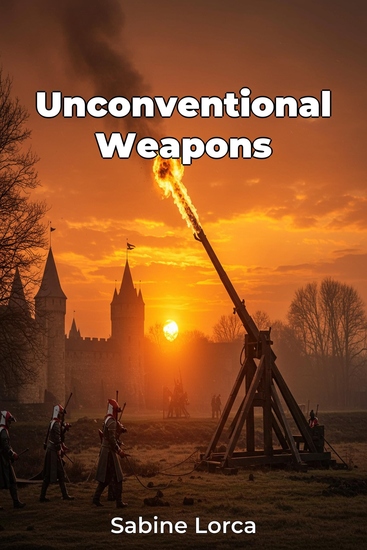
Unconventional Weapons - cover

Unconventional Weapons

Sabine Lorca

Traductor A AI

Editorial: Publifye

  • 0
  • 0
  • 0

Sinopsis

Unconventional Weapons explores the history, technology, and implications of weaponry that falls outside standard military practice, examining how these tools reflect technological innovation and evolving moral considerations. From ancient incendiaries to modern cyber warfare, the book traces the development and deployment of weapons designed to provide a decisive advantage. What was once unconventional can become commonplace, challenging established rules of war and demanding continuous reevaluation.

 
For example, non-lethal technologies, initially developed for crowd control, now play a significant role in military strategy, raising ethical questions about their effectiveness and potential for misuse. The book follows a chronological and thematic approach, from ancient incendiaries and siege engines to the introduction of chemical and biological agents and into the exploration of non-lethal technologies. It blends historical narratives with technical explanations, ensuring readers grasp both the context and science behind each weapon system.

 
The study culminates by considering the future of warfare and examining emerging technologies such as directed-energy weapons and autonomous systems, analyzing their potential to further blur the lines between conventional and unconventional conflict.
Disponible desde: 29/03/2025.
Longitud de impresión: 72 páginas.

Otros libros que te pueden interesar

  • Kill Caesar! - Assassination in the Early Roman Empire - cover

    Kill Caesar! - Assassination in...

    Rose Mary Sheldon

    • 0
    • 0
    • 0
    “Why were Rome’s first emperors—the good, the bad, and the ugly—so vulnerable to conspiracies and assassination? . . . an expert analysis . . . compelling.” —Adrienne Mayor, author of The Poison King: The Life and Legend of Mithradates and Rome’s Deadliest Enemy Exploring the history of internal security under the first Roman dynasty, this groundbreaking book answers the enduring question: If there were 9,000 men guarding the emperor, how were three-quarters of Rome’s leaders assassinated? Rose Mary Sheldon traces the evolution of internal security mechanisms under the Julio-Claudians, evaluating the system that Augustus first developed to protect the imperial family and the stability of his dynasty. Yet in spite of the intensive precautions taken, there were multiple attempts on his life.    Like all emperors, Augustus had a number of competing constituencies—the senate, the army, his extended family, the provincials, and the populace of Rome—but were they all equally threatening? Indeed, the biggest threat would come from those closest to the emperor—his family and the aristocracy. Even Roman imperial women were deeply involved in instigating regime change. By the fourth emperor, Caligula, the Praetorian Guards were already participating in assassinations, and the army too was becoming more politicized.    Sheldon weighs the accuracy of ancient sources: Does the image of the emperor presented to us represent reality or what the people who killed him wanted us to think? Were Caligula and Nero really crazy, or did senatorial historians portray them that way to justify their murder? Was Claudius really the fool found drooling behind a curtain and made emperor, or was he in on the plot from the beginning? These and other fascinating questions are answered as Sheldon concludes that the repeated problem of “killing Caesar” reflected the empire’s larger dynamics and turmoil.
    Ver libro
  • Rus’ The: The History and Legacy of the Group that Established a Russian State in the Middle Ages - cover

    Rus’ The: The History and Legacy...

    Editors Charles River

    • 0
    • 0
    • 0
    For many, the Rus might be synonyms for Russia or Russians, perhaps an early form of the civilization that later became Russia. This is partly true. Modern-day Russia lays claim as a successor to the Rus, particularly the Kievan Rus empire that dominated, with oscillating borders, the area around today’s Kiev and Ukraine between the 8th and 11th centuries. Crucially, the Rus had roots in the Nordic region. Initially, they would travel into modern-day Russia, Ukraine, and beyond to trade. Only later would they start to settle in the region and then become known as the Rus. 
    As with many other groups, the origins of the Rus are tied to the dominance of the Vikings over Western Europe in the early part of the Dark Ages or Medieval Era. Their Scandinavian brethren also traveled eastwards, behaving in similar ways but ultimately settling and assimilating in the region in an idiosyncratic manner. The Rus focused on several trade routes. The most important of these was the “eastern” route towards the Caspian Sea and stretching as far as Baghdad in the Middle East. This then gave way to the “western” route leading through Kiev to the Black Sea and Byzantine capital city Constantinople. The Rus also developed other trade routes, including to Western Europe. 
    Eventually, the Rus began to establish permanent settlements, firstly in Novgorod and then south to Kiev. This will be accompanied by the exploration of growing Rus dominance of this region, particularly through historical figures in the Rurikid dynasty such as Rurik, Oleg, Igor, Olga, Svyatoslav, Vladimir, and Yaroslav. During this time, the Kievan Rus empire was established and rose steadily to become a major regional power, even challenging the dominant Byzantines.
    Ver libro
  • The Joyful Wisdom - cover

    The Joyful Wisdom

    Friedrich Nietzsche

    • 0
    • 0
    • 0
    A collection of aphorisms, stories, and poems that explore the concept of human happiness, the nature of existence, and the role of morality in human life. The book is divided into several sections, each of which explores a different aspect of the human experience. The Joyful Wisdom is a complex and thought-provoking work that challenges traditional beliefs and encourages readers to embrace their individuality and pursue their own paths to happiness. Read in English, unabridged.
    Ver libro
  • Our Search for Belonging - How Our Need to Connect Is Tearing Us Apart - cover

    Our Search for Belonging - How...

    Howard J. Ross, JonRobert...

    • 0
    • 0
    • 0
    Why are we so divided today? Paradoxically, Howard Ross, author of Everyday Bias, says it's our compulsion to belong to a group--something hardwired into us-- that ends up making us deeply connected with some, yet deeply divided from others. Ross shows how we can overcome this growing tribalism. 
     
    We are living in a world of almost unparalleled separation. People are no longer disagreeing, but are instead disavowing each other's rights to an opinion. What is driving this polarization, and how can we overcome it? Howard Ross says that ironically it's our profound need to belong. He delves deeply into the powerful psychological, neurological, and biological forces that drive us to want to identify so strongly with a group we're sometimes even willing to sacrifice our individual identity. 
    Drawing on his decades of leadership in the diversity and inclusion field, Ross probes the depth and impact of this growing tribalism, the role social media plays in exacerbating it, the ways it impacts every aspect of the daily lives, and how to combat it.  Readers will gain tools for exploring contentious dialogue in healthier ways and guidelines for breaking down barriers and building bridges across difference, and organizations and institutions will be able to develop approaches that can open dialogue and encourage mutual understanding.
    Ver libro
  • Pandemie und Politik - cover

    Pandemie und Politik

    Schweiz. Institut für...

    • 0
    • 0
    • 0
    Lehren aus der Pandemie
    Auch 2021 drehte sich wieder vieles in der Welt um das Thema Corona, in anderen Facetten, aber durchaus länger, als man gehofft hatte. Die Krise hat weiterhin Themen nationaler wie internationaler Politik und Wirtschaft beeinflusst, und entsprechend widmeten sich die Veranstaltungen und Gespräche den Themen «Pandemie und Politik». Das Jahrbuch präsentiert eine Rückschau auf unsere renommierten Rednerinnen und Redner sowie unseren Austausch mit ihnen.
    Mit Beiträgen von Mervyn King, Gerhard Schwarz, Ilaria Capua, Christian Lindner, Niall Ferguson, Alain Berset, Anne Applebaum, Sahra Wagenknecht, Elif Shafak und Bertrand Piccard.
    Ver libro
  • The Constitution of the United States - The Original Document September 17 1787 - Includes All 27 Amendments - cover

    The Constitution of the United...

    America's Founding Fathers

    • 0
    • 0
    • 0
    This audiobook is designed for you to listen to while reading the Kindle book of the same title or any unabridged version of the U.S. Constitution. Reading while listening to Howard Lester's smooth and flawless narration creates an immersive multi-sensory experience for studying, understanding, and enjoying this most revered American document. This proven approach of reading while listening will aid your comprehension and retention of the nation-building words of America's Founding Fathers. The U.S. Constitution is one of the most important documents in history. It comes alive in this audiobook and will inspire a renewed respect, appreciation, and gratitude for the written charter that launched the United States of America.
    Ver libro