Junte-se a nós em uma viagem ao mundo dos livros!
Adicionar este livro à prateleira
Grey
Deixe um novo comentário Default profile 50px
Grey
Assine para ler o livro completo ou leia as primeiras páginas de graça!
All characters reduced
River Battles - cover
LER

River Battles

Sabine Lorca

Tradutor A AI

Editora: Publifye

  • 0
  • 0
  • 0

Sinopse

River Battles explores the underestimated significance of rivers in military history, positioning them not just as geographical features but as active participants in warfare. The book argues that rivers have fundamentally shaped military strategy, influencing everything from troop movements to resource supply. Amphibious assaults and the strategic manipulation of river crossings are central themes, highlighting the critical role of bridges, their defense, and their destruction in deciding the outcomes of military campaigns. 

 
The book examines battles and campaigns chronologically and thematically, demonstrating how rivers have been weaponized through engineering and tactical deployment. Case studies, such as the Rhine crossings during WWII, illustrate the challenges of amphibious landings, while examples like the Battle of the Bridge of Remagen underscore the importance of bridge security. By synthesizing historical examples, River Battles reveals the enduring relevance of river warfare principles in modern military strategy, highlighting how control of rivers has often equated to control of territory. 

 
Drawing on primary accounts, military archives, and topographical analyses, this study offers a unique perspective. It emphasizes environmental factors and logistical considerations often overlooked in traditional military histories. This approach provides military scholars, history enthusiasts, and strategists with a focused, in-depth exploration of the intersection between geography and warfare, making it a valuable resource for understanding military operations in riverine environments.
Disponível desde: 29/03/2025.
Comprimento de impressão: 65 páginas.

Outros livros que poderiam interessá-lo

  • Scipio Africanus: The Life and Legacy of the Roman General Who Defeated Hannibal during the Second Punic War - cover

    Scipio Africanus: The Life and...

    Charles River Editors

    • 0
    • 0
    • 0
    While he remains far less known than Hannibal, Publius Cornelius Scipio, the man who has become known to history as Scipio Africanus, is widely regarded as one of the greatest military leaders of all time. In the space of less than 10 years, the genius of Scipio took Rome from being on the brink of utter destruction to becoming the dominant power in the Mediterranean. He displayed not just acute understanding of the tactical needs of the battlefield but also a strategic overview that consistently allowed him to confound his enemies. Scipio has been described as “the embodiment of grand strategy, as his campaigns are the supreme example in history of its meaning.” 
    However, like many other successful military leaders, Scipio proved much less able to deal with the envy and political machinations of the Roman Senate, and he ended his life not in glory but in bitter, self-imposed retirement, much the same way Hannibal did. Both men left legacies of military genius, catastrophic defeats, perseverance in the face of setbacks, astounding victories. Their stories also heavily involve ingratitude, envy, and enmity from within. 
    Scipio Africanus: The Life and Legacy of the Roman General Who Defeated Hannibal during the Second Punic War chronicles how Scipio rose to prominence, his legendary victory at Zama, and the legacy he had on antiquity. 
    Ver livro
  • Height of the Cold War The: The History of the Events that Brought the Soviet Union and United States to the Brink - cover

    Height of the Cold War The: The...

    Charles River Editors

    • 0
    • 0
    • 0
    In the wake of World War II, the European continent was devastated, and the conflict left the Soviet Union and the United States as uncontested superpowers. This ushered in over 45 years of the Cold War, and a political alignment of Western democracies against the Communist Soviet bloc that produced conflicts pitting allies on each sides fighting, even as the American and Soviet militaries never engaged each other. Though it never got “hot” between the two superpowers, the Cold War was a tense era until the dissolution of the USSR, and nothing symbolized the split more than the division of Berlin. Berlin had been a flashpoint even before World War II ended, and the city was occupied by the different Allies even as the close of the war turned them into adversaries. 
    If anyone wondered whether the Cold War would dominate geopolitics, any hopes that it wouldn’t were dashed by the Soviets’ blockade of West Berlin in April 1948, ostensibly to protest the currency being used in West Berlin but unquestionably aiming to extend their control over Germany’s capital. By cutting off all access via roads, rail, and water, the Soviets hoped to force the Allies out, and at the same time, Stalin’s action would force a tense showdown that would test their mettle. The Berlin Airlift would technically continue until September, but for all intents and purposes, the first crisis of the Cold War had come to an end, and most importantly, the confrontation remained “cold.” 
    That said, Stalin’s regime had been working on a nuclear weapons program since 1942, relying greatly upon successful Soviet espionage to help lead the way. With intelligence sources connected to the Manhattan Project, Stalin was able to keep abreast of the Allies’ progress toward creating an atomic bomb, so that by 1945, the Soviets already had a working blueprint of America’s first atomic bombs. On August 29, 1949, the Soviets successfully tested an atomic bomb.
    Ver livro
  • Girls on Heat - Lesbian First Time - cover

    Girls on Heat - Lesbian First Time

    Laura Vixen

    • 0
    • 0
    • 0
    Heather isn’t expecting the visit of a friend, but finds out the reason when a soft porn magazine is revealed. The pair of them can’t resist looking through the pictures of the sexy girls, and Heather is slightly shocked when her friend asks her to pose.  
    She gives in to the pleading to get naked, but it’s more than pictures the other girl wants, and Heather can’t resist her first lesbian encounter.  
    This story is a work of fiction and contains sex scenes and is suitable for adults only. All characters are fictional and are 18 years or older.
    Ver livro
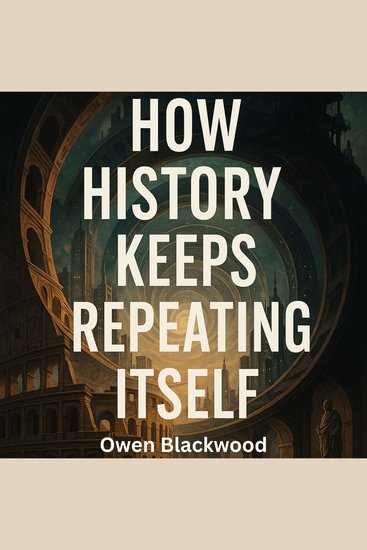
  • How History Keeps Repeating Itself - cover

    How History Keeps Repeating Itself

    Owen Blackwood

    • 0
    • 0
    • 0
    This audiobook is narrated by an AI Voice.  
    Unravel the mysterious patterns governing human civilization across millennia. This mind-expanding journey explores how historical events repeat in predictable cycles that seem impossible to break. From information revolutions to civilizational collapse, discover why humanity seems trapped in eternal loops of rise and fall. Learn from ancient philosophers who understood eternal return, modern historians who identified patterns in twenty-one civilizations, and consciousness researchers exploring how awareness itself might be cyclical. Discover the Library of Alexandria burning then and burning now through digital fragmentation. Understand Arnold Toynbee's creative minorities, Nietzsche's eternal return, and Pierre Teilhard de Chardin's noosphere. This exploration suggests we're not doomed to repetition but invited to consciously participate in evolution's next phase through awareness of the patterns themselves.
    Ver livro
  • The Cop's Sissy 3 - Some Like It Hot - cover

    The Cop's Sissy 3 - Some Like It...

    Kinky Press

    • 0
    • 0
    • 0
    Some Like It Hot: 
    When Christine isn’t willing to go as far as Officer Flannigan wants on her road to transitioning to a real woman, it’s time for a reality check. Christine is reminded where she would be without Officer Flannigan and is hauled off to jail... and put in a holding cell with all men. Will her time behind bars persuade Christine to go all the way?
    Ver livro
  • Why Privacy Matters - cover

    Why Privacy Matters

    Neil Richards

    • 0
    • 0
    • 0
    Everywhere we look, companies and governments are spying on us—seeking information about us and everyone we know. Ad networks monitor our web—surfing to send us "more relevant" ads. Databases of human information are assembled for purposes of "training" artificial intelligence programs designed to predict everything from traffic patterns to the location of undocumented migrants. We're even tracking ourselves, using personal electronics like Apple watches, Fitbits, and other gadgets. As Mark Zuckerberg once put it, "the Age of Privacy is over." But Zuckerberg and others who say "privacy is dead" are wrong. In Why Privacy Matters, Neil Richards explains that privacy isn't dead, but rather up for grabs. 


    Richards shows how the fight for privacy is a fight for power that will determine what our future will look like, and whether it will remain fair and free. Privacy matters because good privacy rules can promote the essential human values of identity, power, freedom, and trust. If we want to preserve our commitments to these precious yet fragile values, we will need privacy rules. Richards explains why privacy remains so important and offers strategies that can help us protect it from the forces that are working to undermine it. Pithy and forceful, this is a must-listen for anyone interested in a topic that sits at the center of so many current problems.
    Ver livro